
You don’t need physical touch to generate oxytocin; you need the right sensory and cognitive signals that mimic bonding.
- Your nervous system responds to specific inputs like deep pressure, vocal resonance, and shared goals to release this calming hormone.
- By consciously “bio-hacking” these triggers, you can achieve the physiological benefits of social connection, even while in solitude.
Recommendation: Start by incorporating one sensory hack, like using a weighted blanket for 20 minutes before bed, to directly calm your nervous system and initiate the oxytocin feedback loop.
In our hyper-connected yet often isolated world, the craving for connection is a fundamental human need. We often associate the release of oxytocin, the so-called “love hormone,” with physical touch—a hug, a handshake, or a comforting arm around the shoulder. For those who live alone or are experiencing a period of touch deprivation, this can feel like a biological disadvantage, leading to heightened stress and a persistent sense of unease. The common advice to “hug more people” or “get a pet” can ring hollow when your circumstances don’t allow for it.
But what if the key to unlocking this powerful neurochemical isn’t about the act of touching another person, but about the specific signals that touch sends to the brain? As a neuro-chemist, I can tell you that your nervous system is a sophisticated but literal machine. It responds to sensory input. The feeling of security, warmth, and trust that triggers oxytocin can be replicated. It is possible to bio-hack this system and provide your body with the neurochemical comfort it craves, entirely on your own terms. This isn’t about faking connection; it’s about understanding the mechanisms of bonding and consciously providing your body with the right stimuli.
This guide moves beyond the platitudes and into the practical science of self-soothing. We will explore how you can use tools like deep pressure, the sound of a human voice, and even structured altruism to generate oxytocin. We will deconstruct the biological processes at play and provide actionable strategies, with a special focus on the Canadian context, to help you cultivate a state of calm and well-being from the inside out.
To help you navigate these neurochemical hacks, this article breaks down the science and provides practical, step-by-step guidance. Explore the sections below to learn how to master your own biology.
Summary: A Guide to Hacking Your Love Hormone
- Why Does a Weighted Blanket Mimic a Hug for Your Nervous System?
- How Does Petting a Dog Lower Your Blood Pressure Instantly?
- Text or Call: Which Communication Method Actually Releases Oxytocin?
- The Dark Side of Bonding: Does Oxytocin Make You More Suspicious of Strangers?
- When to Give a Gift: The Selfish Science of Altruism?
- Heavy Blanket or Muscle Relaxation: Which Hack Forces Your Body to Chill?
- How to Use Deep Sleep to Sprout Your Testosterone Levels Naturally?
- Why Joining a Local Club Is More Effective for Longevity Than Quitting Sugar?
Why Does a Weighted Blanket Mimic a Hug for Your Nervous System?
The calming sensation of a hug isn’t just emotional; it’s a profound physiological event. The firm, gentle pressure on your body is known as Deep Pressure Stimulation (DPS). This sensory input signals your parasympathetic nervous system to shift from a “fight or flight” state to a “rest and digest” mode. A weighted blanket is a tool designed specifically to replicate this signal, providing the neurological benefits of a hug without another person present. It acts as a form of neurochemical mimicry, telling your body it is safe, secure, and cared for.
When DPS is applied, your brain responds by decreasing the production of cortisol (the primary stress hormone) and increasing the production of serotonin and dopamine, neurotransmitters that regulate mood and create feelings of well-being. More importantly for our purpose, this process also stimulates the release of oxytocin. Furthermore, this hormonal cascade has a direct impact on sleep. For instance, a recent Swedish study from Uppsala University found that a 32% increase in melatonin, the sleep hormone, occurred in participants using a weighted blanket, facilitating a deeper, more restorative rest.
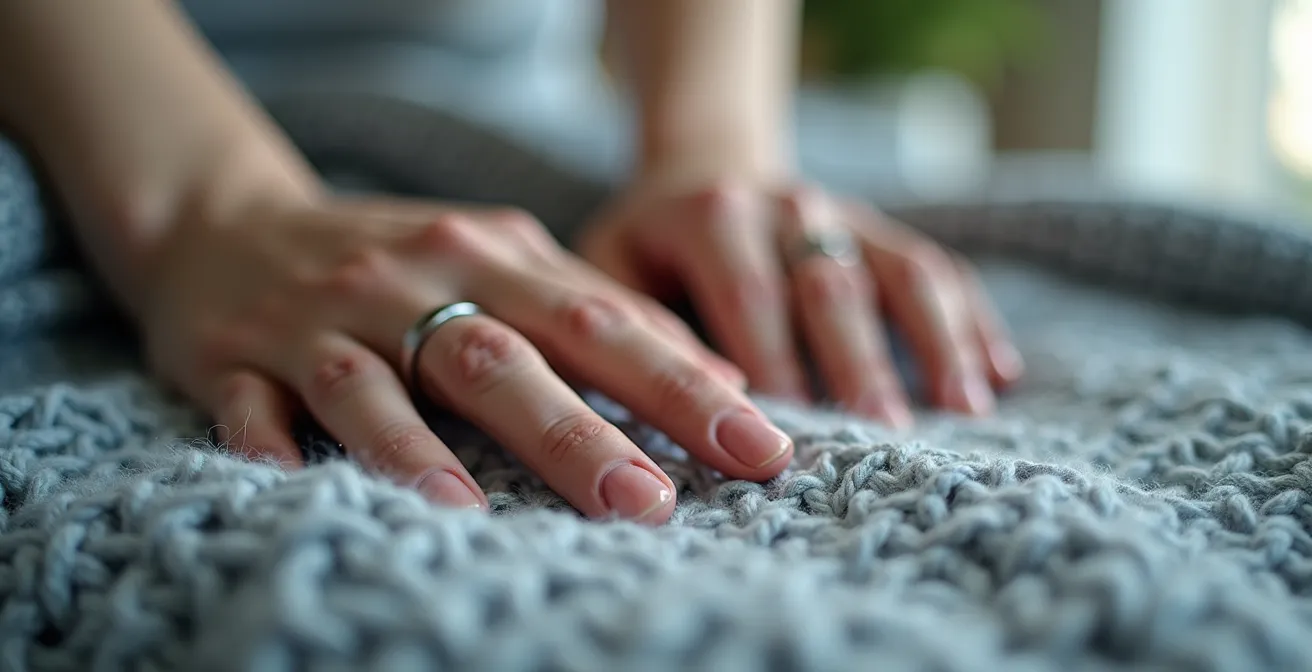
This image captures the essence of Deep Pressure Stimulation. The hands pressing into the fabric illustrate the targeted, comforting weight that underpins the blanket’s therapeutic effect. To maximize this neurochemical benefit, it’s crucial to select the right tool for your body and environment.
Your Action Plan: Choosing the Right Weighted Blanket for Canadian Climates
- Calculate Your Weight: Select a blanket that equals 10-12% of your body weight. This ratio is key to achieving optimal Deep Pressure Stimulation without feeling restricted.
- Consider Your Climate: For humid southern Ontario summers, choose breathable materials like cotton or bamboo to avoid overheating. For cold prairie winters, opt for a cozier fleece or minky fabric to combine weight with thermal comfort.
- Shop Local Expertise: Look for trusted Canadian brands like Hush or Gravid. They design their products with an understanding of local climate variations and temperature swings.
- Test for a Timed Response: Before committing to a full night, test the blanket for at least 20 minutes before bedtime. This is the typical duration needed to feel the initial activation of oxytocin and melatonin production.
- Assess the Construction: Check for durable stitching and small, well-distributed pockets for the weights (usually glass beads). This ensures even pressure across your entire body, preventing the filling from bunching up.
How Does Petting a Dog Lower Your Blood Pressure Instantly?
The connection between humans and animals is a powerful source of oxytocin, operating through a mutual biofeedback loop. When you pet a dog or cat, the rhythmic, gentle motion and the animal’s warmth provide sensory signals that your brain interprets as safe social interaction. This triggers an immediate release of oxytocin in your system, which in turn helps lower heart rate and blood pressure. Simultaneously, the animal experiences a similar effect; studies show that their oxytocin levels also rise, reducing their stress and reinforcing the bond with you. It’s a perfect symbiotic relationship.
This effect isn’t limited to pet owners. The key is the interaction itself. For those living alone in cities, there are ways to access this powerful bio-hack without the full-time commitment of pet ownership. For example, the Toronto Humane Society’s volunteer program allows individuals to schedule regular sessions walking or socializing with shelter dogs. This provides all the bonding benefits, creating a structured opportunity for both the human and the animal to experience an increase in oxytocin and a decrease in cortisol. It’s a scientifically-backed method for enhancing well-being that also serves the community.
While the immediate oxytocin spike from petting a furry animal is potent, other forms of nurturing can also contribute to this hormonal balance. Activities like caring for houseplants or even observing fish in an aquarium can provide a more gradual, low-grade release of oxytocin. They engage the brain’s caregiving circuits, which are closely linked to the oxytocin system. While the effect is less immediate than petting a dog, it is more sustained, contributing to a longer-term sense of calm and purpose.
Text or Call: Which Communication Method Actually Releases Oxytocin?
In our digital age, we often default to texting as our primary means of connection. It’s fast, convenient, and low-pressure. However, from a neurochemical perspective, it’s one of the least effective ways to generate oxytocin. The hormone of bonding is not triggered by information alone; it’s triggered by signals of genuine human presence and empathy. The key ingredient missing from a text message is vocal resonance—the rich tapestry of tone, pitch, and intonation that communicates emotion far more powerfully than words or emojis ever could. Your brain’s auditory cortex is finely tuned to detect warmth and empathy in a voice, and this detection is a primary trigger for oxytocin release.
As oxytocin expert Dr. Paul Zak explains, the nuance of the human voice is a critical component of building trust and connection. His research highlights why a simple phone call can be so much more rewarding than a series of texts.
The brain’s auditory cortex processes the warm, empathetic tone and intonation of a human voice, which is the primary trigger for oxytocin release—an element entirely absent in text-based communication.
– Dr. Paul Zak, Trust Factor
This doesn’t mean you must abandon digital tools. Instead, you can be more strategic by choosing methods that retain elements of human presence. A video call adds visual cues, though for some, being “on camera” can slightly increase cortisol. A voice note is an excellent compromise, as it preserves the warmth of your voice without the pressure of a real-time conversation. To maximize your oxytocin potential when you’re feeling isolated, consider this hierarchy of digital communication:
- Level 1 (Highest): Phone calls – The direct transmission of voice prosody provides the strongest oxytocin trigger.
- Level 2: Video calls – Adds visual cues like facial expressions but can introduce performance anxiety.
- Level 3: Voice notes – Maintains vocal warmth and personality without real-time pressure.
- Level 4: Personal texts with emojis/photos – A small emotional connection is possible, but it lacks the core auditory signal.
- Level 5 (Lowest): Generic texts – Provides information but has minimal to no oxytocin activation.
The Dark Side of Bonding: Does Oxytocin Make You More Suspicious of Strangers?
While we celebrate oxytocin as the “love hormone,” it’s more accurately described as the “bonding hormone.” Its primary evolutionary role is to strengthen the bonds within a social group, or “in-group.” This has a crucial and often overlooked flip side: by promoting loyalty and trust toward one’s own group, oxytocin can simultaneously increase defensiveness and suspicion toward those perceived as outsiders. It’s not a universal trust serum; it’s a loyalty amplifier. This mechanism helps explain tribalism, prejudice, and the “us vs. them” mentality. In fact, research showed that oxytocin led to increased in-group favoritism and out-group suspicion, demonstrating its dual-edged nature.
For someone living alone, this can be a hidden trap. If your primary oxytocin-releasing activities are with a very small, homogenous group of friends or family (even remotely), you may inadvertently be reinforcing a narrow definition of your “in-group.” This can make it harder to connect with new people and expand your social circle, perpetuating a cycle of isolation. The bio-hack, then, is not just to get more oxytocin, but to get it from a diverse range of sources. By consciously expanding who you consider part of your “in-group,” you can counter this exclusionary effect.

The solution lies in activities that foster positive interactions with a wide variety of people, as shown in the community garden above. In a multicultural country like Canada, opportunities abound. Engaging in shared goals with people from different backgrounds trains your brain to expand its definition of “us.” Consider these strategies tailored for Canadian cities:
- Join multicultural community centers in diverse cities like Toronto or Vancouver.
- Participate in community sports leagues that naturally bring together different social circles.
- Attend cultural festivals (e.g., a Caribbean festival, a Lunar New Year celebration) to build positive associations.
- Volunteer for organizations that serve diverse populations, building empathy through shared work.
- Practice loving-kindness meditation, specifically focusing goodwill on strangers and those you perceive as “other.”
When to Give a Gift: The Selfish Science of Altruism?
Altruism, or the act of giving without expecting anything in return, is one of the most reliable and sustained ways to generate oxytocin. From a neurochemical standpoint, giving is far from selfless. When you perform an act of kindness, your brain’s reward centers are activated, releasing a cocktail of feel-good chemicals including oxytocin, dopamine, and serotonin. This phenomenon, often called the “helper’s high” or “warm glow,” creates a powerful positive feedback loop: giving feels good, so you’re motivated to do it again. This process reinforces social bonds and a sense of purpose, both of which are critical for long-term well-being.
Case Study: The Terry Fox Run and Collective Oxytocin Response
The annual Terry Fox Run is a uniquely Canadian example of altruism’s power. Research on prosocial behavior shows that participating in this national event creates a massive, collective oxytocin surge. It combines multiple potent triggers: a shared, meaningful purpose (fighting cancer), synchronized physical activity (running/walking together), reinforcement of national identity, and pure altruism (fundraising). Many participants report feeling a “warm glow” that lasts for days after the event, a clear sign of a sustained neurochemical shift. It demonstrates how giving to a cause larger than oneself activates brain’s reward system while profoundly strengthening community bonds.
Not all forms of giving are created equal in terms of their neurochemical “return on investment.” The more personal, tangible, and connected the act of giving is, the greater the oxytocin release. Volunteering your time, where you can see the direct impact of your actions, is far more potent than an anonymous online donation. This table breaks down the typical response from different types of altruism.
| Type of Giving | Oxytocin Release Level | Duration of Effect | Social Feedback |
|---|---|---|---|
| Online donation | Low | Minutes | Minimal |
| Personalized gift | Medium-High | Hours | Direct recipient response |
| Volunteering time | High | Days | Immediate visible impact |
| Teaching/mentoring | Very High | Weeks | Long-term relationship |
Heavy Blanket or Muscle Relaxation: Which Hack Forces Your Body to Chill?
When your mind is racing and your body is tense, you need a way to interrupt the stress cycle. Two of the most effective methods are using a weighted blanket and practicing Progressive Muscle Relaxation (PMR). While both lead to a state of calm, they work through opposite pathways. A weighted blanket is a body-to-mind hack; it uses passive Deep Pressure Stimulation to send calming signals from your body’s sensory receptors up to your brain. You don’t have to think about it; you simply lie under it and let physiology take its course. This makes it ideal for when you feel physically anxious or are too mentally exhausted to focus.
Progressive Muscle Relaxation, on the other hand, is a mind-to-body hack. It’s an active process where you consciously tense and then release different muscle groups, from your toes to your face. This practice forces you to focus your attention on physical sensations, pulling you out of anxious thought loops. The act of releasing tension is a powerful signal to the nervous system to relax, reducing cortisol. Dr. Adam Perlman of the Mayo Clinic notes that these relaxation techniques trigger “a decrease of cortisol, which is sort of our stress hormone, and an increase of serotonin and dopamine.” As this neurochemical shift occurs, the body becomes primed for oxytocin release. PMR is particularly effective for mental anxiety and racing thoughts, as it requires active mental engagement.
For Canadians, there’s a third, readily available option in the winter: cold exposure. A short, brisk walk in the cold can act as a powerful reset for the vagus nerve, which is a primary component of the parasympathetic nervous system. This jolt can quickly interrupt an acute stress response and boost mood. The best approach often depends on the type of stress you’re experiencing, and sometimes, combining methods—like doing PMR while under a weighted blanket—can provide the most profound relaxation.
| Method | Mechanism | Best For | Cost | Accessibility |
|---|---|---|---|---|
| Weighted Blanket | Body-to-mind (passive DPS) | Physical anxiety, insomnia | $100-300 one-time | No skill needed |
| Progressive Muscle Relaxation | Mind-to-body (active focus) | Mental anxiety, racing thoughts | Free | Requires practice |
| Cold Exposure (Canadian winter walk) | Vagus nerve reset | Acute stress, mood boost | Free | Weather-dependent |
| Synergy Stack (PMR + blanket) | Combined pathways | Severe stress, deep relaxation | $100-300 | Moderate skill |
How to Use Deep Sleep to Sprout Your Testosterone Levels Naturally?
Sleep is not a passive state; it’s a critical period of hormonal regulation and repair. For both men and women, deep sleep is when the body does its most important work, including the production of key hormones like testosterone. Low testosterone can contribute to fatigue, low mood, and reduced vitality, creating a vicious cycle with feelings of loneliness. There’s a fascinating interplay between oxytocin and the hormones that govern sleep and energy. By boosting oxytocin in the evening, you can lower cortisol, calm the nervous system, and create the ideal conditions for entering deep sleep, which in turn optimizes testosterone production.
Think of it as a hormonal domino effect: an oxytocin-rich evening routine directly facilitates the deep sleep necessary for a testosterone-rich morning. This is about creating a deliberate pre-sleep ritual designed to sequentially trigger the right neurochemical responses. It’s not just about avoiding screens; it’s about actively cultivating a state of relaxation and security that tells your body it’s time to repair and rebuild. For Canadians dealing with long, dark winters, managing your circadian rhythm with tools like a light therapy box becomes an essential first step in this process.
By stacking several oxytocin-boosting activities, you create a powerful synergy that promotes profound rest and hormonal balance. The following nightly routine is designed as a step-by-step guide to prime your body for optimal sleep and natural testosterone production.
- 8:30 PM: Regulate with Light. Use a light therapy box for 15 minutes to help regulate your circadian rhythm, especially during the darker Canadian winter months.
- 8:45 PM: Connect with Voice. Have a 15-minute phone call with a friend or family member to get a dose of oxytocin through vocal resonance.
- 9:00 PM: Calm with Sound. Listen to calming, ambient music. Canadian artists like Alexandra Stréliski or even the internationally acclaimed Nils Frahm are excellent choices.
- 9:15 PM: Soak in Warmth. Take a warm bath with magnesium salts. The heat and magnesium enhance oxytocin release and further reduce cortisol.
- 9:30 PM: Add Gentle Pressure. Get into bed and read a physical book (not a screen) under a weighted blanket (around 10-12% of your body weight) in a cool, dark room.
- 10:00 PM: Prime the Mind. Lights out. As you drift off, practice a simple loving-kindness meditation, extending goodwill to yourself and others to end the day on a final oxytocin-rich note.
Key Takeaways
- Oxytocin release is triggered by specific sensory signals (deep pressure, vocal warmth) that can be simulated even when you are alone.
- Activities like using a weighted blanket, having a phone call, or volunteering create measurable neurochemical shifts that reduce cortisol and promote calm.
- True longevity is tied more closely to the quality of social bonds than to many popular diet or exercise fads, making community engagement a critical health practice.
Why Joining a Local Club Is More Effective for Longevity Than Quitting Sugar?
In the quest for a long and healthy life, we often focus intensely on diet and exercise. We count calories, track our steps, and demonize sugar. While these factors are undoubtedly important, a growing body of research suggests we may be overlooking the single most powerful predictor of longevity: the quality and quantity of our social connections. Chronic loneliness is a significant health risk. In fact, research on social isolation shows its loneliness impacts health equivalent to high blood pressure, a sedentary lifestyle, or obesity. Social connection is not a “nice-to-have”; it’s a biological necessity.
The mechanism behind this is, once again, oxytocin. Regular, positive social interactions keep a steady, low-grade level of oxytocin flowing through your system. This acts as a constant buffer against stress, reduces inflammation, and promotes cellular repair. Joining a local club or group provides a structured, consistent way to get this vital neurochemical dose. It combines several oxytocin triggers: a shared interest or goal, a sense of belonging to an in-group, and the potential for creating genuine friendships. The specific activity of the club is less important than the social structure it provides.
The beauty of this approach is its adaptability to local culture and geography. Canada, with its distinct regional identities and strong community spirit, offers a wealth of opportunities to connect. From the curling rinks of the prairies to the “cabanes à sucre” of Quebec, these local institutions are powerful engines of social health. Finding your tribe is one of the most effective health interventions you can make.
- Prairie Provinces: Join a local curling club. The team-based sport provides months of regular social bonding during the long winters.
- Ontario/Quebec: Participate in a volunteer group for the spring maple syrup harvest (Cabane à Sucre) or join a community garden.
- British Columbia: Join one of the countless hiking groups that explore the province’s vast network of parks and trails.
- Atlantic Canada: Connect through community music events like kitchen parties or join a local arts and crafts circle.
- Across Canada: Royal Canadian Legion branches offer a unique opportunity for intergenerational connection, while urban multicultural cooking clubs provide a way to bond over shared food and culture.
Begin implementing these neurochemical hacks today to consciously cultivate a state of calm and connection from within, proving that well-being is a skill you can develop on your own.