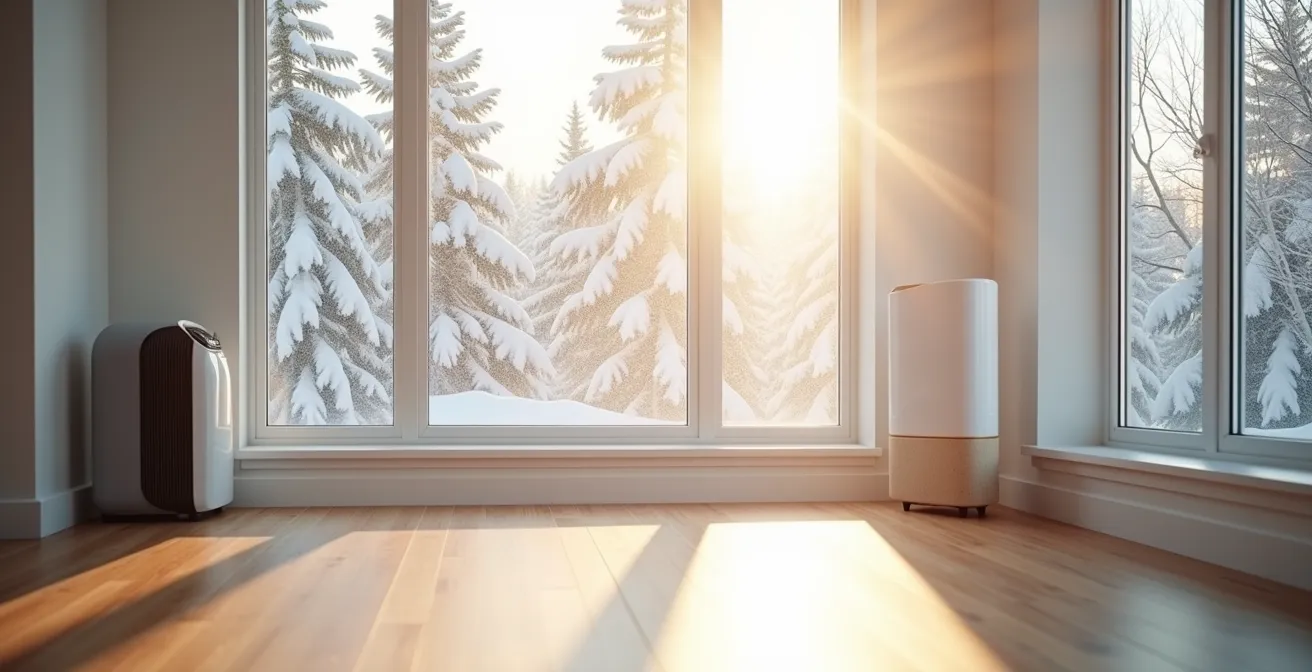
The key to a healthier winter isn’t just cleaning surfaces; it’s actively managing your home’s invisible environment of humidity and airborne particles.
- Dry winter air allows viruses to travel further and weakens your body’s natural defenses. Maintaining 40-60% indoor humidity is critical.
- HEPA filters are superior for capturing tiny virus particles, but a systemic approach including ventilation and personal habits offers the best protection.
Recommendation: Combine targeted humidification with a high-quality air filtration strategy to create a home sanctuary that actively resists airborne pathogens.
As the first frost paints the windows and the unmistakable chill of a Canadian winter sets in, every homeowner’s focus shifts. We seal our homes, turn on the furnace, and prepare for the cozy months ahead. But this annual ritual creates an unintended consequence: it turns our homes into perfect incubators for airborne viruses like the flu, RSV, and COVID-19. The common advice is to wash hands and disinfect surfaces, and while important, this approach largely ignores the primary way these pathogens travel: through the air we breathe.
Many homeowners invest in an air purifier, hoping a single device will solve the problem. Others simply try to “air out” the house, a freezing and inefficient proposition when it’s -20°C outside. These fragmented efforts fail because they don’t address the root cause. The real battle against winter viruses is fought in the invisible environment of our homes. The secret lies not in one magic bullet, but in understanding and controlling the interplay between air, moisture, and our body’s own defense systems.
But what if the key to a healthier winter wasn’t just about trapping viruses, but about creating an environment where they struggle to survive and where our bodies are optimized to defeat them? This guide moves beyond the surface-level tips. We will deconstruct the journey of a pathogen inside a heated Canadian home and provide a systemic plan for air fortification. We will explore how to manage humidity, which technologies truly work, and how simple daily habits can rebuild your body’s first line of defense against respiratory illness.
To help you create a comprehensive defense strategy, this guide is structured to tackle each layer of protection. The following sections will walk you through the science, the technology, and the practical habits needed to transform your home into a bastion of health this winter.
Summary: How to Fortify Your Home Against Airborne Viruses During Canadian Winters?
- Why Does Dry Winter Air Make Viruses Travel Further in Your House?
- How to Use a Neti Pot to Flush Pathogens from Your Sinuses?
- HEPA or UV-C: Which Technology Actually Kills Viruses in the Air?
- The Mouth Breathing Habit That Bypasses Your Natural Immune Filters
- How to Eat to Strengthen the Lining of Your Lungs and Nose?
- Humidifier or Purifier: Which Device Prevents Winter Sinus Infections?
- How to Replace the “Dirty Dozen” Hormonal Disruptors in Your Home?
- How to maintain mental and physical vitality during a 5-month Canadian winter?
Why Does Dry Winter Air Make Viruses Travel Further in Your House?
The moment you turn on your furnace for the season, you begin a scientific process that inadvertently helps viruses. Cold, outdoor Canadian air holds very little moisture. When that air is drawn into your home and heated, its relative humidity plummets. In fact, when outdoor air at 0°C is heated to a comfortable 20°C, the indoor relative humidity can drop to a desert-like 20% or lower. This creates the perfect superhighway for airborne pathogens.
In a properly humidified environment (40-60%), the microscopic droplets we exhale that carry viruses are larger and heavier. They fall out of the air quickly, settling on surfaces where they can be wiped away. In dry air, however, these droplets evaporate rapidly. The viral particles left behind are smaller and lighter, allowing them to remain suspended in the air for hours, traveling on air currents throughout your entire house. Your breathing zone becomes a minefield.
This isn’t just theory. An extensive MIT study analyzing COVID-19 data from 121 countries found a clear link between low indoor humidity and higher rates of infection and death. Regions experienced spikes in cases when their indoor relative humidity dropped below 40% during colder months. Furthermore, dry air compromises your body’s respiratory mucosal barrier. The delicate lining of your nose and airways dries out, becoming less effective at trapping and expelling invaders, essentially leaving the front door wide open for infection.
How to Use a Neti Pot to Flush Pathogens from Your Sinuses?
While managing your home’s air is crucial, supporting your body’s personal filtration system—your nasal passages—is an equally powerful strategy. During winter, even in a well-humidified home, you are inevitably exposed to airborne pathogens outdoors. Nasal irrigation, a practice often done with a neti pot, is a simple mechanical way to flush out viruses, bacteria, and allergens before they can take hold and cause an infection.
The goal is to use a gentle, sterile saline solution to wash away invaders and moisturize the nasal passages, reinforcing your respiratory mucosal barrier. This can reduce the severity and duration of colds and sinus infections. However, safety is paramount. Using improper water or technique can introduce harmful bacteria. For this reason, Health Canada has published specific guidelines for safe usage. Below is a checklist based on their official recommendations to ensure your nasal rinsing routine is both effective and safe.

As you can see, the technique is a gentle, gravity-fed flow, not a forceful spray. This process soothes inflamed tissues and helps your sinuses function optimally as the body’s primary air filter. Consistency is key; incorporating this into your routine during peak cold and flu season can be a game-changer for respiratory health.
Your Action Plan: Safe Neti Pot Use, The Health Canada Way
- Use Only Sterile Water: Always use boiled, distilled, or sterile water. If using tap water, bring it to a rolling boil for 3 to 5 minutes and then let it cool until it is lukewarm.
- Proper Water Storage: You can store unused boiled water in a clean, closed container for up to 24 hours. Discard it after that time.
- Use Correct Saline Packets: Do not use table salt. Use only saline packets specifically designed for nasal irrigation, which are readily available at Canadian pharmacies like Shoppers Drug Mart.
- Clean Your Device: Follow the manufacturer’s instructions to clean your neti pot or rinse bottle thoroughly after every single use to prevent bacterial growth.
- Never Share Your Device: To prevent the transmission of germs, your nasal rinsing device is for your personal use only. Do not share it with anyone.
HEPA or UV-C: Which Technology Actually Kills Viruses in the Air?
Once you’ve humidified your air, the next step in air fortification is filtration. This is where many homeowners get confused by marketing terms. The two dominant technologies are HEPA and UV-C. Understanding their different mechanisms is crucial to making an effective choice. A HEPA (High-Efficiency Particulate Air) filter is a physical barrier. It’s an incredibly dense, pleated mechanical filter that traps airborne particles as air is forced through it. A UV-C system, on the other hand, uses ultraviolet light to inactivate or “kill” microorganisms like viruses and bacteria.
While UV-C sounds more high-tech, its effectiveness in a typical home air purifier is debatable. For the light to work, the virus must be exposed to it for a sufficient duration and at a close enough range. In a fast-moving air stream, this “dwell time” is often too short. HEPA filters, by contrast, physically remove particles from the air. As technical experts from ISO-Aire note, this is a critical distinction:
Considering the threat that the spread of COVID-19 and other germs pose, an upgrade of a building’s air filter to a HEPA is a far more effective step than just to a MERV 13 considering the small size of a virus (0.06-0.12 microns). The problem is that a HEPA is too fine of a filter media to implement into existing HVAC systems.
– ISO-Aire Technical Experts, ISO-Aire Air Filtration Systems
This highlights a key point: while standalone HEPA purifiers are effective for rooms, you cannot simply swap your furnace filter for a HEPA filter, as it would strain your HVAC system. A more practical upgrade for a whole-home system is a MERV-13 filter, which offers good, but not HEPA-level, filtration. The table below breaks down the key differences for a Canadian homeowner.
| Technology | Virus Capture Rate | Best Use Case | Cost Range (CAD) |
|---|---|---|---|
| HEPA Filter | 99.99% at 0.3 microns | Standalone room purifiers | $200-$800 |
| MERV-13 Filter | Less than 75% at 0.3-1.0 microns | Whole-home HVAC systems | $40-$80 per filter |
| UV-C System | Kills pathogens but doesn’t remove | In-duct installation | $500-$1500 |
The Mouth Breathing Habit That Bypasses Your Natural Immune Filters
You can have the best air filtration money can buy, but if you’re bypassing your body’s built-in HEPA filter, you’re undermining your own defenses. We are talking about your nose. It is exquisitely designed to warm, humidify, and filter incoming air. The fine hairs (cilia) and mucous lining trap dust, pollen, and pathogens. Nasal breathing also promotes the production of nitric oxide, a gas that has antiviral properties and improves oxygen circulation.
Mouth breathing, on the other hand, does none of this. It’s an unfiltered, open door for cold, dry, and pathogen-laden air to go directly into your lungs. Many people become mouth breathers at night, especially during winter when dry air and heating can cause nasal congestion. This habit not only increases your risk of respiratory infections but also leads to poorer sleep quality and a dry mouth and throat in the morning.
Training yourself to breathe nasally, especially while you sleep, is a free and powerful way to fortify your respiratory health. This is a critical component of managing your personal “invisible environment.” The goal is to keep your nasal passages moist and open, making nasal breathing your body’s default state. Here are several practical tips specifically for combating dry Canadian winter nights:
- Use a bedside humidifier to maintain 40-60% humidity directly in your breathing zone.
- Apply a saline nasal spray right before bed to keep nasal passages moist and prevent them from swelling shut.
- Keep your bedroom temperature cool, between 16-19°C. Overly warm air can worsen nasal congestion.
- For persistent mouth breathing, consider specialized porous mouth tape, but only after consulting with a healthcare provider to ensure it’s appropriate for you.
- As a low-tech solution, place a bowl of water near your heating vent to add a small amount of passive humidity to the room.
How to Eat to Strengthen the Lining of Your Lungs and Nose?
Your home’s defense system is only one half of the equation. The other half is your body’s own resilience. Air fortification starts from the inside out, specifically by strengthening the respiratory mucosal barrier. This delicate, single-cell-thick lining in your nose, sinuses, and lungs is your first biological line of defense. A healthy mucosal barrier physically traps pathogens and contains immune cells ready to neutralize them. A weak, inflamed, or dry barrier is an open invitation to infection.
You can directly support this barrier through nutrition. Certain vitamins and minerals are essential for the integrity and immune function of these mucosal surfaces. During a long Canadian winter, when fresh produce can be limited and sun exposure is minimal, a targeted nutritional strategy is vital. Focus on foods rich in the following nutrients:
- Vitamin A: Often called the “anti-infection vitamin,” it’s crucial for maintaining the structural integrity of mucosal cells. Find it in sweet potatoes, carrots, spinach, and beef liver.
- Vitamin D: Essential for modulating the immune response. As Health Canada notes, supplementation is often necessary for Canadians between October and April. Dietary sources include fatty fish (salmon, trout), fortified milk, and egg yolks.
- Zinc: This mineral helps maintain the skin and mucosal membranes. It’s found in lean meats, legumes, nuts, and seeds.
- Omega-3 Fatty Acids: Known for their anti-inflammatory properties, they can help calm inflammation in the airways. Excellent sources include Canadian wild salmon, mackerel, and walnuts.
This is not about “boosting” your immune system with megadoses, but about providing the specific building blocks your body needs to maintain its frontline defenses.

Humidifier or Purifier: Which Device Prevents Winter Sinus Infections?
This is the classic Canadian winter dilemma for homeowners worried about respiratory health. Do you need to add moisture to the air, or remove particles from it? The answer is: it depends on your primary problem. A humidifier’s sole job is to combat the excessive dryness caused by indoor heating. By adding water vapor to the air, it helps keep your nasal passages moist and functional, and makes it harder for virus particles to travel, as we’ve discussed.
An air purifier, typically with a HEPA filter, has a different job. It physically removes airborne particles: dust, pet dander, pollen, smoke, and, yes, the tiny aerosolized particles that carry viruses. It does nothing to change the humidity level. For a person prone to winter sinus infections, the primary culprit is often the dry air itself, which damages the sinus’s natural defense and cleaning mechanisms. In this case, a humidifier is the frontline tool.
However, in a modern, airtight condo or for a family with allergies, particle buildup can be a significant problem, making a purifier essential. For many Canadian homes, the ideal solution is a combination of both. For those looking for an integrated, energy-efficient, whole-home solution, there is a third option often overlooked: a Heat or Energy Recovery Ventilator (HRV/ERV). As the Government of Canada explains, these systems are a game-changer for ventilation without energy loss. A Heat Recovery Ventilation (HRV) system exchanges stale indoor air for fresh outdoor air while transferring heat in the process, maintaining efficiency.
| Device Type | Primary Function | Best For | Annual Operating Cost |
|---|---|---|---|
| Humidifier | Adds moisture to combat dry heated air | Older drafty homes, prairie provinces | $50-$150 |
| HEPA Air Purifier | Removes airborne particles and pathogens | Airtight modern condos, allergy sufferers | $40-$200 (filter replacement) |
| HRV/ERV System | Exchanges stale air while retaining heat/humidity | Energy-efficient whole-home solution | $100-$300 |
How to Replace the “Dirty Dozen” Hormonal Disruptors in Your Home?
Fortifying your home against airborne viruses involves more than just germs. It also means reducing the overall “body burden” on your immune system. Our tightly sealed winter homes can trap a cocktail of chemicals known as endocrine-disrupting compounds (EDCs). These chemicals, found in everyday products, can interfere with your body’s natural hormone function and, by extension, your immune response. According to the American Lung Association, on any given day, your indoor air can be 2 to 5 times more polluted than the air outdoors.
These chemicals off-gas from furniture, flooring, cleaning products, and even scented candles. Reducing your exposure to this “dirty dozen” of common household toxins frees up your immune system to focus on fighting actual pathogens. The key is not to panic, but to make simple, gradual swaps to non-toxic alternatives. Fortunately, Canada has a growing market of excellent, health-conscious products. Here are some simple swaps you can make to lower the chemical load in your home:
- Flooring: Replace aging vinyl flooring, which can release phthalates, with sustainable Canadian hardwood or natural cork options.
- Cleaning Products: Switch to brands like Attitude, a Quebec-based company whose products are ECOLOGO certified and transparent about ingredients.
- Candles: Many scented candles release volatile organic compounds (VOCs). Opt for unscented candles made from 100% beeswax or soy from local Canadian producers.
- Furniture: When buying new furniture, look for a label stating it is “TB117-2013 compliant,” which means it was made without harmful flame retardant chemicals.
- Food Storage: Use glass, ceramic, or stainless steel containers for food storage and reheating instead of plastic, which can leach chemicals into your food.
- Air Filtration: Installing a MERV-13 furnace filter can help capture some of the larger particles released from off-gassing materials.
Key Takeaways
- The greatest winter virus threat indoors comes from dry air, which allows pathogens to travel further and weakens your body’s defenses.
- A systemic approach is best: combine 40-60% humidity, HEPA filtration for key areas, and fresh air exchange via an HRV/ERV.
- Personal habits like nasal breathing and a nutrient-rich diet to support your mucosal barrier are as critical as any technology.
How to maintain mental and physical vitality during a 5-month Canadian winter?
Surviving a five-month Canadian winter is one thing; thriving through it is another. The strategies we’ve discussed for fortifying your home against viruses have a powerful and direct side effect: they also enhance your overall physical and mental vitality. The fatigue, brain fog, and low mood many Canadians experience in winter aren’t just from the lack of sunlight. They are significantly impacted by poor indoor air quality.
When your home’s air is stale and filled with CO2, VOCs, and other pollutants, your body is under constant, low-grade stress. Your immune system is working overtime, and your cognitive function suffers. A landmark study co-written by the Harvard T.H. Chan School of Public Health revealed that improving indoor environmental quality could boost decision-making scores by a staggering 101%. Clean, fresh, properly humidified air is not a luxury; it’s a performance-enhancing tool for your brain and body.
The ultimate goal is to transform your home from a sealed box into a wellness sanctuary. This is achieved by creating a dynamic system that brings in fresh air, removes contaminants, and maintains optimal humidity. An ERV system (Energy Recovery Ventilator), which transfers both heat and humidity, is the gold standard for achieving this in a Canadian climate. It ensures a continuous supply of fresh air without the energy penalty of opening a window. Paired with good filtration and conscious lifestyle choices, it completes the project of total air fortification, creating an environment that supports restorative sleep, sharp thinking, and a resilient immune system all winter long.

By implementing this systemic approach, you move from passively enduring winter to actively creating an indoor environment that fosters health, energy, and well-being. Start today by assessing your home’s humidity and air filtration, and take the first step towards a healthier, more vital winter.