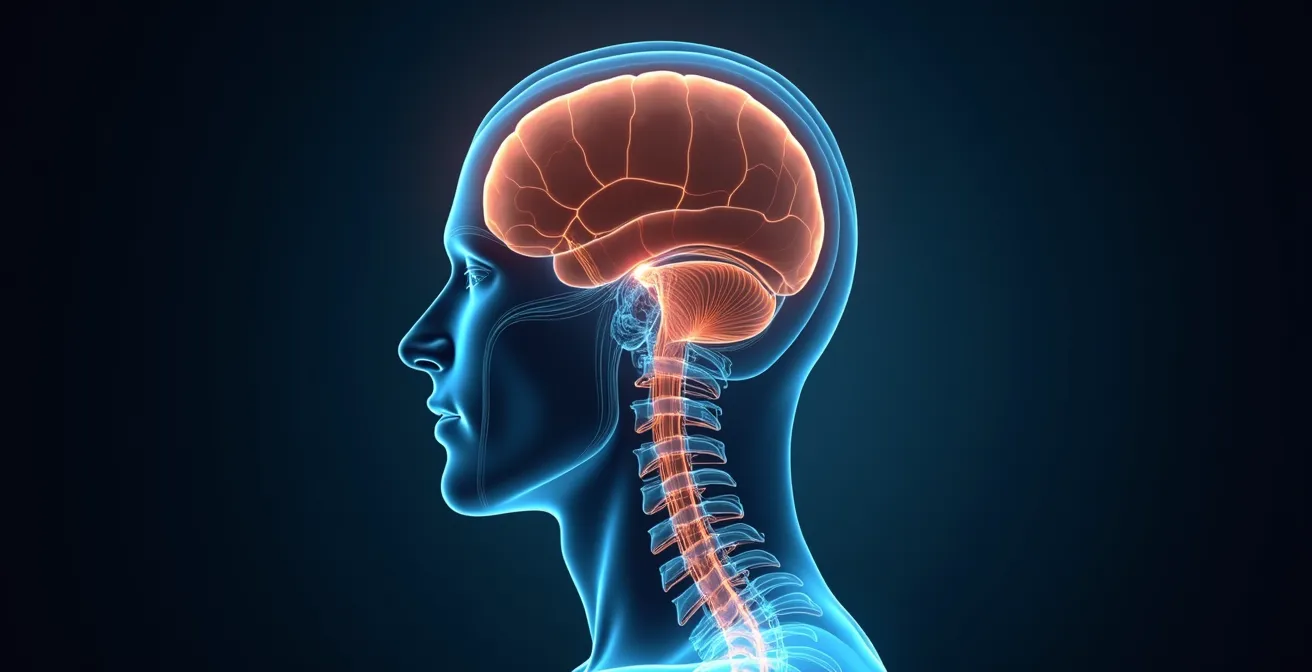
Your chronic migraines may not be a head problem, but a symptom of a structural and neurological issue originating in your spine.
- A misaligned vertebra, particularly in the neck, can irritate nerves and the brainstem, disrupting the body’s entire operating system.
- This structural failure creates a cascade of symptoms, from the biomechanical stress of forward head posture to systemic issues like digestive distress.
Recommendation: Instead of only managing pain, investigate the underlying mechanical cause. A thorough chiropractic assessment can determine if a spinal misalignment is the source of your migraines.
If you suffer from chronic migraines, you have likely tried a range of solutions, from over-the-counter painkillers to prescription medications, with limited or temporary success. The conventional approach treats the migraine as the primary problem—a headache to be subdued. But what if the migraine is not the problem itself, but a final, powerful symptom of a deeper mechanical failure? This is a critical distinction for anyone seeking a long-term solution rather than temporary relief. The focus often falls on triggers like stress, diet, or lack of sleep, which are valid contributors. However, they may only be aggravating an underlying structural vulnerability.
The true origin for many chronic headache sufferers lies in the structural integrity of the spinal column, specifically the cervical spine (the neck). A misalignment, or subluxation, of a single vertebra can initiate a neurological cascade of dysfunction. This is not simply about a “pinched nerve.” It’s about disrupting the central command centre of your body. When the relationship between the skull and the top vertebrae is compromised, it can exert mechanical tension on the brainstem, the very structure that regulates nearly all vital functions. This article will deconstruct this connection from a mechanical and neurological perspective, moving beyond masking symptoms to understanding the root cause.
We will examine the precise mechanisms by which a spinal fault can trigger systemic issues, how to protect your alignment, and how to differentiate between types of pain. Understanding your body as an interconnected system is the first step toward finding a lasting resolution for your migraines.
Summary: Uncovering the Mechanical Link Between Your Spine and Migraines
- Why Can a Misaligned Vertebra Cause Stomach Issues?
- How to Sleep to Hold Your Adjustment for More Than 3 Days?
- Activator or Hands: Which Adjustment Method Is Safer for Seniors?
- The “Self-Adjustment” Habit That Destabilizes Your Ligaments
- When to Adjust: Is It Safe to See a Chiropractor Immediately After a Fall?
- Why Does Your Head Feel 10lbs Heavier for Every Inch It Tilts Forward?
- Anxiety or Injury: How to Tell if Back Pain Is Emotional or Physical?
- Why Does Rolling on a Foam Roller Hurt So Much but Feel So Good?
Why Can a Misaligned Vertebra Cause Stomach Issues?
The connection between a spinal misalignment and seemingly unrelated issues like stomach pain, acid reflux, or IBS is not coincidental; it is neurological. The spine houses the central nervous system, the master communication highway between your brain and every organ, including your digestive tract. The critical link here is the vagus nerve, which originates in the brainstem and travels down through the neck, innervating the heart, lungs, and the entire digestive system. It is the primary regulator of “rest and digest” functions.
Case Study: Vagus Nerve Irritation from Cervical Misalignment
When a misalignment occurs in the upper cervical spine, pressure may be placed on the brainstem or spinal cord, which can directly affect the function of the vagus nerve. This irritation can disrupt the signals sent to the stomach and intestines, leading to poor motility, acid production imbalances, and inflammation. The body’s “righting reflex” attempts to level the head, causing compensatory shifts throughout the entire spine, which further strains the nervous system and exacerbates systemic dysfunction.
This neurological cascade means a mechanical problem in your neck can manifest as a functional problem in your gut. This is why some individuals with chronic migraines also report a history of unexplained digestive distress. The two are not separate issues but are often symptoms stemming from the same root cause: a disruption in nerve communication due to a structural fault.
The following table illustrates how specific spinal regions are linked to digestive functions, providing a mechanical map of this connection.
| Spinal Region | Associated Nerves | Potential Digestive Issues |
|---|---|---|
| Upper Cervical (C1-C2) | Vagus Nerve | Acid reflux, nausea, IBS symptoms |
| Thoracic (T5-T9) | Splanchnic Nerves | Stomach pain, bloating |
| Lower Thoracic (T10-T12) | Greater Splanchnic | Indigestion, intestinal issues |
Therefore, addressing the structural alignment of the spine, particularly in the cervical region, is not just about alleviating head and neck pain. It is about restoring proper function to the entire nervous system, which can have profound positive effects on digestive health and overall well-being.
How to Sleep to Hold Your Adjustment for More Than 3 Days?
A chiropractic adjustment aims to restore proper motion and position to vertebral segments, but the success of this correction is heavily influenced by your activities in the hours and days that follow. Sleep is particularly critical, as you spend roughly a third of your life in this state. Poor sleeping posture can easily undo the benefits of an adjustment by placing sustained, low-grade stress on your spine and its supporting ligaments, effectively re-introducing the mechanical faults that were just corrected. Maintaining a neutral spinal position during sleep is paramount.
A neutral spine means all three natural curves—the cervical (neck), thoracic (mid-back), and lumbar (low-back)—are maintained without rotation or bending. The most common culprit for losing this alignment is sleeping on your stomach, which forces your neck into extreme rotation for hours. This position creates significant torsional stress on the cervical vertebrae and can directly counteract a recent adjustment. The best positions are on your back or your side, but only with proper support.

As shown in the illustration, proper pillowing is not about comfort alone; it’s about structural support. For side sleepers, the pillow under your head must fill the space between your ear and the bed, keeping your neck straight. A second pillow between the knees prevents the top leg from falling forward, which would rotate the pelvis and lumbar spine. For back sleepers, a thinner or contoured pillow that supports the neck’s natural curve without pushing the head forward is essential.
Action Plan: Preserving Your Spinal Alignment During Sleep
- For back sleepers: Place a cervical contour pillow under your neck and a small pillow under your knees to maintain the natural curve of your spine.
- For side sleepers: Use a pillow between your knees and ensure your neck pillow fills the gap between your shoulder and head.
- Avoid stomach sleeping: This position forces neck rotation and creates spinal torsion, which is mechanically unsound.
- Pre-sleep decompression: Perform 5 minutes of gentle cat-cow stretches before bed to mobilize and decompress the spine.
- Eliminate ‘tech neck’: Keep phones and tablets away from the bed to prevent the forward head posture that counteracts adjustments right before sleep.
By transforming your sleep environment from a source of stress into a period of structural reinforcement, you give your body the best possible chance to heal and stabilize, allowing the benefits of your chiropractic adjustment to hold for longer periods.
Activator or Hands: Which Adjustment Method Is Safer for Seniors?
The question of which adjustment method is “safer” for seniors, or any patient with specific health considerations like osteoporosis, is a matter of matching the technique to the individual’s unique physiology. Both manual (hands-on) adjustments and instrument-assisted methods like the Activator are effective, but they operate on different principles of force and speed. There is no single “best” method; there is only the most appropriate method for the patient’s condition.
Subluxations located in the neck (or cervical spine) are believed to contribute to migraine headaches. With chiropractic care, patients report less severe, less frequent, and sometimes complete elimination of migraine headaches.
– Chiropractic Health Kansas City, Clinical observations on migraine treatment
Manual adjustments, often associated with a “popping” sound (cavitation), use a high-velocity, low-amplitude thrust delivered by the chiropractor’s hands. This is a highly effective and safe technique for the majority of the population. However, for a senior with decreased bone density or other sensitivities, a lower-force approach may be more suitable. This is where instrument-assisted techniques provide a critical alternative. The Activator Methods technique, for example, uses a small, handheld spring-loaded instrument to deliver a very fast, low-force impulse to a specific point. Because the thrust is so quick, the body’s muscles are less likely to tense and resist the adjustment, allowing for a precise correction without the need for heavy force.
For seniors, the primary concern is often bone fragility. An instrument-based adjustment minimizes the physical load on the skeletal structure while still effectively restoring motion to a restricted joint. In fact, research demonstrates the effectiveness of specific, gentle approaches. One study found that patients receiving upper cervical chiropractic care experienced a significant reduction in migraine frequency and intensity. The choice is ultimately a clinical decision based on a thorough examination, health history, and any diagnostic imaging, such as a bone density scan.
A competent chiropractor will be proficient in multiple techniques and will select the one that offers the highest degree of safety and effectiveness for your specific structural and health profile, ensuring the care is both gentle and corrective.
The “Self-Adjustment” Habit That Destabilizes Your Ligaments
The urge to “crack” one’s own neck or back to relieve a feeling of stiffness is common, but it is a biomechanically flawed and potentially harmful habit. While the popping sound may provide a fleeting sense of release, it does not address the underlying problem. In fact, it often worsens it. The sensation of stiffness or being “stuck” typically comes from a joint that is fixated or has restricted motion (a hypomobile segment). Your body, in an attempt to maintain overall mobility, develops compensatory hypermobility in the joints above and below the stuck one.
When you perform a “self-adjustment,” you are almost always moving these already hypermobile (overly mobile) joints. The path of least resistance for the force you apply is not the fixated segment, but the one that already moves too much. This creates a harmful cycle: the fixated joint remains stuck, while the adjacent joints are repeatedly pushed beyond their normal range of motion. Over time, this repeated action can stretch and destabilize the ligaments that are meant to provide passive structural support to your spine.
The Mechanical Flaw of Self-Manipulation
The core issue with migraines is often nerve irritation from spinal misalignment. A professional chiropractic adjustment is designed to apply a specific force, in a precise vector, to the exact vertebral segment that is fixated, thereby restoring proper motion and reducing inflammation. In contrast, self-cracking typically moves hypermobile joints rather than the stuck ones needing treatment. This not only fails to correct the primary problem but also contributes to long-term ligamentous laxity and chronic instability, making your spine more susceptible to future misalignments and nerve irritation.
Instead of forceful self-manipulation, a better approach is to use gentle mobility exercises that encourage movement throughout the entire spinal region without forcing any single joint. These alternatives promote circulation and reduce muscle tension without compromising ligamentous stability.
- Perform thoracic spine rotations using a foam roller placed perpendicular to your spine.
- Practice chin tucks: Pull your chin straight back (not down), holding for 5 seconds, and repeat 10 times.
- Do doorway pectoral stretches: Place your forearm on a door frame and gently rotate your body away to stretch the chest muscles.
- Try seated cat-cow movements to mobilize the entire spine gently.
- Use a tennis ball against a wall for targeted pressure point release in the upper back muscles.
True correction requires a specific, targeted intervention that you cannot perform on yourself. By ceasing the habit of self-cracking and focusing on safe mobilization, you create the conditions for lasting spinal health.
When to Adjust: Is It Safe to See a Chiropractor Immediately After a Fall?
Following a trauma such as a fall, car accident, or sports injury, the immediate priority is to rule out any serious medical issues. Chiropractic care is highly effective for addressing the biomechanical injuries that lead to post-traumatic headaches and migraines, but it must be applied at the appropriate time. The key is to first distinguish between symptoms that require immediate emergency medical evaluation and those that are safe for a chiropractic assessment.
A direct link has been established between physical trauma and the onset of migraines. Indeed, a connection has been seen between migraine headaches and previous head trauma from accidents or falls. These events can easily misalign the upper cervical vertebrae, leading to nerve irritation and the development of chronic pain patterns. However, certain “red flag” symptoms following an injury warrant a trip to the emergency room before any other intervention. These include loss of consciousness, severe radiating pain, sudden loss of strength, or confusion.
This image depicts a professional conducting a careful assessment, which is the necessary first step after a trauma to determine the appropriate course of action.

Once serious injuries have been ruled out by medical professionals, a chiropractic evaluation becomes crucial. A chiropractor will perform a thorough history and physical examination to assess for joint dysfunction, soft tissue damage, and neurological deficits. In the acute phase (the first 48-72 hours), treatment may focus on reducing inflammation with methods like ice or gentle soft tissue therapy. Adjustments, if indicated, will be highly specific and gentle to avoid aggravating the acute injury.
The following table provides a clear guide for when to seek emergency care versus when a chiropractic assessment is appropriate.
| Red Flags (ER First) | Safe for Chiropractic Assessment |
|---|---|
| Loss of consciousness | Mild neck stiffness after 48-72 hours |
| Severe radiating pain | Localized muscle soreness |
| Sudden loss of strength/sensation | Minor headache without neurological signs |
| Memory loss or confusion | Limited range of motion without sharp pain |
In summary, the rule is: first, rule out the major dangers with a medical evaluation. Then, address the underlying structural damage with a chiropractic assessment to prevent the trauma from becoming a source of chronic pain and migraines.
Why Does Your Head Feel 10lbs Heavier for Every Inch It Tilts Forward?
This widely cited statistic is a powerful illustration of basic biomechanics. The human head weighs, on average, 10-12 pounds. When your head is balanced directly over your shoulders in a neutral posture, the deep cervical muscles and spinal structures support this weight with minimal effort. However, as your head moves forward, away from this centre of gravity, the mechanical load on your neck and upper back muscles increases exponentially. This phenomenon is known as forward head posture.
Think of holding a bowling ball. When you hold it close to your body, it feels relatively light. As you extend your arm and hold it away from your body, the perceived weight and the strain on your arm muscles increase dramatically. The same principle applies to your head and neck. For every inch your head translates forward, the force on your cervical spine can increase by an additional 10 pounds. A posture with just two inches of forward head translation means your neck muscles are working to support the equivalent of a 30-pound head.
The Biomechanical Load of Forward Head Posture
This sustained increase in biomechanical load is a primary driver of cervicogenic (neck-related) headaches and migraines. The suboccipital muscles at the base of the skull go into a state of chronic contraction to prevent your head from falling further forward. This constant tension can irritate the nerves that pass through this region, including the greater and lesser occipital nerves, which supply sensation to the back and top of the head. It is very common for a misaligned bone to irritate one of your nerves, causing headaches and other symptoms. Forward head posture creates the exact conditions for this type of sustained nerve irritation.
This chronic muscle strain and nerve irritation is a direct pathway to developing a migraine. The body is not designed to withstand this type of continuous load. Eventually, the overworked muscles, compressed joints, and irritated nerves signal a crisis, which manifests as pain. Correcting forward head posture through targeted adjustments and postural retraining is therefore not just about aesthetics; it is about removing a major source of mechanical and neurological stress from your system.
Ultimately, your posture is not a passive state; it is an active reflection of your spinal alignment and muscle function. Reducing the biomechanical load on your neck is a fundamental step in alleviating the conditions that trigger migraines.
Anxiety or Injury: How to Tell if Back Pain Is Emotional or Physical?
The distinction between “emotional” and “physical” pain is often a false dichotomy, as the two are intricately linked through the nervous system. However, from a diagnostic standpoint, it is useful to differentiate between pain primarily driven by a structural, mechanical injury (nociceptive pain) and pain that is amplified or generated by central nervous system processes, often influenced by emotional states like anxiety or stress (centralized or nociplastic pain). They present with different characteristics.
Pain from a physical injury—like a disc herniation or a joint sprain—is typically localized, predictable, and consistent. It is usually easy to pinpoint, gets worse with specific movements (e.g., bending forward), and improves with rest or application of ice. In contrast, pain influenced by emotional or centralized factors is often diffuse, unpredictable, and inconsistent. It may be hard to locate (“it just hurts everywhere”), can flare up without any clear physical trigger, and might even feel worse with inactivity. This is because the pain is less about tissue damage and more about the nervous system’s interpretation and amplification of signals.
This table outlines the key indicators to help differentiate between the two primary pain presentations.
| Physical Pain Indicators | Emotional/Centralized Pain Indicators |
|---|---|
| Localized to specific area | Diffuse, hard to pinpoint |
| Predictable with movement | Unpredictable, varies with stress |
| Responds to rest and ice | May worsen with inactivity |
| Consistent pain pattern | Fluctuates with emotional state |
From a neurological perspective, chiropractic adjustments can influence both pathways. For physical pain, an adjustment restores proper mechanics, reducing strain on injured tissues. For centralized pain, the effect can be more complex. As one clinical review notes, there is a connection between spinal manipulation and neurotransmitter regulation. It is proposed that adjustments may facilitate the release of neurochemicals like serotonin and norepinephrine, which play a significant role in both mood regulation and the body’s natural pain-gating mechanisms.
Research suggests a connection between spinal manipulation and neurotransmitter regulation. Adjustments may facilitate the release of neurotransmitters, such as serotonin, which play a role in pain perception and mood stabilization.
– Adjusted Life Chiropractic, Clinical review of pain-emotion feedback loops
In many chronic pain cases, including migraines, both components are present. The key is to identify and correct the underlying structural faults while also addressing the nervous system’s response, creating a more comprehensive and effective path to relief.
Key Takeaways
- Migraines are often a neurological symptom of a mechanical failure in the spine, not just a “head problem.”
- A single misalignment can create a systemic cascade, affecting everything from biomechanical load to digestive function via the nervous system.
- Effective management involves identifying and correcting the root structural cause, rather than only masking the pain with medication.
Why Does Rolling on a Foam Roller Hurt So Much but Feel So Good?
The paradoxical sensation of pain and pleasure from foam rolling can be explained by a combination of mechanical and neurological principles. The “hurt” you feel is the result of applying direct pressure to adhesions and trigger points within your muscle and fascia, the connective tissue that surrounds your muscles. These are areas of chronic tension, restricted blood flow, and metabolic waste buildup. Applying pressure to these knotted-up tissues is inherently uncomfortable, much like a deep tissue massage.
The “so good” feeling that follows is primarily due to two neurological phenomena: autogenic inhibition and Gate Control Theory. When you apply sustained pressure to a tensed muscle (for 30-60 seconds), you stimulate sensory receptors within the muscle tendon called Golgi Tendon Organs (GTOs). When sufficiently stimulated, the GTO sends a signal to the spinal cord that overrides the signal to contract, telling the muscle to relax. This is autogenic inhibition—a built-in safety mechanism that protects muscles from tearing.
The Neurology of Myofascial Release
The “good” feeling is also explained by Gate Control Theory of pain. This theory posits that the nervous system can only process a limited number of sensations at once. The intense pressure signals from the foam roller travel to the brain on faster nerve fibers than the dull, aching pain signals from the muscle. The pressure signals effectively “close the gate” on the pain signals, blocking them from reaching the brain. Concurrently, the process of soft tissue therapy improves circulation, helping to flush out the inflammatory byproducts that contribute to soreness, leading to a feeling of release and relief.
However, it’s crucial to use a foam roller correctly to support, not compromise, your spinal health. Incorrect use can be counterproductive. Here are some fundamental safety guidelines:
- Never roll directly on your lumbar spine (low back) or your neck. These areas lack the structural support of the rib cage and direct pressure can be harmful. Focus on the muscles surrounding them.
- Target the large muscle groups that support your spine, such as the glutes, IT bands, hamstrings, and quadriceps.
- Roll slowly and deliberately. When you find a tender spot, pause and hold the pressure for 30-60 seconds to allow the muscle to release.
- For the upper back, use a smaller tool like a tennis ball or lacrosse ball against a wall for more targeted pressure between the spine and shoulder blades.
- Hydrate well after a rolling session to help your system flush out the metabolic waste that was released from the tissues.
When used correctly, foam rolling is an excellent complement to chiropractic care, helping to maintain muscle flexibility and reduce the tension that can contribute to spinal misalignments and migraines.
Frequently Asked Questions About Chiropractic Care for Seniors and Migraines
Given my bone density scan results, which technique do you recommend?
Your chiropractor should review your bone density scan to make a clinical recommendation. For patients with osteoporosis or significant osteopenia, a low-force instrument-assisted technique like the Activator Method is often preferred. If bone density is adequate, gentle manual techniques may be entirely appropriate.
Are you certified in low-force techniques?
This is an excellent question to ask. Look for a chiropractor with certifications or advanced training in specific low-force techniques such as Activator Methods, NUCCA, or other instrument-assisted protocols. This indicates a specialization in caring for sensitive patients.
How will you coordinate with my other healthcare providers?
A qualified, patient-centred chiropractor should be willing and able to communicate with your family doctor, physiotherapist, or medical specialist. Integrated care ensures that all your providers are working together for your best outcome. Don’t hesitate to ask about their process for interprofessional communication.