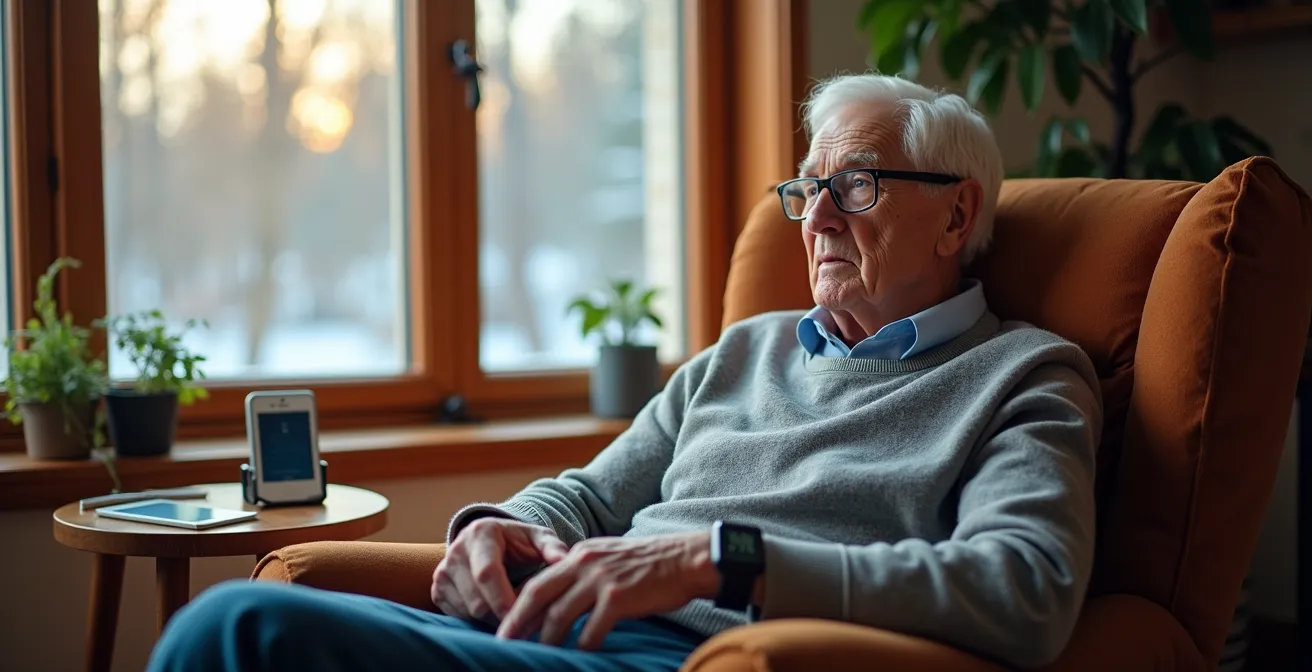
In summary:
- Modern devices send data via Bluetooth to an app, which can then be shared with your Canadian healthcare provider, closing the “care loop.”
- Create a personal “Alert Protocol” to know exactly when to call a clinic, visit an Urgent Care Centre, or call 911, avoiding unnecessary ER trips.
- Use data to have a “data-driven dialogue” with your care team, helping them make faster, more accurate adjustments to your treatment.
- You can build a “decentralized care team” in Canada using pharmacists, nurse practitioners, and telehealth, even without a family doctor.
The flashing numbers on a home blood pressure monitor can feel like a constant source of anxiety. For the many Canadians managing a chronic heart condition or diabetes, the goal is simple: stay safe at home and avoid the long waits and potential exposure of an emergency room. You’ve been told to monitor your vitals, but what does that really mean? Simply recording numbers in a notebook often feels like shouting into the void, with no guarantee a doctor will ever see it, let alone act on it.
The common advice is to “share data with your doctor,” but this overlooks the practical challenges within the Canadian healthcare system. How do you share it? In what format? And what if you’re one of the millions of Canadians without a dedicated family doctor? This leaves patients feeling isolated, reactive, and often defaulting to the ER for issues that could have been managed proactively.
But what if the key wasn’t just collecting data, but transforming it into a proactive care partnership? The true power of at-home monitoring lies in creating a “care loop”—a system where your data actively informs your care team, enabling swift adjustments and preventing crises before they start. This approach turns your monitor from a source of anxiety into a tool of empowerment.
This guide will walk you through the practical steps to establish this care loop. We will explore how your devices communicate with your care team, what to do when an alert triggers, how to manage the emotional side of monitoring, and most importantly, how to build a robust care plan within the Canadian system, empowering you to take control of your health from the comfort of your home.
To navigate this new era of proactive self-care, this article is structured to guide you from the technical fundamentals to building a complete support system. The following sections break down each critical component of effective at-home monitoring in Canada.
Summary: How to Monitor Your Heart Condition From Home Without Visiting the ER
- How Does Your Blood Pressure Monitor Send Data Straight to Your Doctor?
- What Happens When Your Home Monitor Triggers a “Red Alert”?
- Continuous Monitor or Daily Check: Which Tracks Atrial Fibrillation Better?
- The Beeping Anxiety: How to Cope with Constant Medical Monitoring at Home?
- When to Upload: How Real-Time Data Helps Doctors Adjust Your Dosage Faster?
- How to Export Wearable Data for Your Doctor to Actually Look At?
- Clinic or Hospital: Where to Go When Your Chronic Condition Flares?
- How to Build a Care Plan for Chronic Illness When You Don’t Have a Family Doctor?
How Does Your Blood Pressure Monitor Send Data Straight to Your Doctor?
The idea of a home device communicating directly with a doctor’s office might seem futuristic, but the underlying technology is surprisingly straightforward. Most modern, “connected” blood pressure monitors use Bluetooth to sync automatically with a dedicated application on your smartphone or tablet. This app becomes your personal health dashboard, collecting and organizing readings without manual entry. This is the first, crucial step in creating your proactive “care loop.”
From the app, the data transfer to your clinician is not always direct. In Canada, integration with hospital or clinic Electronic Medical Records (EMR) is still evolving. While some progressive clinics might use dedicated Remote Patient Monitoring (RPM) platforms, most patients will need to export their data. This is typically done by generating a PDF report from the app, which can then be sent via a secure patient portal or email. While some remote monitoring programs are currently offered in five Canadian provinces, including Ontario and British Columbia, the infrastructure varies widely.
Therefore, choosing the right device involves more than just accuracy; it requires understanding its data-sharing capabilities within the Canadian healthcare landscape. Some devices offer easier export functions than others, which can make a significant difference in facilitating a data-driven dialogue with your care team.
The following table provides a snapshot of how some popular connected devices integrate with the Canadian system, highlighting that “sending data” often means creating a clear, shareable report rather than direct EMR integration.
| Device | Canadian EMR Integration | Provincial RPM Support | Price Range (CAD) |
|---|---|---|---|
| Omron Connect | Limited (PDF export) | Ontario, BC | $100-150 |
| QardioArm | Third-party apps | Ontario | $120-180 |
| Withings BPM | Export only | Multiple provinces | $130-200 |
Understanding this process is the foundation. It shifts the focus from merely taking a reading to ensuring that reading becomes a useful piece of information for the people managing your care.
What Happens When Your Home Monitor Triggers a “Red Alert”?
An alarming beep or a red-flagged reading on your monitor can trigger immediate panic. The instinct may be to rush to the nearest emergency room. However, a key part of successful home monitoring is having a pre-defined “Alert Protocol”. This is a clear, tiered plan that you create with your care team, outlining specific actions for different alert levels. It transforms a moment of fear into a moment of calm, decisive action, and it is the most effective way to avoid unnecessary ER visits.
An alert doesn’t automatically mean a 911 call. It’s a signal to consult your protocol. A “yellow” alert (e.g., slightly elevated blood pressure) might prompt you to re-measure in 15 minutes and log any symptoms. A “red” alert (e.g., significantly high BP without severe symptoms) might mean calling your clinic, provincial telehealth service (like 811), or visiting an Urgent Care Centre. Only alerts accompanied by severe symptoms like chest pain, shortness of breath, or confusion warrant an immediate 911 call. This structured response ensures the level of care matches the level of urgency.

This proactive approach is already making a difference in the Canadian healthcare system. By creating these communication channels, patients and providers can collaborate to manage flare-ups efficiently.
Case Study: Nova Scotia Pharmacist Blood Pressure Alert Response
A patient in Nova Scotia shared their blood pressure log with their local pharmacist through the MedsCheck program. The pharmacist identified a pattern of morning hypotension, contacted the family doctor with specific recommendations, and the prescription was adjusted over the phone within 24 hours, avoiding an emergency visit. This demonstrates a perfect “care loop” in action, leveraging the accessibility of Canadian pharmacists.
Your personal protocol should be clear and accessible. The following steps, adapted for the Canadian context, form a solid foundation for your own alert response plan.
- Acknowledge the alert immediately through your monitoring app.
- Follow your care team’s specific protocol (provided at device setup).
- For non-urgent alerts: Call your clinic or use provincial telehealth (811).
- For urgent but stable situations: Visit an Urgent Care Centre to avoid ER waits.
- For emergency symptoms combined with an alert: Call 911 immediately with your recent readings ready.
Ultimately, a red alert is not a failure; it’s the system working exactly as intended, providing you with the critical, early information needed to act appropriately and stay safe.
Continuous Monitor or Daily Check: Which Tracks Atrial Fibrillation Better?
For conditions like Atrial Fibrillation (AFib), where symptoms can be intermittent and fleeting, the method of data collection is critical. A single daily check might miss an episode entirely. This is where the distinction between spot-checking and continuous (or near-continuous) monitoring becomes a vital topic for a data-driven dialogue with your doctor. Choosing the right tool depends on your specific goal: are you trying to get an initial diagnosis or manage a known condition long-term?
Traditionally, a doctor would prescribe a Holter monitor, a medical-grade device worn for 24-72 hours to get a continuous electrocardiogram (ECG) reading. This is considered the gold standard for diagnosis. However, within the Canadian healthcare system, wait times for a Holter monitor can be long, and the short monitoring window might still miss an infrequent event. This is where personal ECG devices, like KardiaMobile, have become powerful tools for long-term management.
These personal devices allow a patient to take a 30-second ECG reading anytime they feel symptoms. While not a replacement for a diagnostic Holter, this capability is invaluable for tracking the frequency of AFib episodes over months or years. As a Canadian-German study demonstrated, a wearable heart monitor device can significantly improve the detection of atrial fibrillation. It empowers patients to capture objective data at the precise moment of a suspected event, providing their doctor with concrete evidence instead of a vague description of “palpitations.”
The choice between these methods involves a trade-off between diagnostic precision, cost, and accessibility within the Canadian system, as detailed in the comparison below.
| Feature | Prescribed Holter | Personal ECG (KardiaMobile) |
|---|---|---|
| Provincial Coverage | Yes (OHIP, MSP, etc.) | No – Out of pocket |
| Wait Time | 2-6 months | Immediate |
| Monitoring Duration | 24-72 hours continuous | 30-second snapshots |
| Best For | Initial diagnosis | Long-term management |
The best strategy often involves a combination: a Holter monitor for a definitive diagnosis, followed by a personal ECG device for ongoing, patient-led management and tracking.
The Beeping Anxiety: How to Cope with Constant Medical Monitoring at Home?
While remote monitoring is a powerful medical tool, it can introduce a new kind of stress: “beeping anxiety.” The constant presence of a medical device, the fear of seeing a high reading, and the pressure to measure consistently can create a significant emotional burden. Acknowledging and managing this emotional load is just as important as managing the physical condition itself. The goal is to see the device as an ally for empowerment, not a source of constant worry.
One of the most effective strategies is a cognitive shift towards “data mindfulness.” This means engaging with the data constructively rather than fearfully. Instead of obsessing over a single reading, focus on trends over days or weeks. This reframes the data from a pass/fail test into a source of information that helps you understand your body’s patterns. It’s about seeing the numbers not as a judgment, but as a guidepost for your next conversation with your care team. Surprisingly, consistent engagement can reduce anxiety.
Patients who used remote monitoring apps for >80% of days during a 12-week study showed improved quality of life scores, demonstrating that consistent engagement with monitoring, when framed positively, can reduce anxiety rather than increase it.
– Formative JMIR, Patient Experience with Data Mindfulness
Building a strong support system is also crucial. In Canada, numerous resources are available specifically for patients with chronic illnesses. Connecting with others who share your experience can validate your feelings and provide practical coping strategies. Distributing the emotional load by creating a “Monitoring Charter” with your family—defining who helps with what and when—can also prevent caregiver burnout and make monitoring a shared responsibility rather than a solitary one.
If you’re struggling, don’t hesitate to reach out for professional help. The following resources are available to Canadians:
- Access Canadian Mental Health Association (CMHA) chronic illness support groups.
- Join Heart and Stroke Foundation virtual support sessions (free for Canadians).
- Utilize provincially-funded virtual therapy through platforms like MindBeacon or AbilitiCBT.
- Contact your provincial health line (811) for mental health navigation.
- Create a ‘Monitoring Charter’ with family to distribute the emotional load.
By combining mindfulness techniques with a strong support network, you can transform the experience of home monitoring from one of anxiety into one of control and confidence.
When to Upload: How Real-Time Data Helps Doctors Adjust Your Dosage Faster?
Collecting data is only half the battle; sharing it effectively is what triggers proactive care. A common mistake is “data dumping”—sending your doctor pages of raw numbers without context or summary. A busy Canadian clinician is unlikely to sift through this. The key to getting faster dosage adjustments and treatment optimization is to share the right data at the right time. This strategic sharing is the engine of the “care loop.”
Real-time data doesn’t mean your doctor is watching your readings 24/7. It means that when a clear trend or a significant event is identified, you can share it promptly, enabling a much faster response than waiting for your next scheduled appointment in three months. For instance, sharing a week-long trend of elevated morning blood pressure allows a pharmacist or doctor to make a confident medication adjustment, often over the phone. Structured data sharing is proven to accelerate care.

The impact of this approach is significant, particularly when leveraging accessible healthcare professionals like pharmacists, who are playing an increasingly central role in chronic disease management in Canada.
Case Study: Digital Therapeutics and Medication Adjustments
In a study involving Canadian patients, 40% of those who shared structured data through a digital therapeutic (DTx) platform had their medication initiated or intensified by their provider. This was in stark contrast to 0% in the control group who did not share data in this way, proving how structured data sharing directly leads to faster and more effective treatment optimization.
To make your data actionable, it’s crucial to follow a schedule that aligns with the rhythms of the Canadian healthcare system. A well-timed summary report is far more powerful than a constant stream of raw data. The following checklist provides a practical framework for sharing your data effectively.
Your Action Plan: Optimal Data Sharing Schedule
- Create a weekly summary report every Friday for routine reviews.
- Share with your pharmacist during monthly MedsCheck appointments (a program available in Ontario and other provinces).
- Upload your data summary 24-48 hours before any scheduled telehealth or in-person appointment.
- Send data related to urgent changes (as defined in your alert protocol) within 24 hours via a secure patient portal.
- Keep a 30-day rolling average report ready for any new specialist referrals to provide instant context.
This strategic communication ensures your efforts at home translate into timely, meaningful clinical action, keeping you healthier and out of the hospital.
How to Export Wearable Data for Your Doctor to Actually Look At?
You’ve diligently tracked your heart rate on your smartwatch, but how do you turn that mountain of data into a molehill your doctor will actually review? The single biggest mistake is assuming your clinician wants to see every single data point. They don’t. They need a concise, trend-focused summary with relevant context. The goal is to create a one-page, doctor-friendly report that tells a clear story at a glance.
Most consumer wearables like Apple Watch and Fitbit are not medical devices, a crucial distinction that needs to be communicated. Their data is best used to show trends and correlate symptoms, not for diagnosis. As experts note, the technology differs significantly from what’s used in a clinical setting.
Personal at-home ECG monitors use wrist or finger sensors and may be less accurate than medical-grade monitors which record continuous ECG.
– GoodRx Health, At-Home ECG Monitors Guide
With this limitation in mind, your export should focus on clarity and context. Instead of exporting a month of raw, minute-by-minute heart rate data, export a weekly or monthly summary graph. Crucially, use the “notes” feature in your health app to add context before you export. For example, a note next to a heart rate spike that says “Felt dizzy after climbing stairs” is infinitely more useful than the number alone. This turns you from a data collector into a data interpreter, doing the initial work for your doctor.
Most health apps (like Apple Health or Google Fit) have a built-in “Export to PDF” function. This is your best tool. A clean, single-page PDF is easy to upload to a patient portal or even print for an in-person visit. This respects the clinician’s time and dramatically increases the chance they will engage with the information you’ve worked so hard to collect.
Here’s a simple checklist for creating a report your doctor will appreciate:
- Use your app’s “Export to PDF” feature to create a single-page summary.
- Include only 2-4 weeks of data, focusing on daily or weekly averages, not raw readings.
- Add contextual notes directly in the app before exporting (e.g., “after exercise,” “felt anxious”).
- Ensure the exported PDF file is under 2MB so it can be easily attached to emails or uploaded to portals.
- Always print a physical copy as a backup, as not all Canadian EMR systems can easily import patient-supplied files.
A well-formatted, contextualized report respects your doctor’s time and transforms your consumer wearable into a genuinely useful tool for your chronic care management.
Clinic or Hospital: Where to Go When Your Chronic Condition Flares?
When a chronic condition like heart disease or diabetes flares up, the immediate question is: where should I go? In the Canadian healthcare system, the emergency room is often the default answer, but it’s rarely the best one for non-life-threatening issues. Knowing the right place to go not only saves you hours of waiting but also ensures you get the most appropriate level of care while helping to reduce the strain on our crowded ERs. This decision is a critical part of your personal care plan.
The key is to triage your own symptoms based on severity. A mild flare-up, such as a blood pressure reading that is slightly higher than usual but without other symptoms, can often be handled by a virtual care appointment or a call to your clinic. This allows for quick advice or a prescription adjustment without leaving your home. For a more urgent but not life-threatening situation—for example, a very high blood pressure reading (e.g., 180/100 mmHg) with mild chest discomfort but not crushing pain—an Urgent Care Centre is the ideal choice. These centres are equipped to handle serious issues but have significantly shorter wait times than a hospital ER.
The emergency room should be reserved for true emergencies: symptoms like severe chest pain, difficulty breathing, sudden weakness or numbness, or a blood pressure reading that is dangerously high (e.g., over 200/120 mmHg) accompanied by other severe symptoms. In these cases, calling 911 is always the right choice. The following decision matrix can help guide you.
| Severity Level | Where to Go | Examples | Wait Time |
|---|---|---|---|
| Mild Flare | Family clinic/Virtual care | BP slightly elevated | Same day-48hrs |
| Urgent Non-Emergency | Urgent Care Centre | BP 180/100, mild chest discomfort | 2-4 hours |
| Emergency | Call 911/ER | BP 200/120 with symptoms | Immediate |
Regardless of where you go, being prepared is essential. Having your health information ready will speed up your care and ensure the medical team has the full picture. Always bring the following items:
- Your recent home monitoring readings (last 48-72 hours, preferably printed).
- Your provincial health card and any private insurance information.
- A complete list of your medications, including over-the-counter drugs and supplements.
- Contact information for your family doctor or specialist, if you have one.
- A brief, written timeline of your symptom onset and progression.
By using this triage approach, you ensure you get the right care, in the right place, at the right time, turning a potentially stressful event into a managed response.
Key Takeaways
- Transform monitoring from a passive task to a proactive “care loop” by learning to share the right data at the right time.
- A “decentralized care team” (pharmacist, nurse practitioner, telehealth) is a powerful and realistic strategy for managing chronic illness in Canada, especially if you lack a family doctor.
- Creating a personal “Alert Protocol” and knowing where to go for different levels of severity are the most effective ways to avoid unnecessary and stressful ER visits.
How to Build a Care Plan for Chronic Illness When You Don’t Have a Family Doctor?
Managing a chronic condition effectively hinges on having a coordinated care plan, but what happens if you’re one of the millions of Canadians without a family doctor? This is a growing reality for many, especially those with conditions like atrial fibrillation, which is a significant public health issue. It’s estimated that as many as a million Canadians live with atrial fibrillation, and navigating care without a primary quarterback can feel daunting. The solution is to build your own proactive, “decentralized care team.”
A decentralized care team is a network of healthcare professionals you assemble to provide the continuity of care a single family doctor normally would. This isn’t a lesser option; it’s a strategic adaptation to the current Canadian healthcare landscape. Your local pharmacist is often the most accessible and valuable member of this team. They can conduct regular medication reviews (often funded by provincial health plans), help you understand your monitoring data, and communicate with other providers. Nurse Practitioner-led clinics are another cornerstone, as they are increasingly accepting new patients and can provide comprehensive care, including diagnosis and prescriptions.
For acute issues and prescription renewals, establishing a relationship with a consistent walk-in clinic or using a virtual care platform like Maple or Tia Health provides reliability. The final piece is you. By using your home monitoring data, you become the central hub of information, providing each member of your decentralized team with the data they need to collaborate effectively. This vision of integrated, technology-enabled care is not just a workaround; it’s the future.
To achieve the quadruple aim of healthcare (improved clinical experience, improve patient experience, better outcomes and lower costs), technology via telehealth is simply unavoidable.
– Aetonix, Canada Telehealth & Remote Patient Monitoring Landscape
Building this team requires proactive effort. Here are the key steps to creating your own care network in Canada:
- Register with your provincial Health Care Connect registry to get on a waitlist for a family doctor.
- Search for Nurse Practitioner-led clinics in your area that are accepting new patients.
- Establish care at a single, consistent walk-in clinic to ensure continuity for prescriptions.
- Connect with your local pharmacist for monthly medication reviews.
- Use provincially-recognized virtual platforms for non-urgent issues and prescription renewals.
By taking these steps, you are not just waiting for care; you are actively building a resilient, modern care plan that puts you in control of your health journey, regardless of your family doctor status.