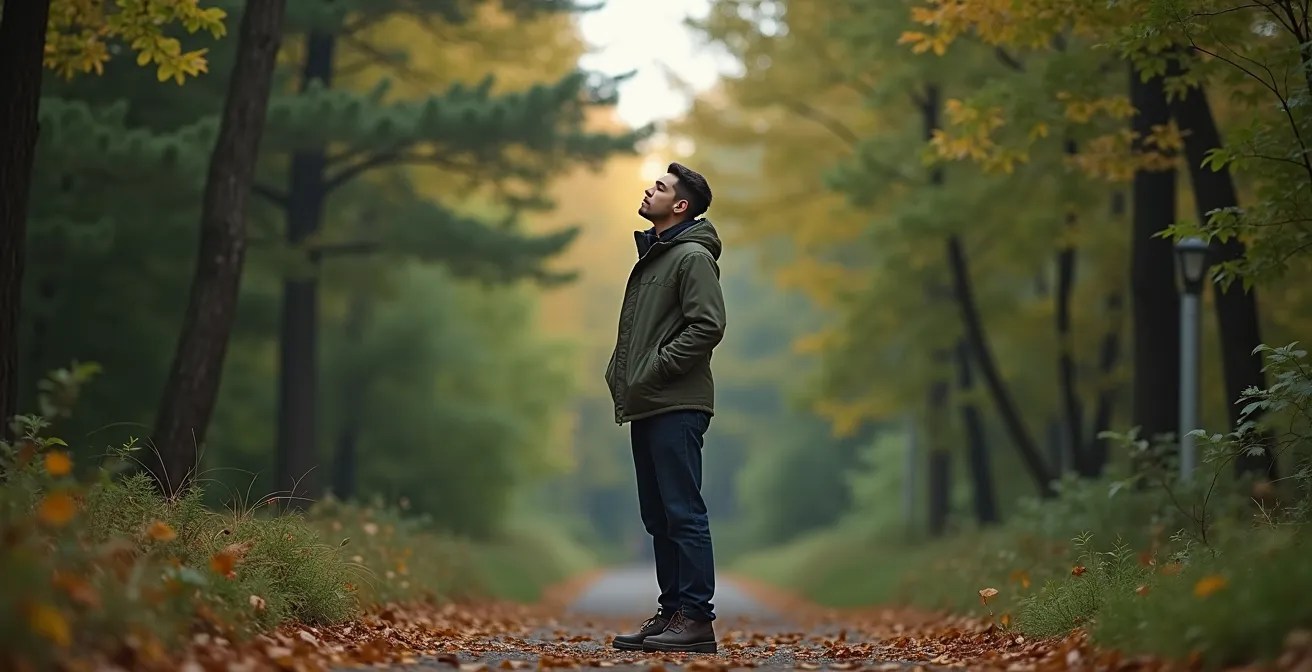
The profound health benefits of forest bathing are not locked away in remote wilderness; they are accessible anywhere by learning to replicate nature’s key therapeutic mechanisms.
- Focus on inhaling phytoncides, the natural compounds from trees, which can be found even in urban parks.
- Practice slow, sensory walking to shift your mindset from a destination-focused hike to a state of mindful immersion.
- Use “nature snacks” and a designated “sit spot” to easily integrate this healing practice into a busy Canadian lifestyle.
Recommendation: Start today by finding a single tree in your neighbourhood and trying the simple, 10-breath “conifer breathing technique” detailed in this guide.
The longing is a familiar one for many Canadians. You see breathtaking photos of ancient forests, hear about the Japanese practice of Shinrin-yoku, or forest bathing, and feel a deep pull to connect with nature. Yet, you find yourself surrounded by cityscapes, with the nearest true wilderness hours away. You might have tried the common advice—bringing a few houseplants indoors or playing nature sounds on an app—but it feels like a faint echo of the real experience, leaving you to wonder if you can ever do it “right.”
This feeling stems from a common misconception: that forest bathing requires a pristine, old-growth forest to be effective. While such places are powerful, the core principles of Shinrin-yoku are not about the location itself. The secret lies in the practice—the intentional activation of your sensory and physiological pathways using specific natural triggers. It’s about shifting your focus from the perfect place to the purposeful practice.
But what if the true key to unlocking the benefits of forest bathing wasn’t in finding a forest, but in learning to see the “forest” that is already around you? This guide is designed to be your certified companion, showing you how to deconstruct the mechanisms of Shinrin-yoku—from the chemical messengers of trees to the calming patterns in a single leaf—and apply them right where you are, from a downtown Toronto ravine to a quiet street in Calgary or even from your own balcony during a long Montreal winter.
For those who prefer a visual introduction, this short video captures the essence and tranquility of connecting with nature, setting the stage for the practical techniques we are about to explore.
This article is structured to guide you from the foundational science of why nature is so healing to the practical steps for creating your own therapeutic experience. We will explore the specific elements you can seek out and the simple mindset shifts that transform any green space into a place of restoration.
Summary: How to Access the Benefits of Shinrin-yoku Anywhere in Canada
- Why Do Pine Trees Boost Your Natural Killer Cells?
- How to Walk Slow Enough to Actually “Bathe” in the Forest atmosphere?
- Guided Tour or Solo Wander: Which Experience Is More Therapeutic?
- The “Selfie” Mistake That Ruins the Benefits of Forest Bathing
- 20 Minutes or 2 Hours: How Long Do You Need to Be in the Woods?
- Why Does Looking at Trees Lower Your Blood Pressure Instantly?
- Why Do Weak Mitochondria Leave You Vulnerable to Infections?
- Why Does Living Near a Park Reduce Your Risk of Depression?
Why Do Pine Trees Boost Your Natural Killer Cells?
One of the most powerful, yet invisible, benefits of being among trees comes from the air you breathe. Conifers like pine, spruce, and fir trees release aromatic compounds called phytoncides into the atmosphere to protect themselves from pests and disease. When we inhale these molecules, they have a remarkable effect on our bodies. Research confirms that phytoncides can boost the immune system by increasing the number and activity of our Natural Killer (NK) cells—a type of white blood cell that fights off infection and tumor formation.
You don’t need to be in a dense forest to experience this. A single pine tree in a city park or even on your street is releasing these beneficial compounds. The key is to get close and breathe intentionally. By learning to identify a few common Canadian conifers, you can give yourself a “phytoncide micro-dose” anytime. This isn’t about the quantity of trees, but the quality of your connection and your breath. The following plan helps you audit your local environment and create a routine for this specific practice.
Your Action Plan: Connecting with Conifers
- Points of contact: List all accessible sources of phytoncides. This includes local parks with coniferous trees (pine, spruce, fir), tree-lined streets, botanical gardens, and even high-quality, sustainably-sourced Canadian essential oils like Balsam Fir or Cedarwood for home use.
- Collecte: Inventory your immediate opportunities. Note the single spruce tree on your walk to work, the small grove of pines in a nearby park, or the bottle of essential oil you already own. These are your starting points.
- Cohérence: Check these opportunities against your values. Is accessing the park a low-stress activity? Is the essential oil brand you’re considering transparent about its sustainable sourcing in Canada? Choose the path that feels most aligned and restorative.
- Mémorabilité/émotion: What makes each source unique? Pay attention to the specific, invigorating scent of a Balsam Fir needle versus the sharp, clean aroma of a White Spruce. This sensory detail deepens the emotional connection and the therapeutic benefit.
- Plan d’intégration: Create a simple, prioritized plan. Start with a five-minute “conifer breathing” session next to the nearest tree. Plan a longer weekend walk in a conifer-rich area. Schedule 30 minutes to use your home diffuser.
By consciously seeking out these natural chemicals, you are actively engaging one of the primary mechanisms of forest therapy, turning a simple walk into an immune-boosting practice.
How to Walk Slow Enough to Actually “Bathe” in the Forest atmosphere?
The term “forest bathing” is a direct translation of Shinrin-yoku, and the verb “to bathe” is crucial. It implies total immersion, not a brisk walk. Many people approach nature with a goal-oriented mindset: reach the viewpoint, complete the loop, get the heart rate up. Forest bathing invites you to do the opposite. The goal is to have no goal. The pace is slow, meandering, and led by your senses. Certified guides often say you should aim to cover only one kilometre in about two and a half hours.
This slowness is a skill, and it can feel unnatural at first. One of the most effective ways to cultivate it is the “Sit Spot” practice. It involves finding one accessible spot—a single tree on your street, a bench in a park, a corner of your balcony—and returning to it regularly. This practice removes the pressure to “go somewhere” and instead builds a deep, intimate connection with the nature that is right in front of you. It’s about depth, not distance.

As the image shows, this practice is about stillness and observation. Instead of using distance goals, try using sensory landmarks. Walk slowly from “the feeling of the sun on my face” to “the sound of the distant traffic fading.” During a Canadian winter, you can practice the “winter shuffle”—taking slow, deliberate steps in the snow, focusing entirely on the crunching sound and the sensation of cold air on your skin. This transforms a simple walk into a rich, multi-sensory meditation.
Guided Tour or Solo Wander: Which Experience Is More Therapeutic?
As you begin to explore forest bathing, you might wonder whether it’s better to join a guided walk or venture out on your own. The founder of the Association of Nature and Forest Therapy (ANFT), M. Amos Clifford, offers a beautiful perspective on this question:
The Forest is the Therapist, the Guide opens the Doors.
– M. Amos Clifford, Association of Nature and Forest Therapy
This quote captures the essence of the choice. The healing power comes from your direct relationship with nature, but a guide can help you access it more deeply, especially when you are starting. A certified guide provides a structured experience with a series of “invitations”—gentle prompts to engage your senses in specific ways—that you might not think of on your own. They hold the space, manage the time, and conclude with a traditional tea ceremony, allowing you to fully immerse yourself without any logistical worries.
However, a solo practice offers its own unique benefits, including flexibility, accessibility, and the chance to build personal intuition. In Canada, with our vast access to public parks and trails, a solo wander is often the most practical way to build a regular habit. The choice is not about which is “better,” but which is right for you at this moment. The following table breaks down the key differences to help you decide.
| Aspect | Guided Forest Therapy | Solo Forest Bathing |
|---|---|---|
| Structure | Certified ANFT guides provide invitations and sensory exercises | Self-directed exploration using personal intuition |
| Duration | Typically 2-3 hours with tea ceremony | Flexible, from 10 minutes to 2+ hours |
| Cost in Canada | $40-80 per group session, $150+ private | Free in public parks and trails |
| Best For | Beginners, those seeking deeper techniques | Experienced practitioners, regular practice |
| Canadian Options | ANFT guides in all provinces, community gardens | Provincial parks, urban green spaces |
Ultimately, many people find a hybrid approach works best: periodically joining a guided walk to learn new techniques and deepen their practice, while maintaining a regular solo routine for consistent benefits.
The “Selfie” Mistake That Ruins the Benefits of Forest Bathing
In our digitally-connected world, the instinct to document and share our experiences is strong. When we find a beautiful spot in nature, the first impulse is often to pull out our phone and take a selfie. While there’s nothing inherently wrong with this, in the context of forest bathing, it represents a fundamental mistake: it shifts the focus from “what is here?” to “I was here.” This act of self-documentation pulls you out of the sensory moment and into a state of self-awareness and performance, effectively ending the “bathing” experience.
The solution isn’t necessarily to leave your phone at home, but to transform it from a tool of distraction into a tool of deepened observation. Instead of taking a selfie, try taking a “sensory selfie.” Capture the intricate pattern of lichen on a rock, the way light filters through a leaf, or the rich texture of moss. This practice forces you to look closer and notice the small wonders you would otherwise miss. It keeps your attention directed outward, on the nature that is present with you.
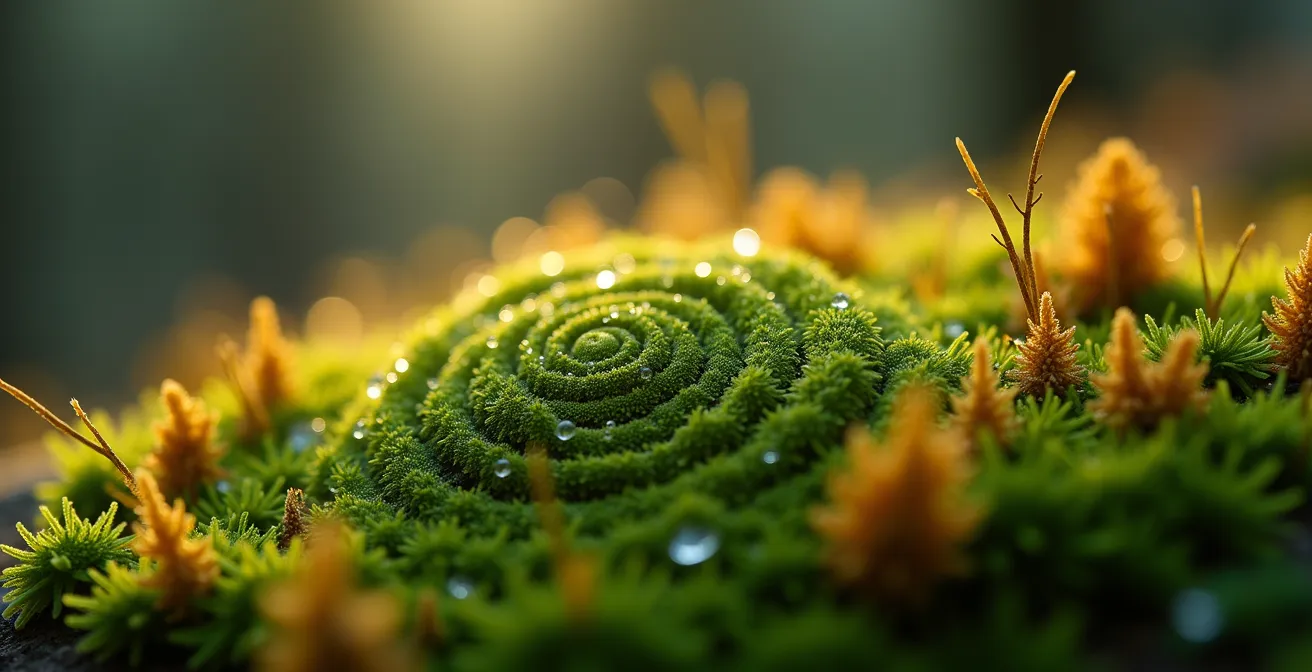
This kind of close-up view is the true heart of forest bathing. It’s about losing yourself in the details. A powerful way to deepen this outward focus is to begin your walk by acknowledging the land itself. For instance, you might silently acknowledge that where you walk in Toronto is the traditional territory of the Mississaugas of the Credit, the Anishnabeg, the Chippewa, the Haudenosaunee, and the Wendat peoples. This act of mindfulness, as highlighted by resources like the Unearthing project which promotes land-based reconciliation, immediately shifts your perspective from your own story to the much larger story of the land, fostering a deeper sense of respect and connection.
20 Minutes or 2 Hours: How Long Do You Need to Be in the Woods?
One of the biggest barriers to starting a forest bathing practice is the belief that you need to block off an entire afternoon. While a two-to-three-hour immersive session is the gold standard for a deep dive, research shows that the benefits begin to accumulate in much shorter timeframes. This is fantastic news for busy urban dwellers and anyone navigating the realities of a Canadian climate. The key is to think in terms of the “minimum effective dose.”
So, what is that dose? According to research from Nature and Forest Therapy of Canada, even a 20-minute walk in a forest environment can reduce the level of the stress hormone cortisol by 16%. This is a significant physiological effect in a short amount of time. It gives you “permission” to let go of the all-or-nothing mindset. A 20-minute walk in a city park during your lunch break is not a “lesser” form of forest bathing; it’s a potent and accessible “nature snack.”
Adapting your practice to the seasons and your schedule is the key to consistency. A weekly goal of 120 minutes in nature—the amount often cited in studies for significant well-being benefits—can be achieved through a combination of short daily sessions and longer weekend immersions. During a long, cold winter, even five-minute “nature snacks,” like watching the snow fall from a window or stepping outside for a few deep breaths of cold air, can help maintain your connection and prevent seasonal affective disorder (SAD). A flexible, season-specific approach makes the practice sustainable all year round in Canada.
Why Does Looking at Trees Lower Your Blood Pressure Instantly?
The calming effect of nature is not just a poetic idea; it’s a measurable physiological response. Studies have repeatedly shown that simply looking at natural scenes can quickly lower blood pressure and pulse rate. But why? The answer lies in how our brains are wired to process visual information. Nature is filled with fractal patterns—complex, repeating shapes found in things like tree branches, snowflakes, river systems, and ferns. Our brains find these patterns effortlessly fascinating, and processing them induces a state of relaxed awareness.
This is a core principle of biophilia, our innate tendency to connect with nature. Urban environments, with their straight lines and simple geometric shapes, lack this visual complexity and can be subtly stressful. In contrast, a view of a tree from an office window provides a dose of natural fractal patterns, triggering a relaxation response. This effect is so reliable that it has been incorporated into “biophilic design” in Canadian cities, such as Vancouver’s vertical gardens and Toronto’s green roofs on condominiums. These installations provide measurable calming effects for residents who have visual access to them.
Interestingly, you don’t even need a real tree to get a dose of this benefit. As a study highlighted by the Canadian Art Therapy Association suggests, even viewing paintings of the Canadian wilderness by artists like the Group of Seven or Emily Carr can provide a calming effect by exposing the brain to these same natural patterns. This demonstrates that the mechanism is tied to the visual pattern itself, a pattern you can seek out anywhere—in a houseplant’s leaves, a city park’s branching pathways, or a piece of art.
Key Takeaways
- The benefits of forest bathing come from the practice, not the place. You can access them anywhere by replicating nature’s therapeutic mechanisms.
- Focus on intentional sensory experiences: inhale phytoncides from urban trees, touch textures, and listen to the soundscape around you.
- Consistency is more important than duration. Short, frequent “nature snacks” of 20 minutes are highly effective at reducing stress.
Why Do Weak Mitochondria Leave You Vulnerable to Infections?
To understand the deepest health benefits of forest bathing, we need to look inside our own cells. Every cell in your body contains tiny power plants called mitochondria. They are responsible for converting food and oxygen into the energy that fuels every single bodily function, including your immune response. When your mitochondria are healthy and numerous, you have abundant energy and a robust immune system. When they are weak or damaged, you become more vulnerable to fatigue, chronic illness, and infections.
One of the biggest threats to mitochondrial health is chronic stress, which floods the body with cortisol and creates oxidative damage. This is where forest bathing provides a profound benefit. As we’ve seen, it directly lowers cortisol. Furthermore, the phytoncides released by trees, particularly the alpha-pinene found in Canadian pines, act as powerful antioxidants. Research indicates these compounds help protect mitochondria from oxidative stress, preserving your cellular energy and, by extension, your immune resilience.
You can even take steps to actively increase the number of mitochondria in your cells, a process called mitochondrial biogenesis. One of the most effective ways to do this is through mild cold exposure. For Canadians, this presents a unique opportunity. A gentle winter walk where you allow yourself to feel the cold air—without becoming uncomfortably cold—can stimulate your body to produce more of these vital energy factories. Combining the stress-reducing, antioxidant effects of forest bathing with the mitochondrial-boosting effects of cold exposure is a powerful strategy for building deep, cellular-level health.
Why Does Living Near a Park Reduce Your Risk of Depression?
The cumulative effect of all these mechanisms—reduced cortisol, boosted immunity, lower blood pressure, and protected mitochondria—contributes to one of the most well-documented outcomes of nature connection: improved mental health. Numerous studies show that people who live near green spaces have a lower risk of depression and anxiety. Even a 30-minute walk in a forest can decrease feelings of hostility and depression while increasing feelings of liveliness.
A simple city park becomes a powerful therapeutic landscape when you know what to look for. It offers a dose of phytoncides from its trees, fractal patterns in its foliage and pathways, and a soundscape that is more restorative than city traffic. In Canada, research from universities like UBC and the University of Toronto has quantified how different types of urban green spaces offer unique mental health benefits. The wide-open prairie parks of Calgary can elevate mood with expansive sky views, while the enclosed ravines of Toronto can reduce anxiety by providing a sense of sanctuary.
Each city’s unique green infrastructure provides a different “flavour” of nature therapy, accessible to millions of Canadians. Understanding these nuances allows you to choose your environment based on your mental and emotional needs on any given day.
| Canadian City | Green Space Type | Mental Health Benefit |
|---|---|---|
| Vancouver | Stanley Park rainforest trails | Reduced anxiety through enclosed canopy immersion |
| Toronto | Ravine system networks | Depression reduction via accessible nature corridors |
| Montreal | Mount Royal parkland | Stress relief through elevation and vista points |
| Calgary | Prairie river valleys | Mood elevation from open sky exposure |
You don’t need to move to the wilderness to protect your mental well-being. By learning to see and use the green spaces that are already woven into the fabric of your Canadian city, you can build a consistent, powerful, and deeply personal forest bathing practice that supports a healthy mind.
Your journey into forest bathing begins not with a trip, but with a simple shift in perception. Start today by applying these principles to the nature that is closest to you, and begin cultivating a more resilient, calm, and connected state of being.