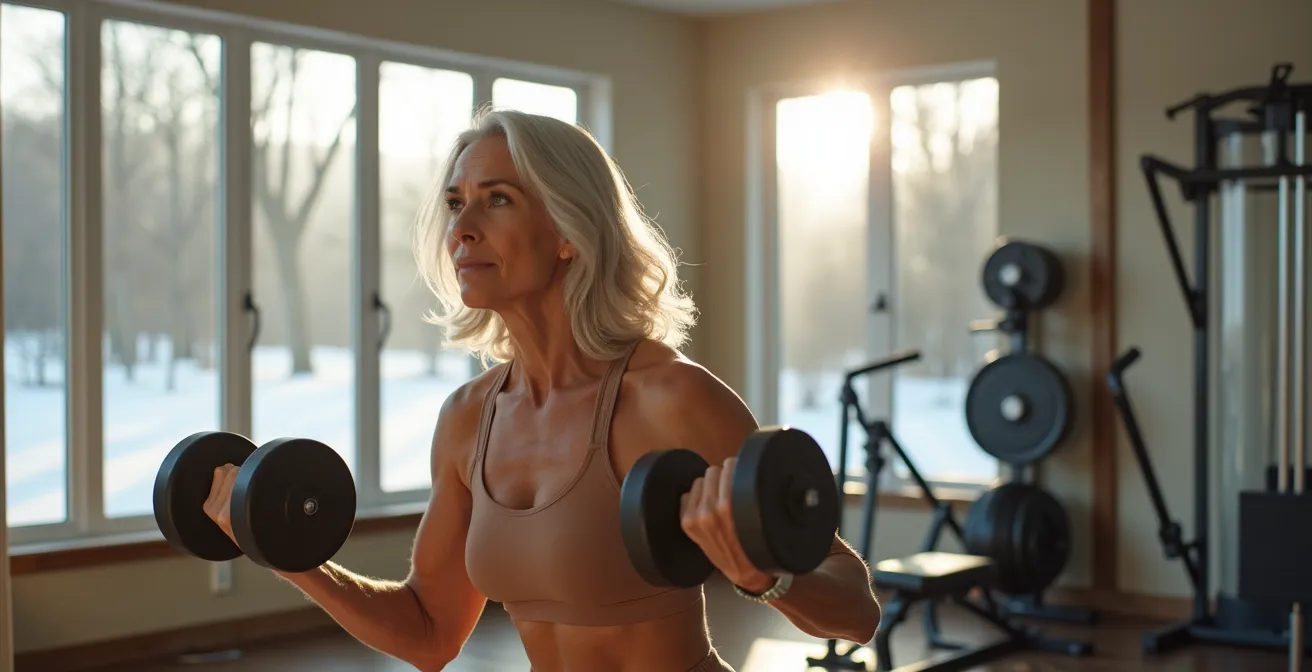
Contrary to popular belief, reversing bone loss isn’t achieved with light, gentle exercise, but through targeted, progressively challenging resistance training.
- Your bones require significant mechanical stress to trigger the rebuilding process; light activities like walking are often insufficient for reversal.
- Safe progression, starting with bodyweight and systematically moving to heavier loads under controlled form, is the key to stimulating bone growth without injury.
Recommendation: Focus on mastering fundamental movements like squats and hinges with weights that challenge you within a safe range (around 60-80% of your maximum effort for 8-10 repetitions).
Receiving an osteopenia diagnosis can feel like a verdict of fragility. The immediate advice often revolves around avoiding falls and impact, which can inadvertently lead to a fear of movement itself. You’re likely told to take calcium, get more vitamin D, and engage in “weight-bearing” activities like walking. These are all valuable pieces of the puzzle, but for many, they only slow the decline; they don’t reverse it.
But what if the mainstream advice is too cautious? What if walking and light exercises aren’t enough to turn the tide? The fundamental truth, supported by decades of research, is that bones don’t get stronger from being coddled. They get stronger from being challenged. The key isn’t just bearing weight, but applying a specific, calculated stress that signals your body to rebuild its own scaffolding, stronger and denser than before. This is where resistance training, done correctly, transforms from a daunting activity into your single most powerful tool for reclaiming bone health.
This guide is designed for you—the Canadian adult concerned about bone density but wary of high-impact exercises. We will dismantle the myths, explain the science in simple terms, and provide a safe, actionable framework. We’ll explore why stress is good for your bones, how to lift safely even with back concerns, and why the strength you build is your best insurance policy against the challenges of aging. You will learn not just to manage osteopenia, but to actively reverse its course.
This article provides a comprehensive roadmap for building bone density safely and effectively. Below is a summary of the key areas we will cover, guiding you from understanding the core principles to implementing a complete, holistic strategy.
Summary: Reversing Osteopenia With Strength Training
- Why Do Bones Get Stronger Only When You Stress Them?
- How to Deadlift Safely if You Have Lower Back Worries?
- Machines or Free Weights: Which Simulates Bone Growth Better?
- The “Pink Dumbbell” Myth: Why Light Weights Won’t Build Bone
- When to Rest: Frequency of Strength Training for Over-60s?
- Why Are Squatting, Hinging, and Carrying Essential for Independence?
- Why Is the “Sunshine Vitamin” Your First Defense Against Autoimmunity?
- Why is Muscle Mass Your Best Insurance Against Aging?
Why Do Bones Get Stronger Only When You Stress Them?
Your skeleton is not a static, concrete structure; it’s a dynamic, living tissue that is constantly remodeling itself. This process is governed by a fundamental principle known as Wolff’s Law, which states that bone adapts to the loads under which it is placed. Imagine a construction crew that only reinforces a building where it detects strain. When you apply mechanical stress to your bones through resistance training, tiny, harmless micro-fractures occur. In response, your body dispatches cells called osteoblasts to the site. Their job is to not just repair the area, but to lay down new, denser bone tissue to better withstand that stress in the future.
This is why low-impact activities like swimming, while excellent for cardiovascular health, do little for bone density. The water supports your body, unloading the skeleton. Even walking, while beneficial, often doesn’t provide a strong enough signal for significant bone growth once you’re accustomed to it. To reverse osteopenia, the signal must be unambiguous and progressively stronger. The “load” needs to be greater than what your bones experience in daily life. This is the very essence of strength training: creating a demand that forces your body to build a more resilient frame.
The scale of this issue in Canada is significant. In 2015-2016, an estimated 2.2 million Canadians aged 40 and over were living with diagnosed osteoporosis, with women accounting for about 80% of that number. This highlights the critical need for effective, non-pharmaceutical strategies to build and maintain bone density throughout our lives. Understanding that stress is the catalyst, not the enemy, is the first and most crucial mindset shift on the path to stronger bones.
How to Deadlift Safely if You Have Lower Back Worries?
The word “deadlift” can be intimidating, especially if you’ve ever experienced lower back pain. It evokes images of powerlifters hoisting immense weights. However, the deadlift is simply a “hinge” movement pattern—the same one you use to pick up a bag of groceries or a grandchild. Mastering this movement is not only safe but essential for protecting your spine and building bone density in the hips and femur. The key is not to avoid it, but to approach it with a structured, progressive plan.
The goal is to teach your body to hinge at the hips while keeping your spine neutral and stable, engaging your powerful glutes and hamstrings to do the lifting. You never start with a heavy barbell. Instead, you earn the right to lift heavier by mastering each preceding step. This methodical progression builds both physical strength and confidence, ensuring your back remains safe and supported throughout the process.
This visual guide illustrates the journey from a simple bodyweight drill to a loaded hinge, emphasizing a gradual increase in complexity and load. Each step builds upon the last, ensuring perfect form before adding weight.
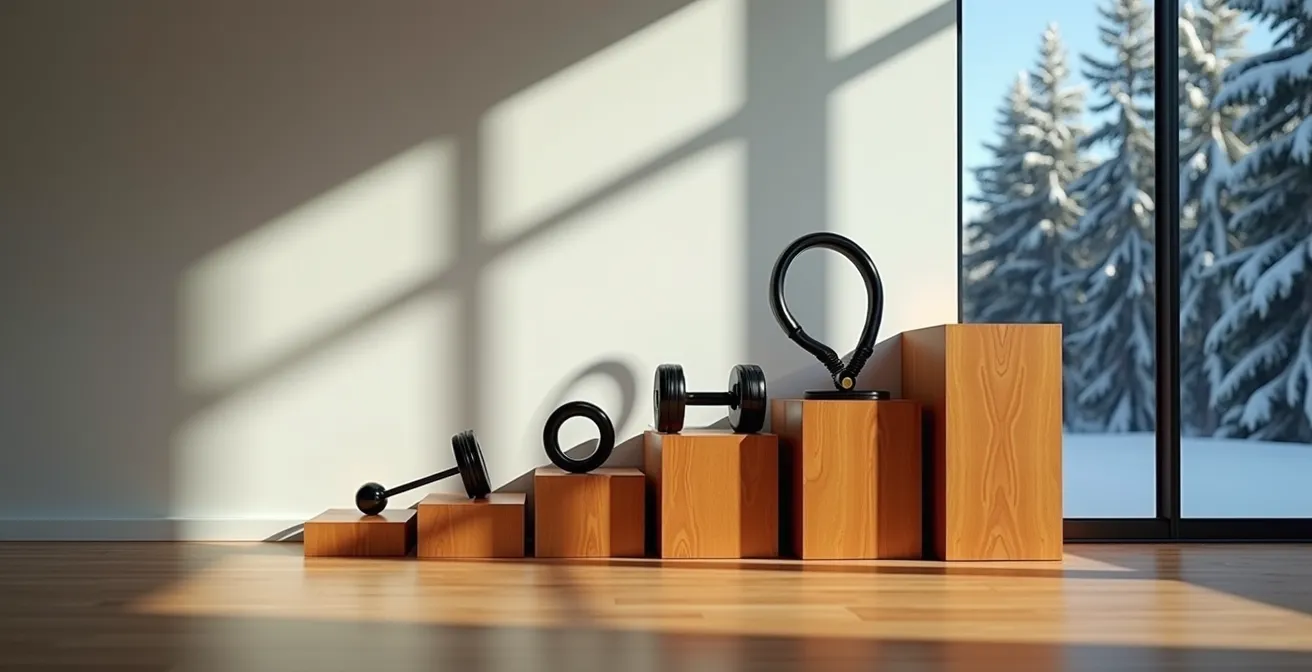
Below is a safe progression hierarchy, inspired by guidelines from programs like Bone Fit™, designed to help you master the hinge without putting your lower back at risk. Remember to perform each movement without pain before advancing to the next stage.
- Bodyweight Hip Hinge Against a Wall: Stand with your back to a wall, feet hip-width apart. Hinge at your hips, pushing your buttocks back to touch the wall while keeping your spine straight. Maintain contact and then return to standing.
- Banded Good Mornings: Place a light resistance band around your shoulders and under your feet. Perform the same hip hinge, now against the gentle, accommodating resistance of the band.
- Romanian Deadlifts (RDLs) with Dumbbells: Hold light dumbbells in front of your thighs. Hinge at the hips, letting the weights slide down your legs to about mid-shin, keeping your back flat. Squeeze your glutes to return to a standing position.
- Trap Bar Deadlifts: If available, the trap (or hex) bar is an ideal next step. Its design allows you to stand inside the weight, keeping the center of gravity aligned with your body and dramatically reducing stress on the lower back compared to a conventional barbell.
- Daily Postural Exercises: Incorporate exercises that strengthen your core and upper back. This creates a “natural corset” of muscle that protects your spine during all activities, as recommended by Bone Fit™ guidelines.
Machines or Free Weights: Which Simulates Bone Growth Better?
When you walk into a gym or community centre, you’re faced with a choice: the orderly rows of weight machines or the seemingly more chaotic domain of free weights like dumbbells and kettlebells. For the specific goal of stimulating bone growth, the evidence points strongly in one direction. While machines offer safety and simplicity, free weights are superior for building bone because they mimic the complex, multi-directional stresses of real life.
A machine guides your movement along a single, fixed path. This isolates a muscle effectively, but it places a predictable, one-dimensional load on the bone. Free weights, on the other hand, demand that you not only lift the weight but also stabilize it in three-dimensional space. This requires the recruitment of dozens of smaller stabilizer muscles. Every tiny adjustment you make to control the weight sends unique stress signals to your bones from multiple angles, promoting a more thorough and robust remodeling process. Furthermore, this improves your proprioception—your sense of body awareness and balance—which is critical for fall prevention.
The following table breaks down the key differences. While machines have a role, especially for beginners or those working around an injury, a program designed for maximal bone density should prioritize a transition to free weights as soon as it is safe to do so.
| Criteria | Free Weights | Machines |
|---|---|---|
| Multi-Directional Stress | High – stimulates bone from multiple angles | Low – single plane of motion |
| Stabilizer Engagement | Maximum – requires full-body coordination | Minimal – isolated movement |
| Proprioceptive Demand | High – improves balance and body awareness | Low – guided path reduces balance challenge |
| Safety for Beginners | Requires supervision initially | Safer for unsupervised training |
| Bone Density Impact | Superior – multiple loading patterns | Good – consistent progressive overload |
Ultimately, the best tool is the one that allows for safe, consistent progressive overload. However, the evidence is clear. As a 2020 systematic review found that higher doses of resistance training yielded the best results for bone density in adults over 65, the multi-faceted stimulus from free weights provides a “higher dose” of bone-building signals compared to the isolated work on machines.
The “Pink Dumbbell” Myth: Why Light Weights Won’t Build Bone
One of the most persistent and damaging myths in fitness for older adults is the idea that lifting light weights for many repetitions is the safest and most effective approach. This is the “pink dumbbell” myth. While high-rep, low-weight training can improve muscular endurance, it does not provide the necessary stimulus to build new bone. As we learned from Wolff’s Law, bone adapts to the *demands* placed upon it. If the demand is too low, the body sees no reason to invest resources in strengthening the skeleton.
To trigger the bone-remodeling process, the resistance must be challenging. This doesn’t mean lifting dangerously heavy weights; it means working within a specific intensity range that signals to your body that it needs to get stronger. The concept of “progressive overload” is paramount: you must gradually increase the challenge over time, whether by lifting a slightly heavier weight, doing one more repetition, or improving your form. Lifting the same 5-pound dumbbell for 20 reps month after month will not reverse osteopenia.
This principle is at the core of expert guidelines in Canada. As the Bone Fit™ program, developed by Osteoporosis Canada, makes clear, the load needs to be significant:
To build strength, the resistance you use needs to be challenging enough to grow your muscles and bones. Bone Fit recommends making decisions based on a percentage of the highest weight you can safely lift for ten repetitions, starting at about 60% of this number.
– Bone Fit Program, Osteoporosis Canada’s Exercise Guidelines 2024
The Power of Velocity: High Velocity Resistance Training (HVRT)
An effective strategy to increase the mechanical load without necessarily using very heavy weights is High Velocity Resistance Training (HVRT). This approach, supported by research, emphasizes moving a moderately challenging weight through the concentric (lifting) phase with power and speed, followed by a slower, controlled eccentric (lowering) phase. This powerful, controlled movement engages fast-twitch muscle fibers, which are directly connected to bone. This method generates significant force and a potent bone-building stimulus, proving far more effective than the slow, light, high-repetition training that fails to challenge the neuromuscular system.
When to Rest: Frequency of Strength Training for Over-60s?
After embracing the need for challenging resistance, it’s natural to wonder, “How often should I be doing this?” More is not always better. Rest and recovery are when the magic actually happens. During your strength training sessions, you are creating the stimulus—breaking down muscle fibers and signaling the bone. It is during the 48 to 72 hours of recovery that your body repairs and rebuilds, making your muscles and bones stronger than they were before. Training the same muscle groups every day without adequate rest can lead to overtraining, increased risk of injury, and diminished results.
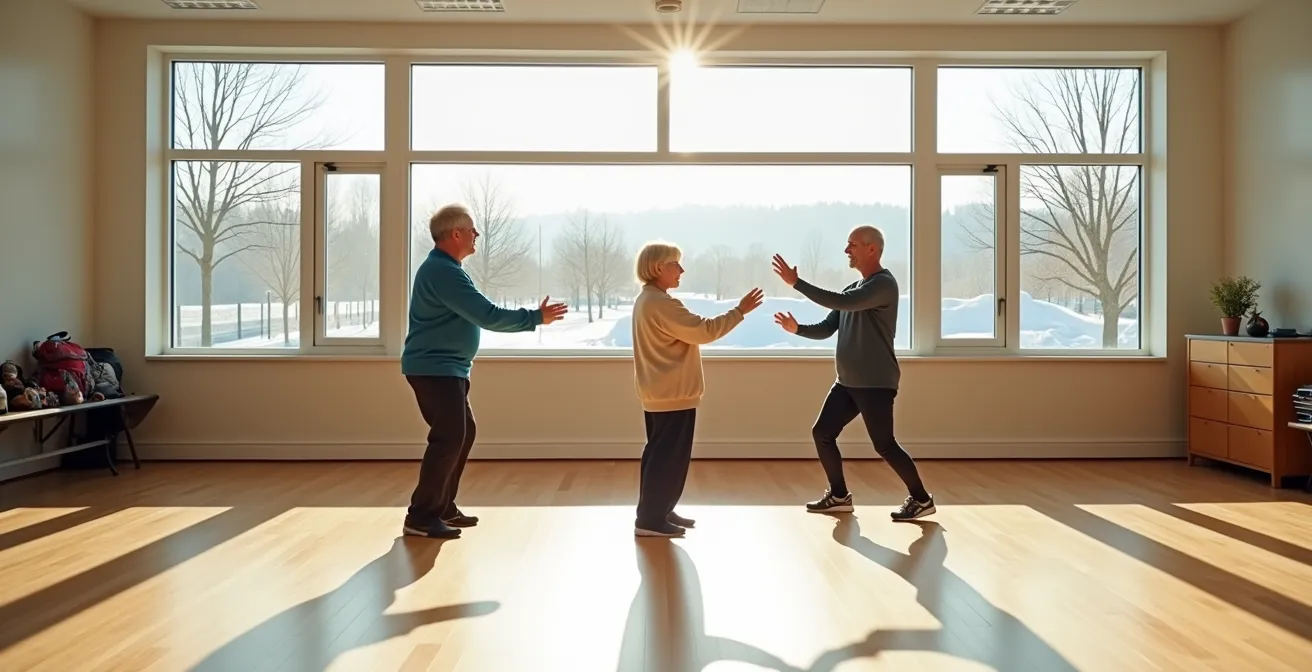
For adults over 60, a well-structured weekly schedule typically includes two to three non-consecutive days of full-body resistance training. This frequency provides the optimal balance of stimulus and recovery. The days in between are not for complete inactivity; they are for “active recovery.” This involves gentle movement that promotes blood flow, reduces muscle soreness, and supports overall health without stressing the system. Activities like walking in a local park, gentle stretching, or practicing Tai Chi at a community centre are perfect examples.
This image of seniors practicing Tai Chi in a sunlit Canadian community centre embodies the concept of active recovery—gentle, mindful movement that complements the intensity of strength training days.
A balanced weekly schedule might look like this, integrating strength, recovery, and other essential fitness components:
- Monday: Full-body resistance training (45-60 minutes), focusing on major muscle groups (squats, hinges, pushes, pulls).
- Tuesday: Active recovery – a brisk walk, swimming, or a gentle yoga class.
- Wednesday: Rest or another active recovery session.
- Thursday: Full-body resistance training, perhaps using slightly different exercises or rep ranges than Monday.
- Friday: Balance and mobility work. This could be a dedicated class or 15-20 minutes of specific drills at home.
- Weekend: One day of complete rest and one day for a recreational activity you enjoy, like gardening, dancing, or cross-country skiing in the winter.
Why Are Squatting, Hinging, and Carrying Essential for Independence?
The exercises you perform in the gym should not exist in a vacuum. Their ultimate purpose is to make your life outside the gym easier, safer, and more enjoyable. The fundamental human movements—squatting, hinging, and carrying—are the building blocks of functional independence. A squat is not just an exercise; it’s the ability to get up from a low chair or the toilet without assistance. A hinge is not just a deadlift; it’s the strength to pick up a bag of soil in the garden without throwing out your back. A loaded carry, like a farmer’s walk, is the capacity to bring all your groceries in from the car in one trip.
When we lose the strength to perform these movements, we begin to lose our independence. We start avoiding activities, our world shrinks, and the risk of a debilitating fall increases. The Public Health Agency of Canada notes that when bones are weakened by osteoporosis, even simple movements like bending over or minor falls from standing height can lead to devastating fractures, most commonly at the wrist, shoulder, spine, and hip. Building strength in these foundational patterns is a direct investment in your autonomy and quality of life.
Each time you perform a properly executed squat or deadlift, you are reinforcing the exact motor patterns and strengthening the precise muscles and bones needed for daily living. This “functional training” is what bridges the gap between exercising and living a full, capable life. The strength you build becomes a robust shield, protecting you from injury and ensuring you can continue to do the things you love. The statistics are a stark reminder of what’s at stake; according to Osteoporosis Canada, at least 1 in 3 women and 1 in 5 men with osteoporosis will suffer a fracture in their lifetime.
Why Is the “Sunshine Vitamin” Your First Defense Against Autoimmunity?
While mechanical stress is the architect of stronger bones, Vitamin D is the essential building material. You can perform the most perfect strength training program in the world, but without sufficient Vitamin D, your body simply cannot absorb the calcium it needs to build new bone. This makes Vitamin D a non-negotiable partner in your fight against osteopenia. Often called the “sunshine vitamin” because our skin produces it in response to sunlight, it functions more like a hormone, playing a critical role in bone metabolism and immune function.
For Canadians, this presents a unique challenge. Our northern latitude and long winters mean that from about October to April, the sun’s UVB rays are too weak for our bodies to produce any Vitamin D. This leads to widespread deficiency. In fact, Statistics Canada data reveals that during winter, 13% of Canadians have Vitamin D levels considered deficient for bone health, compared to just 5% in the summer. Some experts believe the situation is even more concerning.
According to the latest Statistics Canada report, in winter about 40% of Canadians were below the appropriate cut-off of vitamin D levels needed for healthy bones (50 nmol/L).
– Dr. John White, McGill University Department of Physiology
Given that it is nearly impossible to get enough Vitamin D from food alone, and sun exposure is insufficient for half the year, supplementation is essential for most Canadians. Following Health Canada’s guidelines is a critical step in ensuring your body has the raw materials it needs to benefit from your exercise efforts.
Your Action Plan for Optimal Vitamin D Levels
- Know Your Dose: Health Canada recommends a daily supplement of 400 IU for adults under 50, but adults over 50 should aim for a routine supplement of 400 IU. Many health organizations recommend higher doses, often between 800-2000 IU daily, especially during winter months.
- Get Tested: Ask your doctor for a blood test (25-hydroxy vitamin D) to determine your specific levels and get a personalized dosage recommendation.
- Consume Fortified Foods: In Canada, cow’s milk and margarine are mandatorily fortified with Vitamin D. Include these in your diet.
- Eat Fatty Fish: Incorporate fatty fish like salmon, trout, and sardines into your meals at least twice a week for a natural source of Vitamin D.
- Take with Fat: Vitamin D is a fat-soluble vitamin. Take your supplement with a meal that contains healthy fats (like avocado, nuts, or olive oil) to maximize absorption.
Key Takeaways
- Challenge is Necessary: Bone density does not improve without significant mechanical stress that exceeds daily activities. Light exercise is not enough to reverse osteopenia.
- Progression is Safety: The key to lifting heavy enough to build bone is a gradual, methodical progression that prioritizes perfect form before increasing weight.
- Muscle is Your Armor: Building and maintaining muscle mass is not just about strength; it provides a protective cushion for your bones and is directly linked to independence and a lower risk of falls.
Why is Muscle Mass Your Best Insurance Against Aging?
As we age, we face two parallel challenges: the loss of bone density (osteopenia/osteoporosis) and the loss of muscle mass, a condition known as sarcopenia. These two are intrinsically linked. Strong muscles are attached to bones via tendons. When a strong muscle contracts powerfully, it pulls on the bone, creating the very mechanical stress needed to stimulate bone growth. A weak muscle can only produce a weak pull, resulting in a feeble signal. Therefore, building muscle is a direct prerequisite for building bone.
Beyond this direct mechanical link, muscle mass acts as your body’s “metabolic armor” and physical shock absorber. It is your best insurance policy against the insults of aging. More muscle mass improves insulin sensitivity, boosts metabolism, and provides a reservoir of protein that your body can draw upon during times of illness or injury. Physically, muscles act as a protective padding around your skeleton. In the event of a fall, a well-muscled leg can absorb a significant amount of impact, potentially preventing a hip fracture. The link between muscle strength and health outcomes is undeniable; a Statistics Canada Health Report concluded that people with reduced muscular strength had significantly higher odds of impaired mobility, disability, and falls.
The Role of Protein in Preserving Muscle
To build and maintain this muscular insurance, resistance training must be paired with adequate protein intake. As we age, our bodies become less efficient at using the protein we eat, a phenomenon called “anabolic resistance.” This means we need more protein than our younger counterparts to stimulate muscle protein synthesis. A systematic review published in the Canadian Medical Association Journal confirmed that for community-dwelling older adults, protein supplementation provided significant benefits in preserving lean body mass and strength, acting as a critical defense against age-related decline.
Thinking of your strength training not just as a treatment for osteopenia, but as a strategy for building and preserving your life’s greatest asset—your muscle mass—is the ultimate reframe. It’s not about vanity; it’s about functionality, resilience, and a profound investment in your future self.
Your journey to stronger bones starts not with a leap, but with a single, controlled lift. The power to reverse osteopenia is within your grasp, unlocked by a commitment to safe, progressive strength training. Begin today by consulting a qualified kinesiologist or a physiotherapist with experience in geriatric health to help you create a personalized and safe plan.