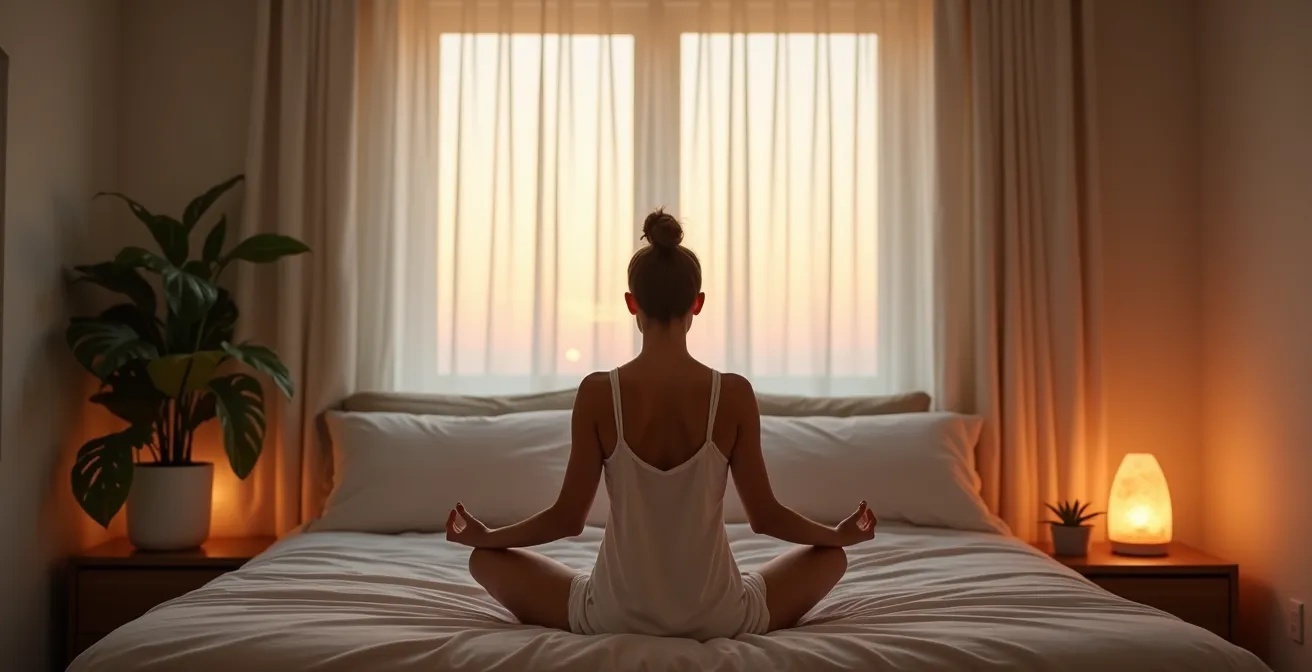
The key to overcoming that ‘wired but tired’ feeling isn’t trying harder to relax; it’s about understanding and actively down-regulating your body’s ancient survival system.
- Modern stressors like emails trigger the same ‘fight or flight’ response as a physical threat, flooding your body with cortisol.
- Specific breathing techniques, like the Physiological Sigh, can instantly shift you from a state of high alert (sympathetic) to ‘rest and digest’ (parasympathetic).
- Common aids like alcohol and even melatonin can backfire, disrupting sleep architecture and worsening the problem long-term.
Recommendation: Create a non-negotiable 60-minute ‘Digital Sunset’ before bed to allow your cortisol levels to naturally decline, signaling to your body that it is safe to sleep.
That familiar feeling of being ‘wired but tired’ is a modern paradox. Your body is exhausted, yet your mind is racing, replaying conversations, and scrolling through tomorrow’s to-do list. You know you should be sleeping, but a primal, buzzing energy keeps you alert. This isn’t a failure of willpower; it’s a physiological mismatch. Your nervous system is stuck in ‘on’ mode, operating with a survival program designed for a world that no longer exists.
Most advice centres on generic tips like ‘avoid stress’ or ‘drink chamomile tea’. While well-intentioned, these suggestions often fail because they don’t address the root cause: an overactive sympathetic nervous system. This is the ‘fight or flight’ mechanism that, while brilliant at helping our ancestors escape predators, is now being constantly triggered by digital notifications, work pressures, and the relentless pace of modern life. In Canada, the issue is so prevalent that policies around the ‘right to disconnect’ are becoming part of the conversation, acknowledging that our brains haven’t evolved to log off when we close our laptops.
But what if the solution wasn’t just to manage the external triggers, but to learn the manual override for your own internal system? The true key to deep, restorative sleep lies in understanding the physiological levers that shift your body from a state of high alert to one of profound calm. It’s about speaking your body’s language through specific, targeted actions that signal safety and initiate recovery.
This guide will move beyond the platitudes and provide you with a practical toolkit based on neuroscience. We will explore the precise mechanisms behind why your body stays on high alert and, more importantly, the actionable techniques you can use tonight to consciously switch into ‘rest and digest’ mode for the recovery you desperately need.
In the following sections, we will delve into the science-backed methods that allow you to take control of your nervous system. From specific breathing patterns to understanding the true impact of common nightcaps, you’ll gain the knowledge to finally quiet the internal alarm and welcome restorative rest.
Summary: Your Guide to Calming the Sympathetic Nervous System for Sleep
- Why Does Your Body Think Your Email Inbox Is a Sabertooth Tiger?
- How to Use the Double-Inhale Breathing Technique to Calm Down Instantly?
- Heavy Blanket or Muscle Relaxation: Which Hack Forces Your Body to Chill?
- The “Nightcap” Trap: Why Alcohol Keeps Your Sympathetic System On
- When to Turn Off Screens: The 60-Minute Buffer Your Nervous System Needs?
- The Breathing Mistake That Keeps Your Fight-or-Flight Mode Active
- Wine or Weed: Which Substance Destroys Your REM Cycle More?
- Why Taking Melatonin Pills Might Be Worsening Your Insomnia Long-Term?
Why Does Your Body Think Your Email Inbox Is a Sabertooth Tiger?
Your nervous system has two primary modes: the sympathetic (‘fight or flight’) and the parasympathetic (‘rest and digest’). The sympathetic system is a masterpiece of evolutionary engineering, designed to save your life from immediate physical danger. When it activates, your heart rate increases, your breathing quickens, and stress hormones like adrenaline and cortisol flood your system to prepare you for action. This was incredibly useful when facing a predator, but your body can’t differentiate between a real-life threat and a stressful work email landing in your inbox at 9 p.m.
This is the crux of the ‘wired but tired’ problem. Your conscious mind knows you’re safe in bed, but the constant barrage of digital pings, social media updates, and work demands keeps your ancient survival circuits firing. Your body interprets this chronic, low-grade stress as a persistent threat, preventing the shift into the parasympathetic state required for deep sleep and cellular repair. It’s a state of autonomic arousal that is incompatible with rest.
This isn’t just a feeling; it’s a documented phenomenon. A Canadian study from McGill University highlighted this modern struggle, finding that 71% of workers surveyed have worked outside their scheduled hours, leading to significant rates of physical fatigue, stress, and mental exhaustion. In response, provinces like Ontario have introduced ‘right to disconnect’ policies for companies with 25 or more employees, a legislative admission that the digital ‘sabertooth tiger’ is a real threat to our well-being. Without a clear boundary, our nervous system remains on high alert, creating a cycle of poor sleep and daytime fatigue.
The solution, therefore, is not to eliminate all stress—an impossible task—but to learn how to manually and intentionally signal to your body that the threat is over and it’s safe to power down. The following sections provide the tools to do just that.
How to Use the Double-Inhale Breathing Technique to Calm Down Instantly?
While “take a deep breath” is common advice, it’s often too vague to be effective. The key to using your breath to control your nervous system lies in a specific, science-backed pattern known as the Physiological Sigh. This is not just another breathing exercise; it’s your body’s built-in, fastest-acting tool for rapidly reducing stress and anxiety. It works by manipulating the balance of oxygen and carbon dioxide in your lungs and bloodstream, directly telling your brain to switch from ‘fight or flight’ to ‘rest and digest’.
The magic happens in your lungs’ tiny air sacs, called alveoli. When you’re stressed, these sacs can collapse, reducing your lungs’ ability to efficiently exchange gases. A normal deep breath isn’t always enough to reinflate them. The Physiological Sigh uses a unique double inhale to maximally inflate the lungs, popping those alveoli back open. This is followed by a long, full exhale, which offloads the maximum amount of carbon dioxide and activates the vagus nerve—the primary pathway of your parasympathetic nervous system.

As neuroscientist Dr. Andrew Huberman explains, this simple action provides a powerful and immediate sense of calm. He highlights its effectiveness in a widely shared insight:
The physiological sigh: two deep inhales through the nose (no exhale in between), followed by a full exhale to lungs empty (through the mouth) is the fastest way to reduce autonomic arousal — aka ‘calm down’
– Andrew D. Huberman, Ph.D., Twitter/X post
To perform this technique, you simply take a deep inhale through your nose, and then, without exhaling, sneak in a second, smaller inhale to fully expand your lungs. Then, you release all the air with a long, slow exhale through your mouth. Just one to three repetitions can produce a noticeable shift in your state, making it an incredibly potent tool to use right when you get into bed or if you wake up with a racing mind in the middle of thenight. A consistent practice of just a few minutes a day can help lower your baseline stress levels over time.
By consciously using this physiological tool, you are no longer a passive victim of your stress response. You are actively taking the controls and guiding your body back to a state of equilibrium and rest.
Heavy Blanket or Muscle Relaxation: Which Hack Forces Your Body to Chill?
Beyond breathing, you can use physical sensations to signal safety to your nervous system. Two popular and effective somatic (body-based) methods are using a weighted blanket and practicing Progressive Muscle Relaxation (PMR). While both aim to reduce anxiety and physical tension, they work through different mechanisms and may be better suited for different needs. Understanding how they function allows you to choose the right tool for the job.
A weighted blanket works through a mechanism called Deep Pressure Stimulation (DPS). The gentle, constant pressure across your body is thought to mimic the feeling of being held or swaddled. This sensation stimulates the release of calming neurotransmitters like serotonin and dopamine while reducing the stress hormone cortisol. It’s a passive approach; you simply lie under the blanket and let its weight do the work. This makes it an excellent choice for those who want a comforting, low-effort tool, especially during cold Canadian winters.
Progressive Muscle Relaxation (PMR), on the other hand, is an active technique. It involves systematically tensing a specific muscle group, holding the tension for a few seconds, and then releasing it completely. You work your way through the body, from your toes to your face. This process does two things: first, it forces you to become aware of the difference between tension and relaxation, improving your interoception (the sense of your body’s internal state). Second, it physically exhausts the muscles, making it harder for them to hold onto the subconscious tension associated with a ‘fight or flight’ state. It’s a skill that you build over time, empowering you to release tension on command.
The following table, drawing on insights from sleep experts, breaks down the key differences between these methods to help you decide which might be best for you, based on analyses of various relaxation exercises.
| Method | Mechanism | Best For | Time Investment |
|---|---|---|---|
| Weighted Blanket | Deep Pressure Stimulation (DPS) – boosts serotonin & dopamine | Passive relaxation, Canadian winter comfort | All night (8+ hours) |
| Progressive Muscle Relaxation | Improves interoception & reduces hypervigilance | Active skill-building, body awareness | 10-20 minutes before bed |
| Neurogenic Tremoring | Natural discharge of stored traumatic stress | Active stress release, somatic healing | 5-15 minutes |
Ultimately, both methods are powerful ways to ground yourself in your body and send a clear message to your nervous system that it’s time to relax. You can even combine them, performing PMR while under a weighted blanket for a compounded calming effect.
The “Nightcap” Trap: Why Alcohol Keeps Your Sympathetic System On
It’s a common ritual: a glass of wine or a beer to “take the edge off” before bed. Alcohol is a sedative, and it can indeed make you feel drowsy and help you fall asleep faster. However, this initial benefit is a trap. While you sleep, your body works to metabolize the alcohol, and this process actively disrupts your sleep architecture and triggers your sympathetic nervous system, leaving you wide awake in the middle of the night.
The primary culprit is an effect known as the glutamine rebound. Glutamine is a natural stimulant in your brain. While you’re drinking, alcohol suppresses its production, contributing to that initial sleepy feeling. However, your brain, sensing this suppression, compensates by producing more glutamine than usual. Several hours later, as the alcohol wears off, the brain is flooded with this excess stimulant. This rebound effect is what abruptly pulls you out of deep, restorative sleep and into lighter, more anxious stages of sleep, often around 2 or 3 a.m.

Your mind starts racing, your heart may beat faster, and you’re left wondering why you’re so alert. This is your sympathetic nervous system kicking back into gear. As one analysis on sleep disruption explains, this rebound is a significant saboteur of rest. The glutamine rebound effect essentially stimulates your brain and pulls you out of deep sleep into lighter, less restful stages. This not only fragments your sleep but also prevents the crucial physical and mental recovery that is supposed to happen overnight.
So, while the nightcap might feel like a solution to your pre-sleep anxiety, it’s actually pouring fuel on the fire. It creates a vicious cycle: you feel tired and anxious from poor sleep, so you have a drink to relax, which in turn leads to another night of fragmented, unrefreshing sleep. This pattern ensures your ‘fight or flight’ system remains chronically activated.
A far better strategy is to replace the alcoholic nightcap with a ritual that genuinely supports the parasympathetic nervous system, such as a warm cup of herbal tea (like chamomile or valerian root) or a few minutes of the breathing exercises discussed earlier. These alternatives signal calm to your body without the disruptive rebound effect.
When to Turn Off Screens: The 60-Minute Buffer Your Nervous System Needs?
The advice to “avoid screens before bed” is everywhere, but it often lacks a clear, actionable timeframe. The reason this buffer is so critical comes down to the stress hormone cortisol. Exposure to stimulating content—from a suspenseful show to a work email—is a stressful event for your nervous system. In response, your body releases cortisol, the primary ‘fight or flight’ hormone that makes you feel alert and awake. This is the exact opposite of what your body needs to be doing before sleep.
Research into the body’s stress response shows that it’s not an instant-off switch. Even after the stressor is removed, the hormone remains in your system. Sleep research indicates that it can take 60 to 90 minutes for cortisol levels to significantly decrease after a stressful event. This means if you’re watching an intense TV show or checking your email right up until you turn out the lights, you’re getting into bed with a body that is still biochemically primed for action, not rest. You are effectively bringing the sabertooth tiger into the bedroom with you.
Creating a “digital sunset”—a non-negotiable period of screen-free time before bed—is therefore not just about avoiding blue light. It’s about giving your body the time it needs to clear out the cortisol and allow the parasympathetic nervous system to take over. This 60-to-90-minute window is a physiological necessity for anyone struggling with a ‘wired but tired’ feeling. It’s a concrete way to signal to your body that the “day” and its associated threats are over, and it is now safe to power down.
Your Digital Sunset Audit: A 5-Step Plan
- Identify Touchpoints: List every screen you interact with in the 90 minutes before bed (phone, TV, laptop, tablet, e-reader).
- Collect Data: For one night, track your actual screen usage. Note what you were doing (scrolling social media, watching news, answering emails).
- Check for Coherence: Compare your evening screen activities to your goal of relaxation. Is watching a political debate or checking work notifications aligned with calming your nervous system?
- Assess Emotional Impact: After each screen activity, rate your mental state. Does it feel activating and stressful (generic) or calming and disconnecting (unique)?
- Create an Integration Plan: Based on your audit, create a new rule. Start by designating the bedroom a “phone-free zone” and replace the last 30 minutes of screen time with a pre-planned non-screen activity (e.g., reading a physical book, light stretching, journaling).
By treating this time as a sacred, non-negotiable part of your sleep hygiene, you give your nervous system the predictable runway it needs to prepare for a night of deep, restorative rest.
The Breathing Mistake That Keeps Your Fight-or-Flight Mode Active
We’ve discussed how to use breathing to calm down, but it’s equally important to understand how you might be breathing in a way that *keeps* you stressed. Many people who feel chronically anxious or ‘on edge’ are, without realizing it, in a state of low-grade, chronic hyperventilation. This often manifests as subtle, shallow chest breathing or habitual mouth breathing, and it directly disrupts the delicate chemistry that governs your sense of calm.
The key player here is carbon dioxide (CO2). Contrary to popular belief, CO2 isn’t just a waste product. Your body needs to maintain a specific level of CO2 in the blood to function properly. It plays a crucial role in regulating your blood pH and, most importantly, in enabling the release of oxygen from your red blood cells into your tissues and brain. When you over-breathe (breathe too rapidly or too deeply, often through the mouth), you “blow off” too much CO2. This imbalance can trigger feelings of anxiety, dizziness, and even panic. Your body interprets this chemical imbalance as a sign of danger, activating the sympathetic nervous system.
This is a subtle but powerful feedback loop. You feel stressed, so you start to breathe faster. This rapid breathing disrupts your CO2 balance, which in turn makes you feel more anxious, leading to even more dysfunctional breathing. Research shows that this disrupted balance of CO2 and oxygen directly impacts your emotions. You are, in effect, breathing yourself into a state of ‘fight or flight’. The solution is to retrain your breathing patterns to be lighter, slower, and exclusively through your nose.
- Practice nasal breathing: Your nose is designed to filter, warm, and humidify air, but it also provides more resistance than your mouth, naturally slowing your breathing and helping to maintain proper CO2 levels.
- Slow your respiratory rate: The ideal for relaxation is around 6 breaths per minute. You can practice this by inhaling for a count of 4 and exhaling for a count of 6.
- Emphasize light, silent breathing: Healthy breathing at rest should be effortless and almost unnoticeable. Big, forceful breaths are a sign of over-breathing.
By making a conscious effort to switch to slow, light, nasal breathing, especially when you feel stress rising, you can break the cycle of hyperventilation and guide your nervous system back towards a state of balance and calm.
Wine or Weed: Which Substance Destroys Your REM Cycle More?
In the search for a pre-sleep relaxation aid, many people turn to either alcohol or cannabis (specifically THC). Both are widely perceived as aids for winding down, but when it comes to sleep quality, they are both significant disruptors. They may help you fall asleep, but they sabotage the critical restorative stages of sleep that happen overnight, each in its own unique way.
As we’ve discussed, alcohol‘s primary disruption occurs in the second half of the night. The ‘glutamine rebound’ effect leads to frequent awakenings and a surge in sympathetic nervous system activity, pulling you out of deep sleep. It fragments your sleep, preventing you from cycling through the stages naturally and leaving you feeling groggy and unrested the next day, even if you technically slept for 7 or 8 hours.
THC, the main psychoactive component in cannabis, has a different but equally damaging effect. Its primary target is REM (Rapid Eye Movement) sleep. REM sleep is the stage most associated with dreaming, emotional processing, and memory consolidation. It’s when your brain works through the day’s events, files away important information, and processes difficult emotions. Regular THC use has been consistently shown to significantly shorten or even suppress the REM stage of sleep. This is why many regular cannabis users report that they don’t dream as much; their brains simply aren’t entering that critical stage for as long.
The scientific consensus is clear that while they feel different, both substances are detrimental to healthy sleep architecture. As a synthesis of multiple sleep studies concludes, they attack sleep from different angles.
Both substances damage sleep quality in fundamentally different ways – alcohol through glutamine rebound causing 3am awakenings, while THC directly shortens REM stages needed for emotional processing
– Sleep research consensus, Multiple sleep studies synthesis
While the occasional use of either might not have a lasting impact, relying on them as regular sleep aids is a surefire way to compromise your mental and physical recovery. The long-term cost to your sleep quality far outweighs the short-term benefit of feeling sleepy.
Key Takeaways
- Your ‘wired but tired’ feeling is a physiological state caused by a chronically activated ‘fight or flight’ system, not a personal failing.
- Specific, science-backed breathing patterns like the Physiological Sigh are the fastest way to manually switch your nervous system to ‘rest and digest’ mode.
- Common sleep aids like alcohol, THC, and even melatonin often disrupt natural sleep cycles, worsening the problem they are meant to solve.
Why Taking Melatonin Pills Might Be Worsening Your Insomnia Long-Term?
When sleep feels elusive, reaching for a melatonin supplement seems like a logical step. It’s marketed as a natural sleep aid, and it’s readily available over-the-counter. However, there’s a profound misunderstanding about what melatonin is and how it works, and this confusion can lead to misuse that actually worsens sleep problems over time.
Melatonin is not a sedative or a hypnotic—it’s not a sleeping pill that forces your brain to shut down. It is a chronobiotic. Its job is to tell your body *when* it’s time to sleep by signaling that it’s dark outside. It’s the “starter pistol” for sleep, not the entire race. Your brain’s pineal gland naturally produces melatonin in response to darkness, which sets off a cascade of processes that prepare you for rest. Taking a melatonin supplement at the wrong time or in the wrong dose can disrupt this delicate natural rhythm.
One of the biggest risks is desensitizing your body’s melatonin receptors. If you consistently flood your system with high doses of external melatonin, your brain’s receptors can become less responsive to it, including the melatonin your own body produces. This means you may need higher and higher doses to get any effect, and you might struggle even more to fall asleep without it. Furthermore, in Canada, melatonin is regulated as a Natural Health Product, which means oversight is less stringent than for pharmaceuticals. Studies have shown that the actual dosage in pills can vary wildly from what’s stated on the label, making consistent, appropriate dosing a challenge.
Instead of relying on a pill, the most effective long-term strategy is to support your body’s own endogenous melatonin production. This involves simple but powerful lifestyle adjustments that reinforce your natural circadian rhythm. A robust protocol involves managing your light exposure throughout the day.
- Morning Light: Get at least 10 minutes of natural light within an hour of waking. Even on a cloudy Canadian winter morning, this signals your brain to shut off melatonin production and set your internal clock for the day.
- Evening Dimming: Start dimming all indoor lights about 2 hours before bed. This signals to your pineal gland that darkness is coming, initiating the natural release of melatonin.
- Complete Darkness for Sleep: Use blackout curtains or an eye mask to ensure your sleep environment is as dark as possible, which allows melatonin levels to stay elevated throughout the night.
By working with your body’s natural chronobiology instead of trying to override it with supplements, you can build a more resilient and sustainable foundation for consistently restful sleep.
Frequently Asked Questions on Relaxation and Sleep
How heavy should a weighted blanket be for optimal results?
Sleep experts recommend choosing a weighted blanket that’s approximately 10% of your body weight for the best Deep Pressure Stimulation effects without feeling too restrictive.
Can I combine these techniques for better results?
Yes, many people find success using Progressive Muscle Relaxation while under a weighted blanket, as the combination addresses both physical tension and sensory needs.
Where can Canadians purchase quality weighted blankets?
Major Canadian retailers like Sleep Country Canada, Hudson’s Bay, and Costco carry weighted blankets suitable for cold winter nights.
What’s the difference between a chronobiotic and a hypnotic?
A chronobiotic like melatonin tells your body WHEN to sleep (darkness signal), while a hypnotic forces you to sleep (sedative). Taking melatonin at wrong times or high doses can desensitize receptors.
How is melatonin regulated in Canada?
Melatonin is sold as a Natural Health Product in Canada with less stringent oversight than pharmaceuticals, and actual dosages often vary wildly from label claims.
What’s the alternative to melatonin supplements?
Boost endogenous melatonin naturally: Get morning light within an hour of waking (even 10 minutes on cloudy days works), dim lights 2 hours before bed, and avoid late meals.