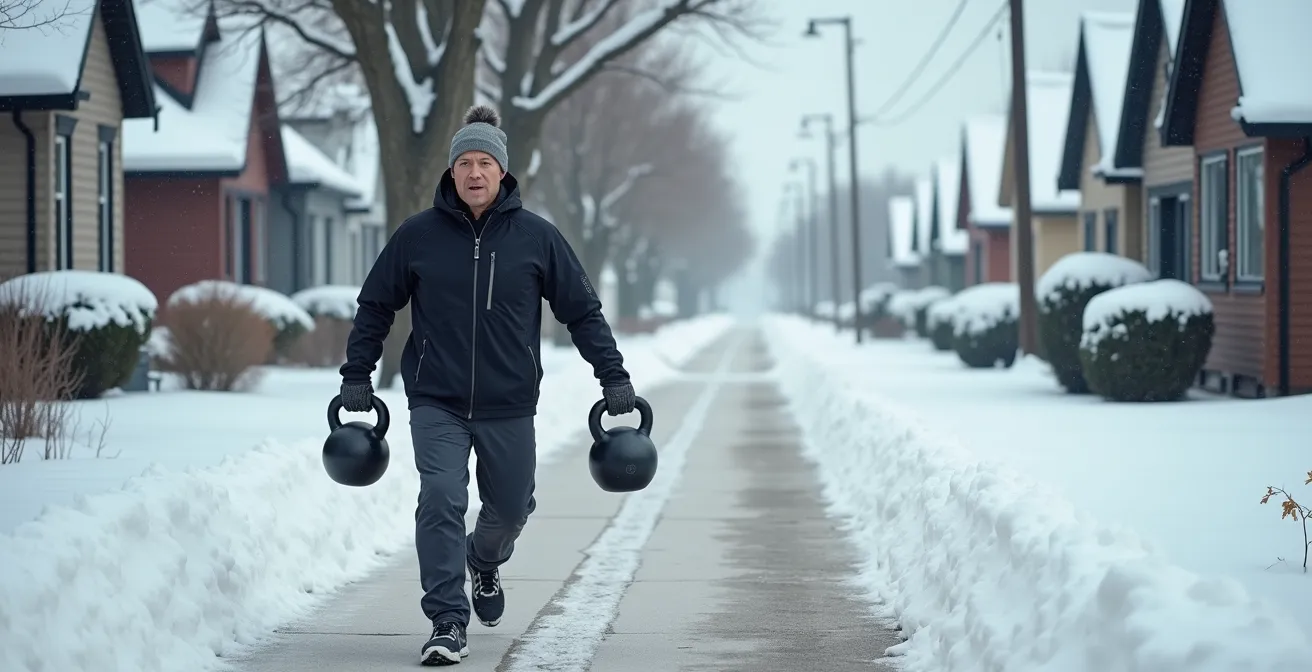
True fitness isn’t measured by bicep size, but by your ability to navigate a slippery Canadian winter without injury.
- Isolation exercises like curls fail to prepare you for real-world lifting; the body works as a system, not in parts.
- Compound movements like goblet squats and loaded carries build practical, full-body strength for tasks like lifting boxes or carrying hockey bags.
- Activities like Nordic walking offer a superior, joint-friendly workout that builds stability for all four Canadian seasons.
Recommendation: Focus on mastering fundamental movement patterns (squatting, hinging, carrying) to build a body that’s resilient and capable for life, not just for show.
The gym is filled with people chasing an aesthetic. They’re focused on building “mirror muscles”—sculpted biceps, defined abs, and peaked shoulders. The routine is predictable: isolation curls, bench presses, and leg extension machines. Yet, when faced with a real-world challenge, like hoisting a heavy suitcase into an overhead bin or carrying two large bags of groceries across an icy Canadian parking lot, that gym-honed physique often fails. The strength is cosmetic, not functional. This disconnect is the core flaw in a fitness approach that prioritizes looks over capability.
The common advice is to simply “lift with your legs” or do a few compound lifts. But this misses the point. The real key isn’t just about doing a squat; it’s about understanding *why* that squat matters when you need to get up after a fall on the ice, or why a farmer’s walk is more valuable for your long-term independence than hours of bicep curls. The goal is to train movement patterns, not just muscles. It’s about building a body that can handle the unpredictable, demanding, and often unglamorous tasks of daily life—from shoveling a snow-clogged driveway to playing with your kids without throwing out your back.
But what if the solution was to stop training for the beach and start training for a lifetime of Canadian winters? This guide shifts the focus from aesthetics to ability. We will deconstruct the essential movements your body needs for long-term independence and explore how to build real-world strength that serves you well beyond the gym walls. We’ll dismantle the myth of isolation exercises and show you how to train your body as the integrated system it is. This is about building a resilient, capable body that can tackle anything life—and a Canadian climate—throws at it.
This article breaks down the principles of functional fitness, showing you how to apply them to everyday challenges. The following sections will guide you through the core movements, common training mistakes, and effective strategies to build strength for life.
Summary: A Guide to Real-World Movement for Life
- Why Are Squatting, Hinging, and Carrying Essential for Independence?
- How to Walk with Heavy Weights to Fix Your Posture and Grip?
- Leg Press or Goblet Squat: Which Prepares You for Picking Up a Box?
- The Isolation Mistake: Why Bicep Curls Won’t Help You Lift Your Suitcase?
- When to Mobilize: The “Grease the Groove” Method for Daily Flexibility?
- Why Does Using Poles Burn 20% More Calories Than Regular Walking?
- Sarcopenia or Aging: When Does Muscle Loss Become a Medical Issue?
- Why Is Nordic Walking More Effective Than Running for Knee Health?
Why Are Squatting, Hinging, and Carrying Essential for Independence?
Long-term independence isn’t secured by a stock portfolio; it’s secured by your physical ability to navigate the world unassisted. Three primal movement patterns form the bedrock of this ability: the squat (lowering your centre of gravity), the hinge (bending at the hips with a flat back), and the carry (moving a load). These aren’t “exercises” so much as fundamental human actions. You squat to pick up a grandchild, hinge to lift a bag of soil for the garden, and carry groceries into the house. Neglecting them is a direct path toward frailty and reliance on others.
In Canada, the stakes are even higher. A simple slip on an icy sidewalk can be catastrophic for those who lack the strength to get back up. In fact, a staggering 20-30% of Canadian seniors fall each year, making fall-proofing your body a non-negotiable part of aging well. A strong squat provides the power to stand up from the ground, a proficient hinge protects your spine when lifting a salt bag, and a robust carrying capacity ensures you can manage your own belongings safely. These movements are the antidote to dependency.
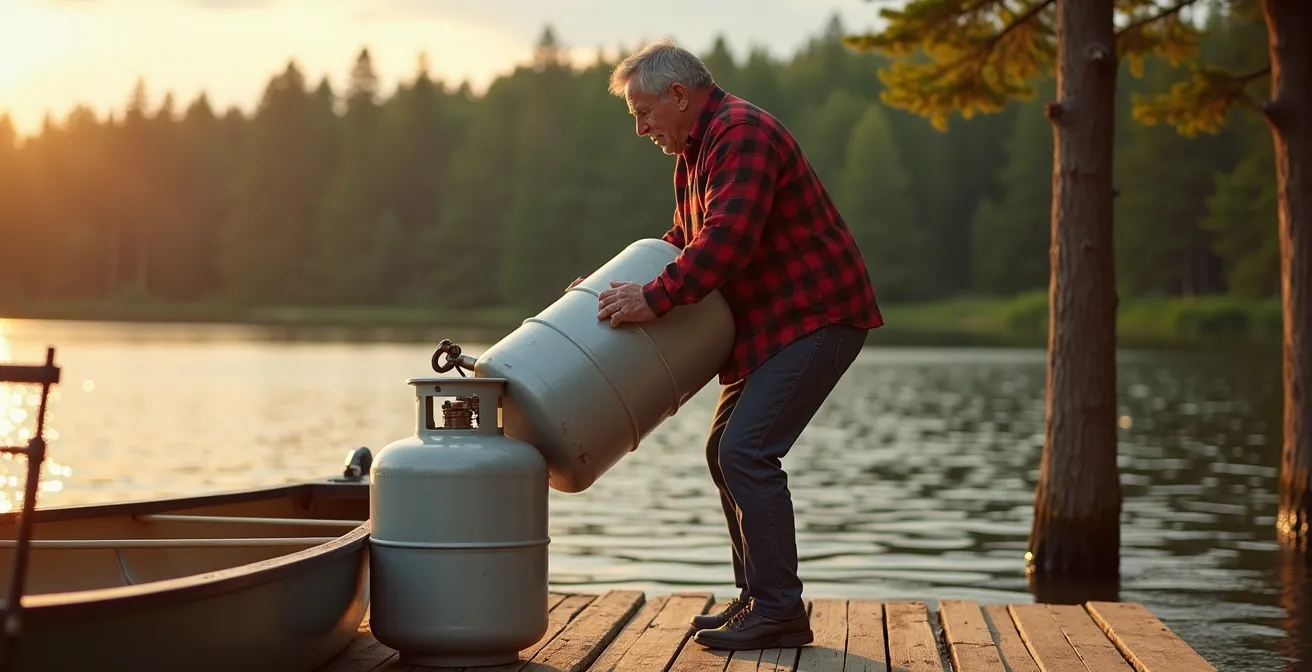
Look at this image. This is not a gym pose. This is a real-life task at a Canadian cottage—lifting a heavy, awkward object. The hip hinge demonstrated here protects the spine, engages the glutes and hamstrings, and uses the entire body as an integrated system. This single movement is more valuable for real-world strength than countless hours on isolated machines. Training these patterns is a direct investment in your ability to remain self-sufficient, capable, and safe for decades to come.
Your action plan: Essential Movement Patterns for Canadian Winter Independence
- Practice deep bodyweight squats daily to prepare your legs and hips for getting up from an icy fall.
- Perform hip hinge exercises (like kettlebell deadlifts) to safely lift snow shovels and heavy salt bags without straining your back.
- Train loaded carries by walking with heavy grocery bags or dumbbells to build the stability needed to navigate slippery parking lots.
- Strengthen your single-leg stability with exercises like lunges to confidently step over high snowbanks or curbs.
- Build rotational strength with medicine ball throws or cable rotations to generate power for shoveling and other winter yard work.
Ultimately, these are not just exercises to check off a list. They are the physical skills that determine your quality of life as you age, especially in a country with demanding seasons.
How to Walk with Heavy Weights to Fix Your Posture and Grip?
One of the most under-appreciated yet highly functional exercises is the loaded carry, also known as the “farmer’s walk.” The concept is brutally simple: pick up heavy things and walk with them. This single action is a powerful remedy for two common side effects of modern life: poor posture and weak grip strength. When you carry a heavy load, your body is forced to self-correct. Your core fires to stabilize your spine, your shoulders retract to support the weight, and your hands grip with maximum force. It’s a full-body lesson in tension and alignment.
Think about the real-world applications in Canada. You’re carrying two hockey bags from the car to the arena, or hauling bags of soil to the garden in the spring. These tasks require not just strength, but the ability to maintain posture and balance under load. As a case study from The Club at Prairie Stone highlights, members who practice farmer’s walks show a significantly improved ability to carry multiple bags from parking lots to their homes, a benefit that is especially crucial during harsh winter conditions when balance is precarious and you’re encumbered by a bulky coat. The grip strength gained is not just for show; it’s what prevents you from dropping a bag on an icy patch.
To get started, you don’t need fancy equipment. Two heavy kettlebells, dumbbells, or even full grocery bags will work. The key is to walk with a tall spine, shoulders pulled back and down, and a braced core. Different variations of the carry target different weaknesses.
The following table breaks down how different types of carries translate directly to common Canadian activities, building strength exactly where you need it.
| Exercise | Canadian Application | Key Benefits |
|---|---|---|
| Farmer’s Walk (two weights) | Carrying hockey bags to the arena | Grip strength, core stability |
| Suitcase Carry (one weight) | Single-arm grocery carry from car | Anti-lateral flexion, balance |
| Overhead Carry (one or two weights) | Loading items into a truck bed | Shoulder stability, posture |
This isn’t about building a physique; it’s about building a body that doesn’t fail you when you need to move a heavy object from point A to point B safely and efficiently.
Leg Press or Goblet Squat: Which Prepares You for Picking Up a Box?
Here lies a central conflict in fitness philosophy: the machine versus free weight. Consider the task of picking up a heavy box of books or a case of water. Your body must stabilize itself, coordinate multiple muscle groups, and manage an awkward, unstable load. Now, which exercise better prepares you for this: the leg press or the goblet squat? The leg press allows you to move tremendous weight, but it does so by isolating the leg muscles while your back is fully supported. It trains strength in a vacuum, removing the critical elements of balance and core stabilization.
The goblet squat, on the other hand, is a masterclass in functional strength. Holding a single dumbbell or kettlebell against your chest, you are forced to engage your entire core to prevent your torso from collapsing forward. Your back, shoulder, and abdominal muscles must work in concert with your legs. This movement pattern directly mimics picking up an object from the floor. You learn to manage a load in front of your body, maintain an upright posture, and control your descent and ascent. It trains the body as an integrated system, which is precisely how it operates in the real world.
While the leg press makes for an impressive number on a machine, its practical carryover is minimal. The strength it builds is not easily transferable to dynamic, real-life situations. The goblet squat builds less “ego” strength but far more usable, practical strength. Research backs this up; a study cited by the National Strength and Conditioning Association found that functional exercises lead to better strength gains for real-life activities than traditional, machine-based resistance training. The nervous system learns to recruit muscles in the correct sequence for a given task—a skill machines simply cannot teach.
So, the next time you need to pick up a heavy box, your body will thank you for choosing the goblet squat. You trained the movement, not just the muscle.
The Isolation Mistake: Why Bicep Curls Won’t Help You Lift Your Suitcase?
The bicep curl is the quintessential “mirror muscle” exercise. It feels good, gives you a satisfying pump, and is easy to perform. But when it comes to lifting a heavy suitcase into the overhead compartment of a plane, its utility plummets. This is the “isolation mistake”: the belief that strengthening a muscle in isolation will automatically make you stronger at complex, real-world tasks. Lifting a suitcase is not a bicep curl. It’s a dynamic, full-body event that starts from the ground up.
The power comes from your legs and hips, transfers through your core, and is then expressed through your back, shoulders, and arms. This sequence is known as the kinetic chain. Every link must be strong and work in coordination with the others. A bicep curl only trains one, very small link in that chain. It’s like trying to build a powerful engine by only polishing the gearstick. True functional strength comes from exercises that train the entire chain to fire together.
As research highlights, functional movements like deadlifts are far more effective for preparing individuals for real-life tasks. Think of the specific challenges in Canada: lifting a heavy recycling bin over a snowbank, pulling the cord to start a snowblower, or loading hockey equipment into the car. These actions require the integrated strength that compound movements build. They train your body to work as a unified system, which is essential for both power and injury prevention. Focusing on bicep curls to get better at lifting is a fundamental misunderstanding of how human movement works.
Instead of isolating muscles, you should be integrating them. Replace bicep curls with rowing variations (like bent-over rows or seated cable rows), which train the entire back and biceps to pull together. Practice deadlifts to master the art of lifting heavy objects safely from the ground. Exercises like the Turkish get-up are phenomenal for teaching your body to move under load from a lying to a standing position—an invaluable skill if you ever slip on ice. This is how you build a body that’s truly strong, not just one that looks strong in a t-shirt.
By shifting your focus to these compound patterns, you’re not just building muscle; you’re building real-world capability.
When to Mobilize: The “Grease the Groove” Method for Daily Flexibility?
Strength is only one part of the functional fitness equation. Without mobility—the ability to move your joints through their full range of motion—that strength becomes locked and unusable. Many people relegate mobility work to a rushed five-minute stretch after a workout, if they do it at all. A more effective approach is the “Grease the Groove” (GTG) method. Popularized by strength coach Pavel Tsatsouline, the principle is simple: perform a movement frequently throughout the day at a low intensity rather than all at once.
Instead of one long, arduous stretching session, you pepper your day with small “doses” of mobility. This teaches your nervous system to accept these new ranges of motion as safe and normal. It’s like oiling a rusty hinge; frequent, small applications work better than one big drenching. For the busy Canadian professional or parent, this is a game-changer. It doesn’t require blocking out an hour for yoga; it requires integrating movement into the life you already live.
The beauty of the GTG method is its adaptability. It transforms the dead time in your day into productive mobility work. You’re not adding another task to your to-do list; you’re simply changing *how* you exist in your environment. This constant, low-level input is far more effective at creating lasting changes in flexibility and movement quality than sporadic, high-intensity sessions.
Here are some Canadian-specific examples of what this could look like in practice:
- Morning: Perform 10 slow, deep bodyweight squats while your Tim Hortons coffee is brewing.
- Mid-morning: During a break from your work-from-home setup, do a set of hip circles and ankle rotations.
- Lunch: Do a few walking lunges in your hallway before taking the dog out for a walk in the snow.
- Afternoon: After sitting in traffic on the 401, perform some thoracic spine (upper back) rotations before starting dinner prep.
By “greasing the groove” throughout the day, you are constantly signaling to your body that movement is the default, not the exception.
Why Does Using Poles Burn 20% More Calories Than Regular Walking?
Nordic walking, or walking with specialized poles, might look a little unusual, but it’s one of the most efficient and effective forms of full-body exercise available. The claim that it burns significantly more calories than regular walking is not an exaggeration. The reason is simple: the poles transform walking from a lower-body activity into a full-body workout. By pushing off with the poles, you actively engage the muscles of your arms, shoulders, chest, and back. You’re essentially combining an upper-body push with every stride.
This increased muscle activation requires more energy, which in turn burns more calories. How many more? While the title suggests 20%, Harvard Health research confirms that Nordic walking can burn anywhere from 18% to 67% more calories than regular walking, depending on the intensity. This is because you are engaging 80-90% of your body’s muscles, compared to only about 50% with normal walking. It’s a remarkably efficient way to boost the cardiovascular benefit of a simple walk.
For Canadians, the benefits extend far beyond calorie burn. A report from the Cleveland Clinic on Nordic walking highlights its value as a four-season fitness tool. The poles provide crucial stability on uneven or slippery surfaces, making it a much safer way to exercise outdoors during the winter. They offer two extra points of contact with the ground, which can be the difference between a confident stride and a dangerous fall on an icy path along the Trans Canada Trail. This makes outdoor exercise accessible year-round, which is particularly beneficial for older adults looking to maintain their fitness and independence in challenging weather conditions. It provides a robust cardiovascular workout without the high impact of running, making it a superior choice for long-term joint health.
By turning a simple walk into a full-body, stable, and higher-intensity activity, Nordic walking proves itself as an ideal form of functional fitness for the Canadian landscape.
Key takeaways
- True strength is functional, enabling real-world tasks like lifting and carrying, not just looking good in a mirror.
- Compound movements that use the whole body (kinetic chain) are superior to isolation exercises for building practical, transferable strength.
- Mobility is as crucial as strength; frequent, low-intensity movement (“greasing the groove”) is more effective than sporadic stretching sessions.
Sarcopenia or Aging: When Does Muscle Loss Become a Medical Issue?
Most people accept muscle loss as an inevitable part of aging. While a gradual decline is normal, there is a point where it crosses a threshold and becomes a medical condition known as sarcopenia. This isn’t just about feeling weaker; it’s a progressive and generalized loss of skeletal muscle mass and strength that significantly increases the risk of falls, fractures, physical disability, and loss of independence. It’s the silent condition that quietly robs people of their ability to perform daily tasks like climbing stairs, carrying groceries, or even getting out of a chair.
The distinction between normal aging and sarcopenia is a matter of function. When muscle loss begins to actively interfere with your quality of life and safety, it has become a medical issue that needs to be addressed. This is a particularly urgent issue in Canada. The Public Health Agency of Canada projects that by 2040, nearly 25% of Canadians will be 65 or older. As the population ages, the prevalence of sarcopenia and its associated health crises, like falls, is set to skyrocket. This makes preventative action, primarily through resistance training and adequate protein intake, a critical public health priority.
Recognizing the warning signs is the first step. Are you finding it harder to open a jar? Do you feel unsteady on your feet, especially on uneven ground? Do you need to use your arms to push yourself out of a deep chair? These aren’t just “signs of getting older”; they are potential red flags for clinically significant muscle loss. The good news is that sarcopenia is highly treatable and even reversible with the right interventions. A focus on functional strength training—squatting, hinging, carrying—is the most potent medicine available to combat this condition and preserve a high quality of life for years to come.
Ignoring these signs is not an option if you want to maintain your independence and vitality into your later years.
Why Is Nordic Walking More Effective Than Running for Knee Health?
For many, running is the go-to form of cardiovascular exercise. However, its high-impact nature, especially on hard or frozen ground, can be punishing on the joints, particularly the knees. This is where Nordic walking emerges as a profoundly more effective alternative for long-term knee health. The primary reason is the significant reduction in joint impact force. When you run, each foot strike can subject your knees to forces three to four times your body weight. Over time, this repetitive stress can lead to pain, inflammation, and degenerative conditions.
Nordic walking, by contrast, dramatically lessens this burden. As expert Andrea Christoforou of the Harvard-affiliated Spaulding Outpatient Center explains:
When you walk with poles, the force of each stride is distributed through the poles — and less through the legs — which reduces the stress on your hips, knees, and feet.
– Andrea Christoforou, Harvard-affiliated Spaulding Outpatient Center Cambridge
This redistribution of force is the key. The poles act as a suspension system, absorbing a portion of the impact that would otherwise be sent directly into your lower body joints. In fact, studies show that Nordic walking can reduce the load on your knees by up to 26% compared to regular walking, and even more compared to running. This makes it an ideal activity for individuals with pre-existing knee issues, those recovering from injury, or anyone who wants a vigorous workout without the associated joint damage.
This side-by-side comparison starkly illustrates the difference, especially in a Canadian winter context where running on frozen ground elevates risk.
| Factor | Nordic Walking | Running on Frozen Ground |
|---|---|---|
| Joint Impact Force | 26% less than regular walking | 3-4x body weight |
| Knee Stress | Distributed through poles | Full load on knees |
| Winter Safety | Enhanced stability with poles | High slip risk |
| Calorie Burn | 375-475 cal/hour | 500-600 cal/hour |
For anyone concerned with long-term mobility and knee health, Nordic walking provides a powerful workout with built-in protection, making it a smarter choice than pounding the pavement.
Frequently Asked Questions on Muscle Loss and Aging
When should Canadian seniors seek medical assessment for muscle loss?
You should seek a medical assessment when you notice functional decline, such as being unable to manage stairs in a multi-level home, finding it difficult to carry groceries from the car in a parking lot, or feeling unable to safely navigate winter conditions like icy sidewalks without assistance. These are signs that muscle loss is impacting your independence.
How does the Canadian healthcare system address sarcopenia?
Your family doctor is the first point of contact. They can assess your condition and provide referrals to specialists like physiotherapists or geriatricians through your provincial health system (e.g., OHIP in Ontario, AHS in Alberta). These specialists can then design a targeted program of exercise and nutritional advice.
What are Canadian-specific independence markers?
Markers of healthy independence in a Canadian context include the physical ability to handle seasonal demands. This includes being able to shovel a light snowfall, carry supplies like salt bags or firewood, maintain balance and confidence on icy surfaces, and manage general seasonal home maintenance tasks without significant difficulty or fear of falling.