The effectiveness of an essential oil for anxiety depends less on marketing terms like “therapeutic grade” and more on its verifiable chemical constituents and safe application.
- Scientific evidence points to specific compounds (like linalool in lavender) that interact with your nervous system.
- In Canada, a Natural Product Number (NPN) on the label is a key indicator of quality control and review by Health Canada, not marketing hype.
Recommendation: Always prioritize oils with a listed NPN, check for third-party testing (GC-MS), and follow strict dilution and application guidelines for true therapeutic benefit.
In a world saturated with stress, the promise of natural anxiety relief is powerfully alluring. Essential oils are often at the forefront of this conversation, promoted by everyone from wellness bloggers to multi-level marketing representatives as a cure-all. You’ve likely heard the common refrains: a drop of lavender on the pillow, a diffuser running all day, or the claim that only special “therapeutic grade” oils will work. This landscape can be confusing and, for the discerning individual, raises a critical question: what does the science actually say?
This guide is for those of you who are wary of marketing schemes and demand evidence. As a clinical aromatherapist, my approach is rooted in science and safety first. We will move beyond the hype to explore the real, evidence-based mechanisms behind how certain essential oils can impact anxiety. We won’t just list oils; we’ll delve into the chemical constituents that make them effective, the pharmacokinetic pathways that determine their speed of action, and the critical safety protocols that protect your health. The focus is not on what a label promises, but on what clinical research and Canadian regulatory standards, like those from Health Canada, can verify.
The truth is, using essential oils therapeutically is a science. It involves understanding dosage, application methods, and potential contraindications. It requires distinguishing between genuine, high-quality products and synthetic counterfeits. This article will equip you with that knowledge. We’ll dismantle dangerous myths, like the “lemon in water” trend, and provide you with a practical framework for using these potent plant extracts safely and effectively for anxiety management, all within the specific context of Canadian regulations.
To navigate this complex topic, we have structured this guide to answer your most pressing questions. From the science of brain waves to the practicalities of spotting a fake oil in a Canadian store, here is a clear path to understanding the clinical use of essential oils for anxiety.
Summary: A Clinical Guide to Essential Oils for Anxiety
- Why Does Smelling Lavender Change Your Brain Waves?
- How to Dilute Oils Safely so You Don’t Burn Your Skin?
- Diffuse or Apply: Which Method Works Faster for Headache Relief?
- The “Lemon in Water” Trend: Why Drinking Essential Oils Damages Your Esophagus
- Therapeutic Grade or Synthetic: How to Spot Fake Oils at the Store?
- Why Do Pine Trees Boost Your Natural Killer Cells?
- Why Does Passionflower Calm Your Brain Like a Mild Sedative?
- Valerian or Lavender: Which Natural Anxiolytic Actually Stops Panic Attacks?
Why Does Smelling Lavender Change Your Brain Waves?
The calming effect of lavender is more than just a pleasant scent; it’s a direct chemical interaction with your brain. When you inhale lavender (Lavandula angustifolia), its volatile molecules travel up the olfactory nerve directly to the limbic system. This area of the brain is responsible for emotion, memory, and arousal. The key is the oil’s chemical constituents, primarily linalool and linalyl acetate. These molecules have been shown in studies to interact with the central nervous system in a way that is similar to some anti-anxiety medications.
Linalool, in particular, works by enhancing the activity of GABA (gamma-aminobutyric acid), a neurotransmitter that has a calming effect on the brain. By binding to GABA receptors, it helps to slow down brain activity, reduce restlessness, and promote relaxation. This is the same mechanism used by drugs like benzodiazepines, though linalool’s effect is much milder. This neurological process can be observed through electroencephalogram (EEG) scans, which show an increase in alpha and theta brain waves—patterns associated with a state of relaxed wakefulness and drowsiness.
So, when you smell lavender, you are not just perceiving a scent. You are initiating a cascade of neurochemical events that actively reduce excitability in the brain. It’s a prime example of how aromatherapy, when based on an understanding of pharmacokinetics, is a legitimate biochemical intervention rather than a simple psychological comfort. This is why the quality and purity of the oil matter: a synthetic fragrance lacks the specific molecular structure of linalool needed to trigger this precise anxiolytic effect.
Understanding this “why” is the first step. The next is learning how to apply this knowledge safely and effectively, as the method of delivery is just as important as the oil itself.
How to Dilute Oils Safely so You Don’t Burn Your Skin?
One of the most critical safety rules in clinical aromatherapy is to never apply undiluted essential oils directly to the skin. These are highly concentrated substances that can cause irritation, sensitization, chemical burns, and even long-term allergic reactions. The key to safe topical application is proper dilution in a carrier oil—a neutral, vegetable-based oil like jojoba, almond, or fractionated coconut oil. The carrier oil “carries” the essential oil onto the skin, allowing for safe absorption without overwhelming the tissue.
The correct dilution ratio depends on the intended use, the specific oil, and the age and health of the individual. For general anxiety management in adults, a 1-2% dilution is standard for a full-body massage, while a slightly stronger 2-3% dilution can be used for localized application on pulse points like the wrists or temples. To create a 1% dilution, you would typically add 5-6 drops of essential oil to 30ml (one ounce) of carrier oil. It is crucial to start with a lower concentration to assess your skin’s sensitivity before increasing the strength.
This paragraph introduces the dilution table provided by Health Canada, a vital resource for safe aromatherapy practice. As per the official guidelines for products used in aromatherapy, different applications have specific concentration limits to ensure consumer safety.
| Application Type | Dilution Range | Body Coverage | Health Canada Guidelines |
|---|---|---|---|
| Body Massage | 1-2% | More than 10% of body | Must include ‘Used in aromatherapy’ qualifier |
| Local Application | 2-3% | Up to 10% of body | Avoid sensitizing ingredients on broken skin |
| Inhalation | Undiluted (99-100%) | N/A | 2 drops maximum per use |
This chart clearly illustrates the difference between topical and inhalation methods. The visualization below helps to conceptualize the process of preparing a safe dilution for topical use.
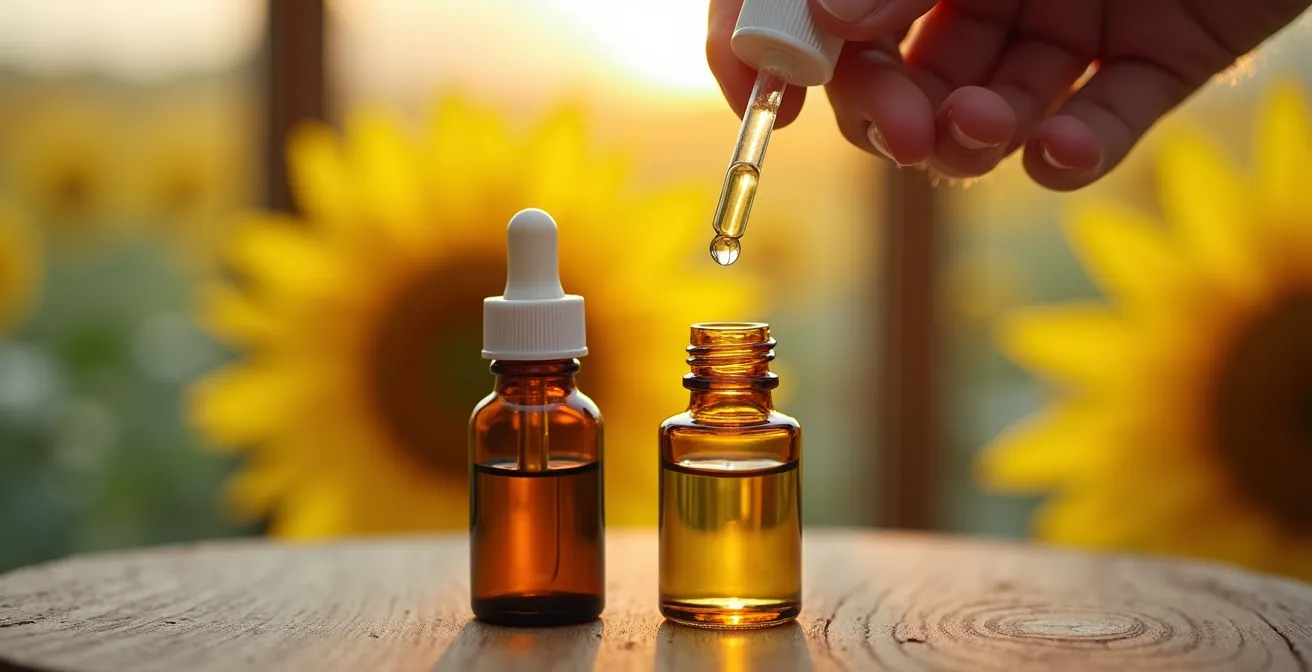
As you can see, the process involves careful measurement. This precision is fundamental to the practice of clinical aromatherapy. It ensures that the application is not only effective but, most importantly, safe, preventing the adverse reactions that often result from improper use promoted by untrained sources.
By respecting these dermal limits, you can harness the benefits of essential oils without compromising the health of your body’s largest organ: your skin.
Diffuse or Apply: Which Method Works Faster for Headache Relief?
When dealing with acute symptoms like a stress-induced headache or a sudden wave of anxiety, the speed of relief is paramount. The choice between diffusing (inhalation) and topical application depends on the desired pharmacokinetic pathway. For rapid psychological and neurological effects, inhalation is generally the faster method. As we discussed, when you inhale an essential oil, its molecules travel directly to the brain’s limbic system via the olfactory nerve, bypassing the digestive system and metabolic processes. This provides a near-instantaneous effect on mood and perception of stress.
This rapid action is supported by clinical research. For instance, in a systematic review of studies on lavender for anxiety, Onyoo Yoo and colleagues noted the consistent and swift impact of inhalation. Their findings in the Healthcare journal underscore this point:
Among the 11 studies, 10 reported that the inhalation of lavender essential oil decreased anxiety.
– Onyoo Yoo and colleagues, Healthcare journal systematic review
This evidence suggests that for an anxiety-triggered headache, diffusing an oil like peppermint (for its analgesic properties) or lavender (for its anxiolytic effects) can offer quicker relief than waiting for a topical application to be absorbed through the skin. Topical application, while also effective, involves transdermal absorption. The oil’s molecules must penetrate the layers of the skin to reach the bloodstream, a process that is slower but provides a more sustained, systemic release. This makes topical application excellent for managing chronic tension or for a prolonged calming effect throughout the day, but less ideal for immediate crisis management.
Therefore, the best strategy is often a dual approach: use a diffuser or personal inhaler for immediate relief from the acute stress of a headache, and apply a diluted blend to the temples and neck for a longer-lasting effect.
The “Lemon in Water” Trend: Why Drinking Essential Oils Damages Your Esophagus
One of the most dangerous pieces of misinformation spread online, often by MLM distributors, is the practice of ingesting essential oils by adding them to water. The claim that a drop of lemon oil in your morning water is a healthy “detox” is not only scientifically unfounded but also hazardous. Essential oils are not water-soluble; they are lipids. This means they do not mix with water. Instead, the undiluted drop of oil floats on top and comes into direct contact with the delicate mucosal linings of your mouth, throat, and esophagus.
This direct contact can cause significant damage. These oils are highly concentrated chemical compounds capable of dissolving petrochemicals; they can easily burn and erode the sensitive tissues of your gastrointestinal tract. Repeated ingestion can lead to esophageal irritation, stomach ulcers, and damage to the gut microbiome. In Canada, the regulatory stance is clear and firm. According to federal guidelines, there is zero approval for the oral use of essential oils marketed as aromatherapy products. Products approved for internal use must undergo a different, more rigorous licensing process as a Natural Health Product (NHP) intended for ingestion, and they will have specific dosing instructions, not a vague “add a drop to water” suggestion.
For those seeking the aromatic benefits of oils like lemon or peppermint throughout the day without the risks of ingestion, there are numerous safe and effective alternatives. The key is to leverage the power of inhalation, which provides the desired psychological effects without causing internal harm. Here is a practical plan for safe daily use.
Action Plan: Safe Alternatives to Ingesting Essential Oils
- Choose aromatherapy accessories like necklaces or bracelets with absorbent materials (e.g., lava stone, felt pads).
- Apply 1-2 drops of essential oil to the accessory’s absorbent surface, not directly on skin that will be in the sun (especially with citrus oils).
- Wear the accessory throughout the day for continuous, gentle inhalation that provides a subtle aromatic experience.
- For acute anxiety or stress, use a personal inhaler (a small plastic tube with a cotton wick) with 2 drops of lavender or bergamot oil for targeted, on-the-go relief.
- Create your own room or linen sprays by mixing distilled water with 10-15 drops of your chosen essential oil per 100ml in a glass spray bottle. Shake well before each use.
By adopting these safe inhalation-based methods, you can enjoy the benefits of these powerful plant extracts without putting your internal organs at unnecessary risk.
Therapeutic Grade or Synthetic: How to Spot Fake Oils at the Store?
The term “therapeutic grade” is one of the most pervasive and misleading marketing terms in the essential oil industry. It has no official definition and is not a standard regulated by any governing body, including Health Canada. Any company can put this phrase on its label. A truly therapeutic oil is defined by its purity and chemical profile, not by a marketing slogan. So, how can a Canadian consumer distinguish a high-quality, authentic essential oil from a cheap, synthetic, or adulterated one?
The key is to look for objective markers of quality and compliance with Canadian law. In Canada, the most important indicator is the Natural Product Number (NPN). If an essential oil makes any health claim (e.g., “helps calm,” “eases headache”), it must be licensed by Health Canada and display an 8-digit NPN on its label. This number signifies that Health Canada has assessed the product for safety, efficacy, and quality. While not all pure oils will have an NPN (if they make no claims), its presence is a strong sign of a company’s commitment to regulatory standards. In fact, Health Canada has licensed over 20,000 NHPs with these numbers, creating a database of reviewed products.
Beyond the NPN, you should look for companies that provide batch-specific GC-MS (Gas Chromatography-Mass Spectrometry) reports. This is the gold standard for testing that verifies the oil’s chemical constituents and ensures it is free from contaminants and synthetic adulterants. A reputable company will make these reports available to consumers on request. To protect yourself, use the following checklist when shopping.
Your Checklist: Vetting Essential Oils in Canada
- NPN Presence: Look for an 8-digit Natural Product Number (NPN) on the label if any health claim is made.
- Bilingual Labeling: Verify the label is in both English and French, as required by Canadian law for consumer products.
- Botanical Name: Ensure the specific Latin botanical name is listed (e.g., Lavandula angustifolia, not just “Lavender”).
- GC-MS Availability: Check the company’s website or contact them to see if they provide batch-specific GC-MS reports.
- Clear Instructions: The label must provide clear dilution instructions and state “Used in aromatherapy” if making associated claims.
This evidence-based approach allows you to confidently select products based on verified science and regulatory compliance, leaving meaningless marketing terms behind.
Why Do Pine Trees Boost Your Natural Killer Cells?
While lavender often dominates the conversation about anxiety, a growing body of evidence points to the powerful anxiolytic effects of other botanicals, including conifers like pine. The connection between pine forests and well-being is central to the Japanese practice of *Shinrin-yoku* or “forest bathing.” The air in these forests is rich in volatile compounds called phytoncides, with alpha-pinene and beta-pinene being primary components. Research shows that inhaling these molecules can lead to a significant increase in the activity and number of Natural Killer (NK) cells, a type of white blood cell crucial for immune response. While this is primarily an immune benefit, the calming psychological effects are also profound.
The anxiolytic mechanism of pine oil is linked to its ability to lower stress hormone levels, such as cortisol. Inhaling alpha-pinene has been shown to have a calming effect on the nervous system, reducing physiological markers of stress. This is particularly relevant given the rising rates of anxiety in Canada. For context, 5.2% of Canadians aged 15 and over reported symptoms consistent with generalized anxiety disorder in 2022. Finding effective, evidence-based natural interventions is therefore a public health priority. Modern science is now beginning to compare the efficacy of various oils for anxiety, moving beyond a singular focus on lavender.
Case Study: Network Meta-Analysis of Anxiolytic Essential Oils
A groundbreaking 2023 network meta-analysis published in *Frontiers in Public Health* was the first to directly compare the efficacy of different essential oils for anxiety. The analysis included oils such as jasmine, citrus, and pine alongside lavender. The goal was to provide clinicians with a more rational basis for choosing an oil. This type of research is crucial as it moves the field from anecdotal evidence to comparative effectiveness, helping to identify which chemical profiles may be best suited for specific anxiety presentations. It validates that oils like pine are not just “lesser” alternatives to lavender but have their own unique, evidence-supported therapeutic potential.
This broadens the therapeutic toolkit available for managing anxiety, offering options for individuals who may not respond to or enjoy the scent of lavender.
Why Does Passionflower Calm Your Brain Like a Mild Sedative?
Expanding our view beyond essential oils, we encounter other Natural Health Products (NHPs) with strong evidence for anxiety, such as Passionflower (Passiflora incarnata). While often consumed as a tea or tincture rather than used aromatically, its mechanism is highly relevant. As defined by Health Canada, NHPs include herbal remedies like Passionflower, which are regulated to ensure safety and quality. The relevance of such remedies is underscored by alarming trends; from 2012 to 2022, the proportion of Canadians with generalized anxiety disorder has doubled, making effective and accessible solutions more critical than ever.
Passionflower’s calming effect is believed to stem from its ability to increase levels of GABA (gamma-aminobutyric acid) in the brain. As discussed with lavender, GABA is an inhibitory neurotransmitter that reduces brain cell activity, leading to feelings of relaxation and calm. The flavonoids in Passionflower, such as chrysin, are thought to be the primary active compounds responsible for this effect. Clinical trials have compared Passionflower’s efficacy to that of common anti-anxiety benzodiazepine drugs for generalized anxiety disorder, finding it to be similarly effective but with fewer side effects, such as impaired job performance.
This positions Passionflower as a mild, non-addictive sedative. It doesn’t just “take the edge off”; it works on a fundamental neurochemical pathway to induce a state of calm. This is why it’s often recommended for anxiety accompanied by sleep disturbances or restlessness. Unlike some pharmaceuticals, it helps to calm the mind without causing significant daytime drowsiness for most people, making it a functional option for managing ongoing anxiety. As an NHP with a long history of traditional use and emerging clinical support, it represents a key tool in the integrative management of anxiety.
It highlights that the world of natural anxiolytics is diverse, offering different tools that work through distinct but complementary neurochemical pathways.
Key Takeaways
- The effectiveness of an essential oil for anxiety is determined by its chemical makeup (e.g., linalool), not by unregulated marketing terms like “therapeutic grade.”
- In Canada, look for an 8-digit NPN (Natural Product Number) on the label as an objective marker of Health Canada’s review for safety and quality.
- Safe application is paramount: always dilute oils in a carrier oil for skin application and never ingest them. Inhalation is often the fastest method for acute anxiety relief.
Valerian or Lavender: Which Natural Anxiolytic Actually Stops Panic Attacks?
When anxiety escalates from a general feeling of unease to the overwhelming physiological and psychological crisis of a panic attack, the choice of intervention becomes critical. This is a scenario where a rapid and potent anxiolytic effect is needed. The issue is particularly pronounced among certain demographics; for example, recent Statistics Canada data shows anxiety disorders affect 7.5% of older females compared to 4.2% of older males. While herbs like Valerian root are well-known for their sedative properties and are often used for sleep, their onset of action can be slow, making them less suitable for the acute phase of a panic attack.
In this high-stakes context, the rapid action of inhaled lavender essential oil often proves superior. As established, inhalation provides the most direct pathway to the brain’s limbic system, allowing for a swift impact on the nervous system. The goal during a panic attack is to interrupt the feedback loop of fear and physical symptoms (rapid heart rate, shortness of breath). Lavender’s ability to quickly modulate the GABAergic system can provide this interruption. This application is not just theoretical; it has been tested in highly stressful clinical settings that mimic the physiological stress of a panic attack.
Case Study: Lavender Inhalation for Pre-Surgical Anxiety
A randomized controlled trial published in 2019 investigated the effect of lavender oil inhalation on patients experiencing anxiety before surgery. The study found that inhaling lavender oil significantly reduced peri-operative anxiety and even had a measurable impact on blood pressure. The authors concluded that lavender is one of the most powerful anxiolytic essential oils and has potential as a sedative in high-stress medical procedures. This demonstrates its efficacy in an acute, high-anxiety state that is physiologically similar to a panic attack, highlighting its role as a powerful, fast-acting tool for crisis management.
For the sudden, intense onset of a panic attack, the evidence points toward the rapid neurochemical intervention of inhaled lavender, while Valerian may be better suited for generalized anxiety and promoting sleep. To effectively manage your anxiety, the next logical step is to build a personalized toolkit of these evidence-based options, knowing which one to reach for in any given situation.