
Contrast therapy is not just about feeling better; it’s a precise method for programming your body’s core systems to enhance resilience, accelerate repair, and control your stress response.
- Heat exposure activates cellular cleanup crews (Heat Shock Proteins), while cold exposure trains your nervous system and reduces inflammation.
- The timing and type of therapy are critical: incorrect application can negate muscle gains, while proper timing can significantly improve sleep and energy.
Recommendation: Start by mastering your body’s response to cold using controlled breathing and gradual immersion before attempting full contrast cycles.
If you’re an athlete or anyone dealing with chronic pain, you’ve likely felt the frustration of recovery that moves at a glacial pace. The conventional wisdom usually involves stretching, foam rolling, and maybe an ice pack on a sore joint. These methods offer temporary relief, but they often fail to address the underlying physiological bottlenecks that are truly holding you back. We accept this slow process as a necessary evil, a passive waiting game where we hope our body eventually gets the memo to heal.
What if recovery wasn’t a passive state, but an active skill? The conversation around recovery often misses the most powerful tool at our disposal: our body’s own innate survival mechanisms. In a country like Canada, we have a cultural relationship with extreme temperatures, from bracing against a frigid January wind to seeking the deep warmth of a cabin sauna. This is the very essence of contrast therapy. But the real secret isn’t just about the “pump” effect of switching between hot and cold. It’s about something far deeper and more powerful.
The true power of contrast therapy lies in using temperature as a deliberate input to program your biology. This is not just about soothing sore muscles; it’s about thermal bio-programming—a conscious technique to trigger profound cellular repair, condition your autonomic nervous system, and build a fortress of physiological resilience. Instead of just treating symptoms, you’ll learn to speak your body’s primal language to command a more robust response to stress, whether it’s from a workout, an injury, or life itself. This guide will deconstruct the science behind this powerful tool, moving beyond the platitudes to give you a precise, actionable framework for recovery.
text
This article provides a complete roadmap to understanding and implementing contrast therapy. We’ll explore the specific cellular mechanisms at play, provide safe and effective protocols, and show you how to tailor this technique to your specific goals, from muscle growth to anxiety control.
Summary: Mastering Recovery with Contrast Therapy
- Why Does Sitting in a Sauna Repair Your Damaged Cells?
- How to Cold Plunge Without Going Into Shock?
- Dry Heat or Wet Steam: Which Is Better for Respiratory Health?
- The Ice Bath Mistake That Kills Your Muscle Gains
- When to Sauna: Morning for Energy or Evening for Sleep?
- How to Use Hot and Cold Water to Flus Inflammation from Your Wrists?
- What Temperature Keeps You in Deep Sleep vs REM?
- How to Hack Your Vagus Nerve to Stop Anxiety Attacks?
Why Does Sitting in a Sauna Repair Your Damaged Cells?
When you expose your body to the intense heat of a sauna, you’re not just sweating out toxins; you’re initiating a powerful, primal process of cellular renewal. This response is driven by something called Heat Shock Proteins (HSPs). Think of HSPs as your cells’ emergency repair crew. The thermal stress of the sauna signals to your body that it’s under threat, activating these proteins to seek out, refold, and repair other damaged proteins within your cells. This process, which we can call “cellular autofitness,” is a fundamental mechanism for maintaining cellular integrity and function.

This deep cellular maintenance has profound, long-term health implications. It’s not just about recovering from a workout; it’s about building a more resilient biological system from the ground up. The benefits are so significant that one landmark study found that men using a sauna 4-7 times per week had a 50% lower all-cause mortality rate compared to those who used it only once a week. This isn’t just recovery; it’s a strategy for longevity, initiated by the simple act of sitting in a hot room and letting your body’s ancient defense systems do their work.
To safely leverage this process, it’s crucial to follow a structured protocol. Start with shorter sessions and gradually increase your tolerance. Hydration is non-negotiable, and you must always listen to your body, exiting immediately if you feel dizzy or unwell. Proper protocol ensures you get the benefits of hormetic stress without pushing your system into a state of genuine danger.
By understanding that you are actively commanding a cleanup of your own cells, a sauna session transforms from a relaxing pastime into a strategic bio-hacking tool.
How to Cold Plunge Without Going Into Shock?
The initial gasp and feeling of panic when you enter cold water is a physiological reality known as the cold shock response. It’s an involuntary reaction involving a sharp intake of breath, hyperventilation, and a rapid increase in heart rate and blood pressure. Research shows that plunging into water between 50-60°F (10-15°C) triggers this cold shock response. The key to a successful cold plunge is not to fight this response, but to manage and control it. This is the essence of autonomic conditioning—teaching your nervous system to remain calm under acute stress.
The goal is to override the initial panic signal and activate the parasympathetic “rest-and-digest” nervous system, primarily through the vagus nerve. The secret weapon here is your breath. By focusing on slow, controlled exhales, you signal to your brain that you are safe, allowing your body to adapt to the cold instead of fighting it. This practice, over time, builds a powerful resilience to all forms of stress, not just cold water.
Wellness practitioners across Canada have refined this process into what can be called the “Canadian Shield Method,” inspired by practices at Nordic spas in regions like the Laurentians. The approach is systematic and gradual. For beginners, the protocol is not about enduring long, painful minutes. Instead, it involves:
- Starting with just your feet and hands in the cold water for several sessions before attempting to immerse your legs, then your torso.
- Focusing on immediate, controlled breathing the moment you enter the water. A long, slow exhale is your first move.
- Aiming for short durations initially, from 30 seconds to 2 minutes, in water around 50-60°F (10-15°C). The goal is consistency and control, not duration.
By treating the cold plunge as a training session for your nervous system, you transform a daunting experience into a powerful tool for building unshakable mental and physical composure.
Dry Heat or Wet Steam: Which Is Better for Respiratory Health?
The choice between a traditional dry sauna and a wet steam room often comes down to personal preference, but when it comes to respiratory health, their effects differ significantly. A traditional Finnish-style dry sauna uses high temperatures (160-200°F or 70-93°C) with low humidity. This dry air can be particularly beneficial for individuals with conditions like asthma, as it may help to open up the airways without the potential irritation of heavy, moist air. The intense heat promotes deep breathing and can help relax the muscles of the respiratory tract.
In contrast, a steam room operates at a lower temperature (around 110-120°F or 43-49°C) but with nearly 100% humidity. This warm, moist air is excellent for loosening mucus and phlegm in the sinuses, throat, and lungs. It acts as a natural expectorant, making it a powerful ally during a cold or for those suffering from sinus congestion. The hydration provided by the steam can also soothe irritated nasal passages.
A third option, the infrared sauna, offers a unique approach. As experts at Massachusetts General Hospital note, it operates differently from traditional models. In their health research, they state:
Infrared saunas operate at lower temperatures between 120°F to 140°F while directly heating body tissues without significantly heating the surrounding air.
– Massachusetts General Hospital, MGH Health Research
This direct heating means you get the benefits of increased core body temperature and sweating at a more tolerable air temperature, which can be ideal for those who find the intense heat of a dry sauna overwhelming. For respiratory health, this gentle, deep-penetrating heat can promote circulation in the chest area without the challenging humidity of a steam room or the extreme dry heat of a Finnish sauna.
Ultimately, whether you need to open airways with dry heat or clear congestion with wet steam, using thermal therapy strategically can provide significant respiratory relief.
The Ice Bath Mistake That Kills Your Muscle Gains
For decades, athletes have been told to jump into an ice bath immediately after training to reduce inflammation and speed up recovery. However, this common practice contains a critical flaw, especially for those training for strength and hypertrophy. The very inflammation you’re trying to eliminate is a crucial signaling process for muscle adaptation and growth. By blunting this natural response too quickly, you are effectively telling your body to cancel the repair and growth signals you just worked so hard to create.
The science is clear on this: using cold therapy too soon after a strength workout can sabotage your gains. Studies have shown that using cold therapy immediately before or after strength training can lead to an 8-12% reduction in maximal force output and a blunting of the molecular signals responsible for hypertrophy. You are essentially trading long-term adaptation for short-term soreness relief. This is a poor trade-off for anyone serious about getting stronger.
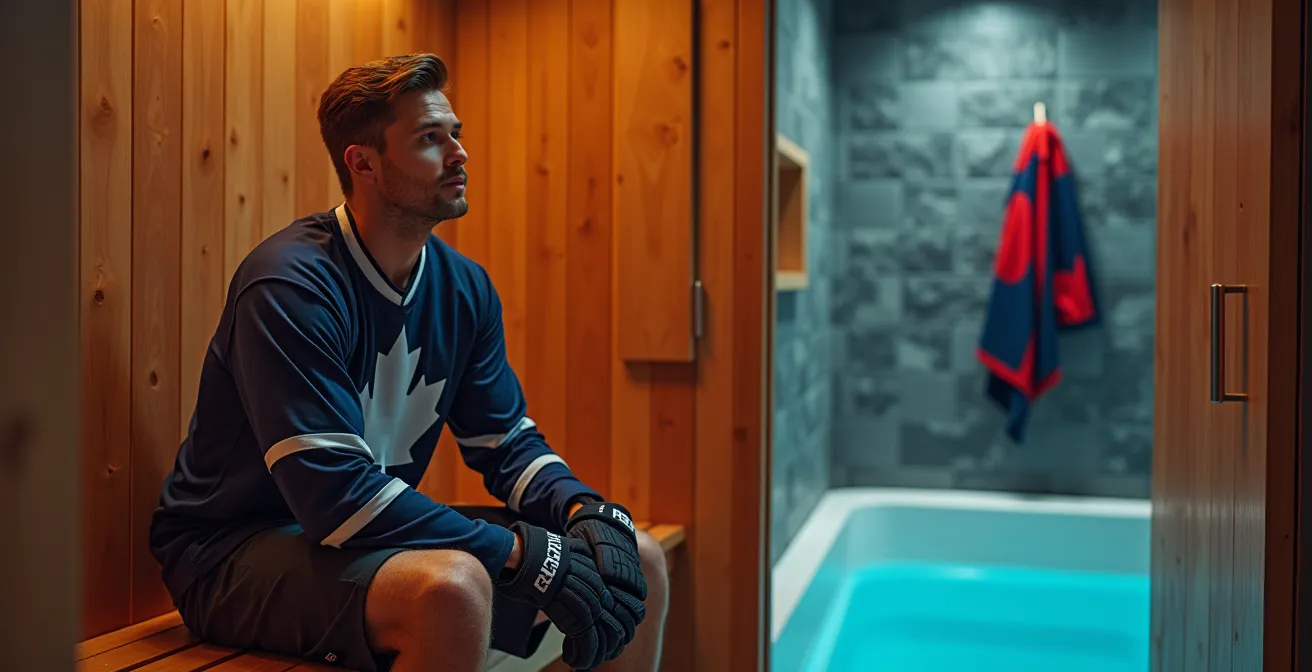
The key is not to abandon cold therapy, but to time it intelligently as part of your thermal bio-programming. The goal determines the protocol. For a Canadian hockey player after a game, immediate cold exposure is perfect for reducing acute inflammation and managing pain to be ready for the next day. But for that same player in the off-season, during a strength-building phase, the protocol must change. A more strategic approach prioritizes the body’s natural adaptation signals.
- For hypertrophy training: Avoid all cold exposure for at least 4 hours post-workout. This allows the inflammatory and anabolic signaling pathways to run their full course.
- For endurance athletes: The rules are more flexible. Cold therapy can be used within 30 minutes post-session, as the primary goal is rapid recovery, not muscle growth.
- For competition/games: Use cold therapy immediately to control inflammation, reduce pain, and accelerate recovery for the next event.
By understanding that inflammation is a necessary signal, you can time your cold exposure to work with your body’s long-term goals, not against them.
When to Sauna: Morning for Energy or Evening for Sleep?
The timing of your sauna session is not arbitrary; it’s a powerful bio-hacking tool that can be used to either energize your day or prepare your body for a deep, restorative sleep. The choice depends entirely on the physiological response you want to trigger. Your body’s temperature and hormone cycles are intrinsically linked, and you can leverage heat therapy to manipulate them to your advantage.
A morning sauna acts as a powerful stimulant for your body’s natural wakefulness signals. The increase in core body temperature helps to promote the release of cortisol, the hormone associated with alertness and energy. For many Canadians, particularly during the long, dark winters, this can be an effective strategy to combat the lethargy associated with Seasonal Affective Disorder (SAD). Research on timed heat therapy for SAD has shown that morning sauna use helps to regulate these crucial cortisol rhythms, effectively jump-starting your day and promoting a more stable energy level.
Conversely, an evening sauna is a potent sedative when timed correctly. The key is not the heat itself, but the subsequent cooling-down period. A significant drop in core body temperature is one of the body’s primary signals to initiate sleep. By taking a sauna 2 to 3 hours before bed, you artificially raise your core temperature, forcing your body to work hard to cool down afterwards. This exaggerated temperature drop mimics the natural process of sleep onset, tricking your brain into producing melatonin and preparing for deep sleep. This can lead to faster sleep onset and more time spent in the crucial slow-wave sleep stages.
By treating your sauna not as a random activity but as a precise chronobiological tool, you can take active control over your daily energy cycles and the quality of your nightly rest.
How to Use Hot and Cold Water to Flus Inflammation from Your Wrists?
For office workers, artists, or anyone who performs repetitive hand movements, wrist and hand inflammation can be a debilitating issue. While rest is important, you can actively accelerate the healing process by using a targeted form of contrast therapy. This technique creates a “vascular pump” in the localized area, using alternating vasodilation (from heat) and vasoconstriction (from cold) to flush out inflammatory by-products and bring in fresh, oxygenated blood to the tissues.
The process is simple, requires no special equipment, and can be done at home or in the office. It’s a direct, mechanical intervention to improve circulation right where you need it most. The key is to follow a specific protocol to maximize the pumping effect. Research shows that an optimal contrast therapy session requires 15-20 minutes to be effective, ensuring enough cycles to create a significant circulatory flush. It’s a small investment of time for significant relief.
Here is a simple and effective protocol for wrist and hand inflammation:
- Preparation: Fill two basins or sinks. One with comfortably hot water (around 98-104°F or 37-40°C) and one with cold water (50-59°F or 10-15°C).
- Heat Phase: Immerse your hands and wrists in the hot water for 3 to 4 minutes. Focus on relaxing the muscles.
- Cold Phase: Immediately switch to the cold water and immerse for 1 minute. This will feel intense, but it is the crucial vasoconstriction phase.
- Repeat: Cycle between hot and cold 3 to 4 times.
- Final Phase: Always end the session with the 1-minute cold water immersion. This helps to close off the cycle by reducing residual inflammation.
Performing this routine 2-3 times a day during periods of acute inflammation can dramatically reduce pain and speed up your return to comfortable, pain-free activity.
What Temperature Keeps You in Deep Sleep vs REM?
Sleep is not a monolithic state; it’s a complex dance of different stages, each with its own specific function and environmental requirements. Two of the most critical stages are Deep Sleep (N3) and REM sleep, and your body’s ability to enter and maintain them is highly dependent on temperature. A cooler environment is not just a matter of comfort—it’s a biological necessity for optimal sleep architecture. Your core body temperature must drop by 1-2°F to initiate and sustain deep, restorative sleep.
The optimal temperature window varies slightly between sleep stages. Deep Sleep, the phase responsible for physical repair, hormone regulation, and memory consolidation, thrives in a cooler environment. In contrast, during REM sleep, your brain’s thermoregulation ability is impaired, making it more sensitive to temperature extremes. The following table breaks down these specific requirements:
| Sleep Stage | Optimal Room Temp | Body Response |
|---|---|---|
| Deep Sleep (N3) | 60-67°F (15-19°C) | Core temp drops 1-2°F |
| REM Sleep | 65-68°F (18-20°C) | Temperature regulation impaired |
| Sleep Onset | 65-70°F (18-21°C) | Requires temperature decline signal |
So, how can you engineer this necessary temperature drop? As a 2018 study in *Nature Scientific Reports* found, pre-bed thermal manipulation can significantly improve sleep quality. The study’s protocol, which involved a 15-20 minute sauna session followed by a brief cold exposure about 2-3 hours before bed, was shown to help participants fall asleep faster and increase their time in slow-wave (deep) sleep. This contrast therapy routine effectively “hacks” your body’s thermostat, creating the powerful temperature decline signal needed to unlock your best night’s sleep.
This makes your pre-sleep routine a powerful lever for controlling not just if you sleep, but how well you repair and recover during the night.
Key Takeaways
- Contrast therapy is a form of hormetic stress that trains your body’s repair and stress-response systems.
- Timing is crucial: avoid cold therapy for at least 4 hours after strength training to maximize muscle growth.
- Use morning saunas to boost energy and evening saunas (2-3 hours before bed) to promote deep sleep.
How to Hack Your Vagus Nerve to Stop Anxiety Attacks?
Beyond muscle recovery, contrast therapy is one of the most powerful and direct methods for conditioning your nervous system. As the team at Revive Wellness Club in Canada notes, this is a core benefit:
The shifting temperatures stimulates the nervous system, helping to reduce stress, improve mood, and boost energy levels through controlled stress response activation.
– Revive Wellness Club, Canadian Wellness Research
The mechanism behind this is the targeted stimulation of the vagus nerve, the main highway of your parasympathetic (“rest-and-digest”) nervous system. Cold exposure, particularly to the face, triggers an ancient and powerful reflex called the “mammalian dive reflex.” This reflex instantly slows your heart rate and redirects blood flow to your core organs, effectively putting the brakes on the sympathetic (“fight-or-flight”) response that fuels anxiety. This is not a psychological trick; it is a hard-wired neurological hack.
You don’t need a full cold plunge to access this benefit. A simple bowl of cold water can be a powerful tool to halt the onset of an anxiety or panic attack. The cortisol-lowering effects are well-documented; research from neuroscientists like Dr. Andrew Huberman shows a significant cortisol reduction after protocols involving cold exposure, which directly contributes to increased stress resilience. By practicing this regularly, you train your vagal tone, making your nervous system more adept at shifting out of stress and into a state of calm.
Action Plan: The Canadian Dive Reflex Anxiety Protocol
- Fill a bowl or sink with cold water, ideally between 50-60°F (10-15°C).
- Take three deep, slow breaths to calm your initial response and prepare your system.
- Hold your breath and gently immerse your face in the water for 10-15 seconds, focusing on the sensation of the cold.
- Lift your head out of the water and breathe normally for 30 seconds, noticing the immediate shift in your heart rate and mental state.
- Repeat this cycle 3-4 times, or until you feel the symptoms of anxiety significantly reduce.
By mastering this simple bio-hack, you are no longer a passenger in your body’s stress response; you are the pilot, capable of navigating turbulence and returning to a state of calm at will.