
Nordic walking is not just “walking with poles”; it’s a full-body workout that burns up to 20% more calories than regular walking while actively protecting your joints.
- Proper pole technique engages up to 90% of your body’s muscles, turning a simple walk into a powerful fitness session.
- Correct equipment choices are crucial for injury prevention and performance, especially in variable Canadian weather.
Recommendation: Master the “plant and push” motion. This is the key to unlocking the immense joint-sparing and metabolic benefits of Nordic walking.
For many Canadians who love the outdoors, the desire to stay active often clashes with a harsh reality: knee pain. Running, long seen as the go-to for cardiovascular fitness, can be punishing on the joints. This leaves many active seniors and injury-prone individuals feeling stuck, believing they must choose between a high-calorie burn and long-term joint health. But what if that’s a false choice? What if there’s a form of exercise that delivers superior fitness results *because* it protects your body, not in spite of it?
Enter Nordic walking. Often misunderstood as a gentle stroll with stability aids, it is, in fact, a sophisticated, full-body workout. The secret lies in the specific techniques and equipment that transform a simple walk into a powerful, low-impact ‘metabolic engine’. This isn’t just about planting poles in the ground; it’s about using them to create kinetic chain propulsion, engaging your upper body and core to propel you forward. This active engagement is what makes it fundamentally different and more effective than both regular walking and, for many, high-impact running.
This guide moves beyond the basics. We’ll deconstruct the science behind the calorie burn, the precise techniques for muscle engagement, and the critical equipment choices that matter most for Canadians. We will explore how to turn this activity into a tool for “real-life” functional fitness, perfectly suited for everything from a walk in a Toronto park to navigating a rocky Canadian Shield trail.
For those who prefer a visual introduction, the following video demonstrates the foundational movements to get you started on the right foot. It provides a great overview of the basic six steps to master the rhythm and coordination of Nordic pole walking.
This article will guide you through the key principles that make Nordic walking such a powerful tool for your health. From the fundamentals of calorie expenditure to the nuances of equipment and terrain, you’ll gain a complete understanding of how to maximize your workout while minimizing stress on your body.
Summary: The Complete Guide to Nordic Walking for Joint Health and Fitness
- Why Does Using Poles Burn 20% More Calories Than Regular Walking?
- How to Plant Your Poles to Actually Engage Your Lats and Triceps?
- Carbon or Aluminum: Which Pole Material Protects Your Shoulders?
- The Sizing Mistake That Makes Nordic Walking Dangerous on Hills
- How to Use the Gauntlet Strap to Prevent Grip Fatigue?
- Slow Jogging or Sprints: Which Builds More Energy Factories in Your Cells?
- Why Is Standing Still Just as Bad as Sitting All Day?
- How to Train for “Real Life” Movement Instead of Just Gym Aesthetics?
Why Does Using Poles Burn 20% More Calories Than Regular Walking?
The single most compelling advantage of Nordic walking is its incredible efficiency. It’s not just a marginal improvement over regular walking; it’s a significant metabolic upgrade. The reason is simple: you are recruiting a massive amount of muscle that remains dormant during a normal stroll. By pushing off with the poles, you engage your arms, shoulders, back, and core, transforming your body into a full-fledged cardiovascular machine. This added work demands more oxygen and energy, which directly translates into a higher calorie burn.
The science backs this up decisively. According to landmark research, Nordic walking can burn up to 20% more calories than conventional walking at the same pace. This is because every single pole plant and push is a mini workout for your upper body. Think about it: over the course of a kilometre, this equates to hundreds of contractions in your abdominal, chest, and back muscles. It’s like doing a subtle, continuous core workout for the entire duration of your walk.
This increased energy expenditure is precisely why Nordic walking is so effective for weight management without the punishing impact of running. You get a workout that approaches the intensity of a light jog but with the joint-friendly motion of walking. It’s the perfect blend of intensity and safety, allowing you to sustain your effort for longer periods and recover more quickly. By turning on this upper-body afterburner, you’re not just moving from point A to B; you’re powering a full-body metabolic engine.
How to Plant Your Poles to Actually Engage Your Lats and Triceps?
Simply carrying poles isn’t enough; the magic of Nordic walking happens in the “plant and push.” Mastering this technique is what separates a casual walk from a powerful, muscle-sculpting session. The goal is not to use the poles for support in front of you, but for propulsion from behind you. The key is to plant the pole tip on the ground roughly in line with the heel of your opposite foot. Your arm should be relatively straight but not locked as it extends forward to plant.
The power phase comes next. As you walk past the planted pole, you push firmly down and back, extending your arm fully behind you. This is the moment of truth for muscle engagement. A proper push-off will immediately fire up your triceps (the back of your arm) and, most importantly, your latissimus dorsi, the large, wing-like muscles of your back. You should feel a distinct contraction under your shoulder blade. This engagement of the ‘lats’ is a cornerstone of the Nordic walking technique and a major contributor to the increased calorie burn.
To visualize this, imagine you’re trying to push the ground away behind you. The movement is a powerful, fluid extension, not a jab. As a case in point, Urban Poling, a leading Canadian provider, has trained thousands in cities like Toronto and Vancouver. Their instructors find that once participants master this propulsive push, they immediately feel the engagement of upper body muscles that were previously inactive during their walks. It transforms the exercise from a lower-body activity into a coordinated, full-body movement.

As you can see in the demonstration, the arm is fully extended backward at the end of the push-off, which maximizes the contraction of the triceps and lats. This is the source of the propulsive power. It’s this active push, repeated hundreds of times, that builds upper body strength and endurance.
Carbon or Aluminum: Which Pole Material Protects Your Shoulders?
When selecting Nordic walking poles in Canada, the choice often comes down to two materials: carbon fiber and aluminum. While they may look similar, their properties have a significant impact on comfort, durability, and most importantly, joint health. Your choice depends on your priorities: vibration reduction versus ruggedness in harsh conditions.
Carbon fiber is the premium choice for a reason. It is exceptionally lightweight and, crucially, has superior vibration dampening qualities. Every time you plant a pole, a small shock travels up the shaft into your arm, wrist, and shoulder. Over thousands of repetitions, this can lead to fatigue or strain. Carbon absorbs a significant portion of this impact, resulting in a smoother, more comfortable walk that is far gentler on your joints. However, carbon has a downside: it can become brittle in extreme cold and tends to break catastrophically under high stress, rather than bend.
Aluminum, on the other hand, is the workhorse. It’s more affordable and incredibly durable. Unlike carbon, it bends rather than shatters, meaning a bent pole can often be straightened and used to get home. This is a major advantage on rugged Canadian trails. Furthermore, as a detailed analysis of trekking pole materials highlights, aluminum’s physical properties do not change in cold weather, making it a reliable choice for winter walking. The trade-off is its weight and higher vibration transfer compared to carbon.
| Feature | Carbon Fiber | Aluminum |
|---|---|---|
| Cold Weather Performance | Can become brittle below -20°C | Maintains strength in all temperatures |
| Vibration Dampening | Excellent – reduces shoulder stress | Moderate – more vibration transfer |
| Weight | ~15 oz per pair | ~18-22 oz per pair |
| Durability | Breaks catastrophically | Bends but remains usable |
| Price Range (CAD) | $100-150 | $30-80 |
For seniors or those with pre-existing shoulder issues, the vibration dampening of carbon fiber is often the winning factor. For those prioritizing budget and bombproof durability for four-season use on challenging terrain, aluminum is an excellent and dependable choice.
The Sizing Mistake That Makes Nordic Walking Dangerous on Hills
Getting your pole length right is fundamental to both efficiency and safety, but many people make a critical error: they use the same length for all terrains. While the general rule of thumb for flat ground is to size your poles so your elbow is at a 90-degree angle when holding the grip with the tip on the ground, this sizing becomes ineffective and even dangerous when you encounter hills.
When walking uphill, poles set to the standard 90-degree length become too long. This forces you to plant them too far in front, turning a propulsion tool into a cumbersome obstacle. It raises your center of gravity, compromises your balance, and puts excessive strain on your shoulders as you try to vault yourself over them. The correct technique is to shorten your adjustable poles by 5-10 cm. This allows for a proper planting angle, enabling you to push off effectively and maintain a natural, forward-leaning posture into the slope.
Conversely, when heading downhill, poles at the standard length are too short. This forces you to lean forward, increasing your momentum and the risk of a fall, while offering little in the way of braking or support. For descents, you should lengthen your poles by 5-10 cm. This allows you to plant them further in front of you, creating a stable “third and fourth leg” to control your descent and absorb impact, taking a significant load off your knees—a key benefit for those with joint concerns.
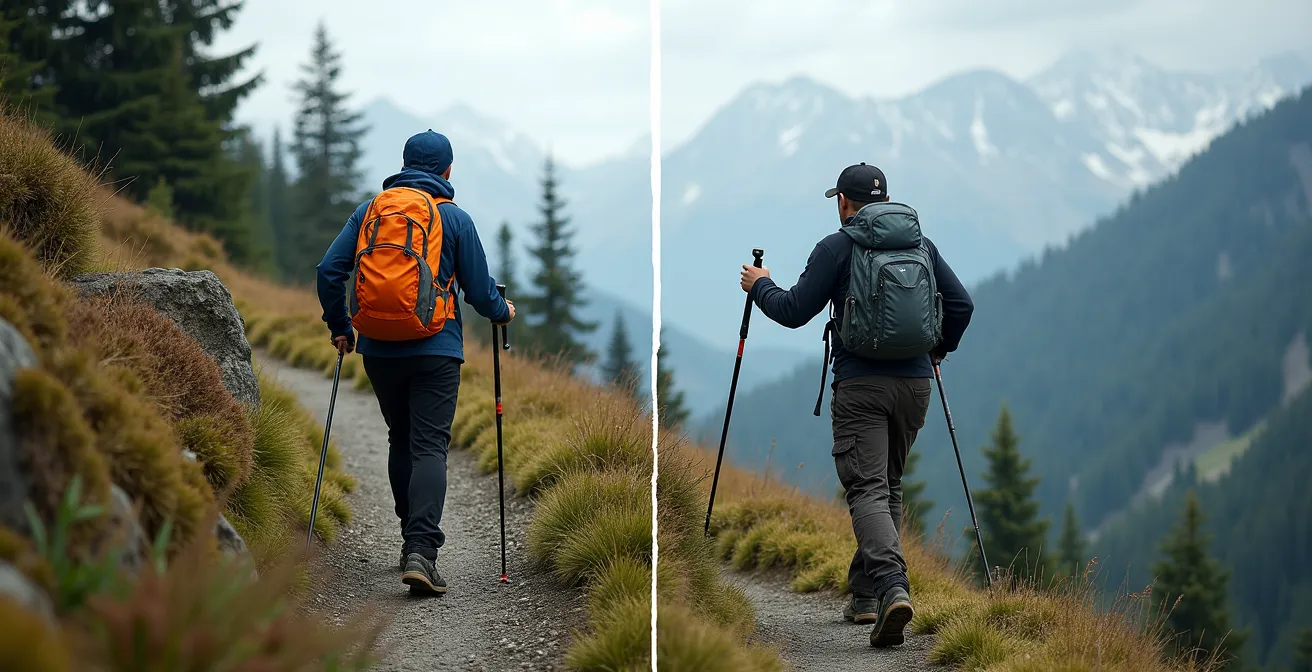
As the comparison clearly shows, using poles that are too long on an ascent (right side) creates an awkward, unsafe posture. The walker on the left, with correctly shortened poles, maintains a powerful and stable climbing position. Ignoring this simple adjustment not only negates the benefits of the poles but introduces a genuine safety hazard on the varied terrain found across Canada.
How to Use the Gauntlet Strap to Prevent Grip Fatigue?
The strap system on a Nordic walking pole is not just a safety loop; it’s an integral part of the kinetic chain that allows you to transfer power efficiently without maintaining a death grip. A common issue for newcomers is grip fatigue or even wrist strain, which arises from clenching the pole handle throughout the entire motion. The specially designed gauntlet strap is the solution to this problem.
The technique is often called “grip-and-go” or “grip-and-release.” You grip the pole handle as you plant it and begin your push-off. Then, as your arm swings back and extends fully behind you, you open your hand and relax your grip, allowing the strap to hold the pole in place. The pole effectively pivots within the strap system. This moment of relaxation is critical. It prevents the constant tension that leads to fatigue in your hands, forearms, and wrists, allowing you to walk for much longer in comfort.
However, traditional strap systems can be cumbersome, especially in a Canadian winter. One walker from Ottawa shared their experience:
After struggling with traditional loop straps while wearing winter mitts in -20°C Ottawa weather, I switched to Urban Poling’s strapless CoreGrip system. The wide ledge design allows me to maintain control even with bulky gloves, and the ergonomic angle prevents the wrist strain I experienced with conventional straps. Three winters later, no elbow or wrist issues.
– Canadian Winter Walker, Urban Poling Canada
This highlights the innovation in handle design. Some Canadian-designed poles, like the ACTIVATOR series, have moved to a strapless ledge system. This design reduces the risk of wrist injury during a fall (as you’re not attached to the pole) while still providing a wide platform to push against, ensuring effective power transfer even with bulky winter gloves. Whether using a gauntlet strap or a modern ledge, the principle remains the same: push through the strap or ledge, not just by squeezing the handle.
Slow Jogging or Sprints: Which Builds More Energy Factories in Your Cells?
When it comes to improving cardiovascular fitness, a key goal is to increase our ‘energy factories’—the mitochondria within our cells. Two popular training philosophies address this: Low-Intensity Steady State (LISS), like a slow jog, and High-Intensity Interval Training (HIIT), which involves short bursts of all-out effort. LISS is excellent for building a base level of aerobic fitness, while HIIT is incredibly effective at stimulating mitochondrial biogenesis in a short amount of time. The beauty of Nordic walking is its remarkable versatility; it’s perfectly suited for both.
You can have a fantastic LISS workout by maintaining a brisk, conversational pace on a flat trail, focusing on perfect technique. This builds endurance and burns fat efficiently. However, to really supercharge your fitness and build those cellular energy factories, you can easily incorporate HIIT principles into your Nordic walk. This is often called Fartlek training, a Swedish term meaning “speed play,” which involves unstructured intervals of fast and slow work.
A Fartlek Nordic walking session is perfect for the varied Canadian landscape. You can use trail markers, large maple trees, or inclines on the Canadian Shield as your targets for high-effort intervals. You walk hard for a short burst, then recover with a period of easy walking, focusing on technique. This blend of intensity spikes and recovery periods is a powerful stimulus for your body to adapt and grow stronger, improving its ability to produce and use energy. It’s also far more engaging and fun than a monotonous pace on a treadmill.
Your Canadian Trail Fartlek Action Plan
- Warm-up: Start with 10 minutes of easy Nordic walking at a comfortable, conversational pace to get your muscles ready.
- Sprint to a landmark: Pick a visible target like the next trail marker or a distinctive tree and walk with maximum effort for 30 seconds.
- Active recovery: Follow the sprint with 2 minutes of easy-paced Nordic walking, focusing on deep breathing and perfect pole technique.
- Hill surge: Use any incline on your path for a 45-second power walk, driving hard with your poles to propel you up the hill.
- Cool-down: Finish your workout with 10 minutes of relaxed-pace walking, allowing your heart rate to return to normal.
By incorporating these simple intervals, you elevate your Nordic walking from a simple exercise to a sophisticated and highly effective training tool that builds true cellular fitness.
Why Is Standing Still Just as Bad as Sitting All Day?
The “sitting is the new smoking” mantra has led many to adopt standing desks, believing that simply getting on their feet is the antidote to a sedentary lifestyle. While well-intentioned, this belief misses a crucial point: the problem isn’t just the position (sitting), but the lack of movement. Being static, whether sitting or standing, leads to poor blood circulation, muscle stagnation, and metabolic slowdown.
The leading experts in Canada agree. As the official guidelines state:
Limit sedentary time to 8 hours or less per day including no more than 3 hours of recreational screen time and breaking up long periods of sitting where possible.
– Canadian Society for Exercise Physiology, Canadian 24-Hour Movement Guidelines for Adults
The key phrase is “breaking up long periods.” A powerful Canadian study illustrates this perfectly. According to a ParticipACTION report on Canadian movement habits, a study of office workers in Toronto’s financial district found that those who switched from sitting to standing desks without incorporating movement breaks showed no significant improvement in key cardiovascular markers. However, a second group—who broke up their day with Nordic walking lunch breaks—showed dramatic improvements in blood flow and reported 30% less afternoon fatigue. This proves that active movement, not just a change in posture, is what truly matters.

Nordic walking is the perfect tool for this. The rhythmic contraction and relaxation of nearly every muscle in your body acts as a “second heart,” actively pumping blood and lymph fluid. This boosts circulation, delivers oxygen to your brain (fighting fatigue), and prevents the blood pooling in the lower legs that can happen during long periods of standing. It is the dynamic, whole-body nature of the movement that counteracts the negative effects of a static workday.
Key Takeaways
- Nordic walking burns up to 20% more calories than regular walking by engaging the upper body and core.
- Proper technique—planting the pole behind you and pushing off—is essential for muscle engagement and propulsion.
- Choose carbon poles for shoulder protection (vibration dampening) and aluminum poles for durability in rugged Canadian conditions.
How to Train for “Real Life” Movement Instead of Just Gym Aesthetics?
So much of modern fitness is focused on aesthetics or isolated muscle groups—bicep curls, leg extensions, crunches. While these have their place, they often fail to prepare our bodies for the complex, multi-directional movements of everyday life. This is the essence of functional fitness: training for strength, stability, and coordination that translates directly to real-world tasks, like carrying heavy groceries, hauling a kayak down to the dock, or keeping your balance on an icy Canadian sidewalk.
Nordic walking is the epitome of functional fitness. It trains the body as an integrated system, not a collection of parts. The cross-body motion (opposite arm and leg forward) mimics our natural gait and builds core rotational strength. Navigating uneven terrain builds stabilizer muscles and improves proprioception—your body’s awareness of its position in space. The full-body engagement prepares you for any task that requires coordinated power.
You can even tailor your training to simulate specific “cottage country” or daily life challenges:
- Dock-hauling simulation: Practice Nordic walking up a steep hill with slightly shortened poles to mimic a powerful pulling motion.
- Kayak-carry training: Use the poles for balance and stability while performing a set of walking lunges.
- Uneven terrain practice: Intentionally seek out a rocky Canadian Shield path or a sandy beach to challenge and build your ankle and hip stabilizers.
- Cross-body rotation drills: Exaggerate your torso rotation with each pole swing to build the core power needed for shoveling snow or swinging a golf club.
This approach builds a resilient, capable body. Instead of just looking strong, you *are* strong in the ways that matter. The ultimate proof lies in the sheer scope of the workout. Research from the renowned Cooper Institute demonstrates that Nordic walking engages up to 90% of your body’s muscles, compared to only 50% in regular walking. This comprehensive muscle activation is what builds true, life-ready strength.
Stop thinking of exercise as a chore that punishes your joints. It’s time to embrace a smarter, more effective way to build fitness that serves you for life. Grab a pair of poles, step outside, and transform your next walk into a powerful, joint-friendly workout. Your knees, and the other 90% of your muscles, will thank you.