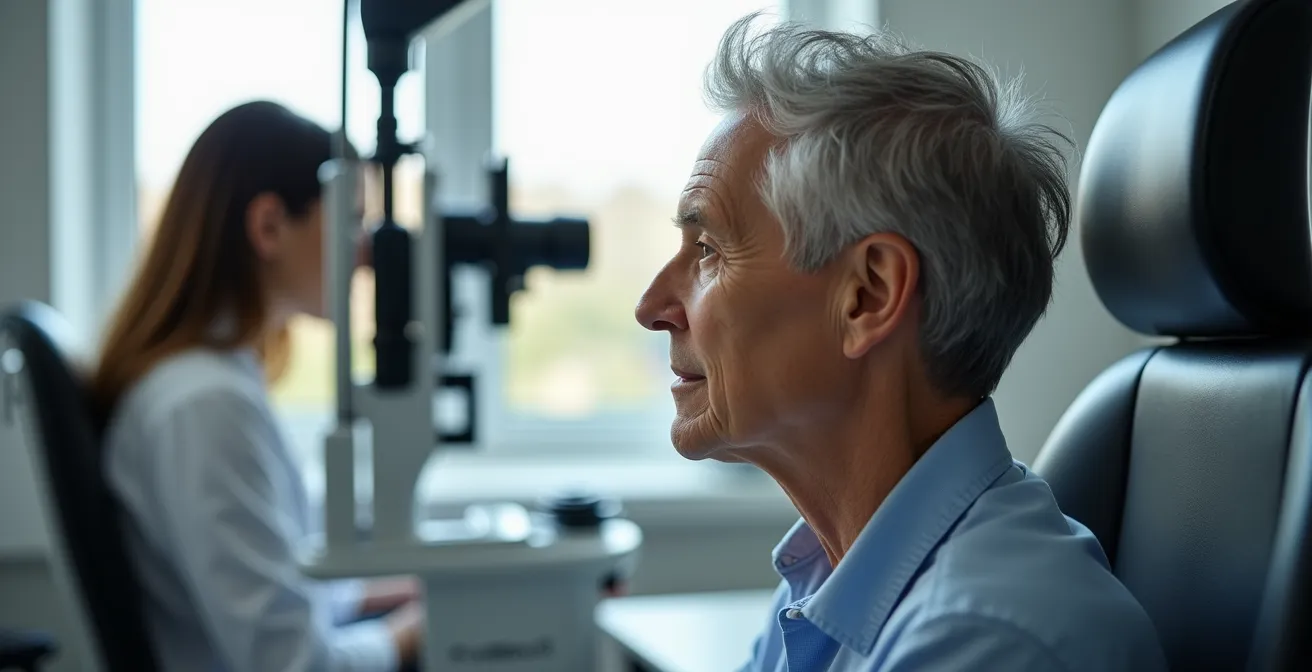
Contrary to popular belief, a 20/20 vision test is not a clean bill of health; it’s a missed opportunity for early disease detection.
- The eye is the only place in the body where doctors can non-invasively see live blood vessels, nerves, and arteries, offering a direct preview of your systemic health.
- Subtle changes in your retinal blood vessels can be the first predictive biomarkers for chronic conditions like hypertension and diabetes, often years before other symptoms emerge.
Recommendation: Treat your annual eye exam not as a simple vision check, but as a critical, predictive health screening, especially if you believe your vision is “fine.”
If you can read road signs clearly and your computer screen isn’t a blur, you probably think your eyes are perfectly healthy. It’s a common and logical assumption: good vision equals good eye health. For many Canadians, this belief means skipping routine eye exams, seeing them as an unnecessary expense, especially if they don’t wear glasses. We’ve all heard the adage that “the eyes are the window to the soul,” but in a clinical setting, they are more accurately the window to your overall health. The problem with waiting for vision changes is that by the time they occur, the underlying systemic disease may already be well-established.
But what if the key wasn’t waiting for symptoms, but proactively looking for the earliest possible signs? The true value of a comprehensive eye exam lies beyond the vision chart. It offers a unique, non-invasive look at your body’s vascular and neurological systems in real-time. This isn’t just about spotting eye diseases; it’s about leveraging the eye as a predictive diagnostic tool. This article will explore how optometrists can identify the silent, microscopic clues of systemic diseases like hypertension and diabetes, often long before your family doctor might, and why that “optional” screening technology could be the best investment you make in your long-term health.
To fully understand this interconnectedness, we will delve into the specific signs we look for in your retinal vessels, how new technologies are enhancing our diagnostic capabilities, and why basic school vision screenings are simply not enough. This guide provides a clear roadmap to the wealth of health information your eyes hold.
Summary: A Look Inside Your Body’s Health Map
- What Do Your Retinal Blood Vessels Reveal About Your Heart Health?
- How Can an Eye Exam Detect Diabetes Years Before a Blood Test?
- Is Paying $50 Extra for the OCT Scan Worth It for Healthy Eyes?
- The “Harmless” Floater That Could Signal a Retinal Detachment
- When to Book the First Exam: Why School Screenings Are Not Enough?
- HbA1c or Fasting Glucose: Which Marker Predicts Diabetes Earlier?
- When to See Sunlight: Lowering Hypertension Through Light Exposure
- Will AI Diagnosis Replace Your Radiologist Within the Next 10 Years?
What Do Your Retinal Blood Vessels Reveal About Your Heart Health?
When we look into your eyes, we’re not just checking your vision; we are directly examining a part of your central nervous system and its vascular network. The retina at the back of your eye is a unique vascular blueprint of your entire body. The tiny arteries and veins we see there share the same characteristics as those in your heart, brain, and kidneys. If they show signs of stress or damage, it’s a powerful indicator that similar processes are happening elsewhere.
Chronic high blood pressure, or hypertension, forces these delicate retinal vessels to adapt. We can observe arteries becoming narrower and stiffer (arteriolar narrowing), veins becoming compressed where arteries cross over them (AV nicking), and in more advanced stages, we can see flame-shaped hemorrhages or cotton wool spots, which signify a lack of oxygen. These are not just “eye problems”; they are direct, visible biomarkers of cardiovascular risk.
To standardize these findings, Canadian optometrists often use a grading system to classify the severity of what is known as hypertensive retinopathy. The Keith Wagener Barker (KWB) classification system provides a framework with four distinct grades. Grade 1, the most common stage, involves mild narrowing of the retinal arteries with no symptoms, while Grade 2 shows more pronounced changes. This structured approach allows us to communicate the level of systemic risk to your family doctor with precision, facilitating timely intervention long before a cardiovascular event might occur.
How Can an Eye Exam Detect Diabetes Years Before a Blood Test?
Just as with hypertension, diabetes is fundamentally a vascular disease, especially in its early stages. High blood sugar levels over time damage the delicate lining of small blood vessels throughout the body, and the first place this damage is often visible is in the eye. This is because the retina has an extremely high metabolic rate and is densely packed with tiny capillaries that are sensitive to the slightest changes in blood glucose.
The earliest detectable sign of diabetic retinopathy is the appearance of microaneurysms—tiny, balloon-like swellings in the walls of retinal blood vessels. These can leak fluid or blood into the retina, a condition that often precedes any vision loss. As a holistic optometrist, finding these markers in a patient who is unaware they have diabetes is a critical moment. It allows for a referral for blood testing and lifestyle intervention years before more significant complications, like diabetic macular edema, can develop.
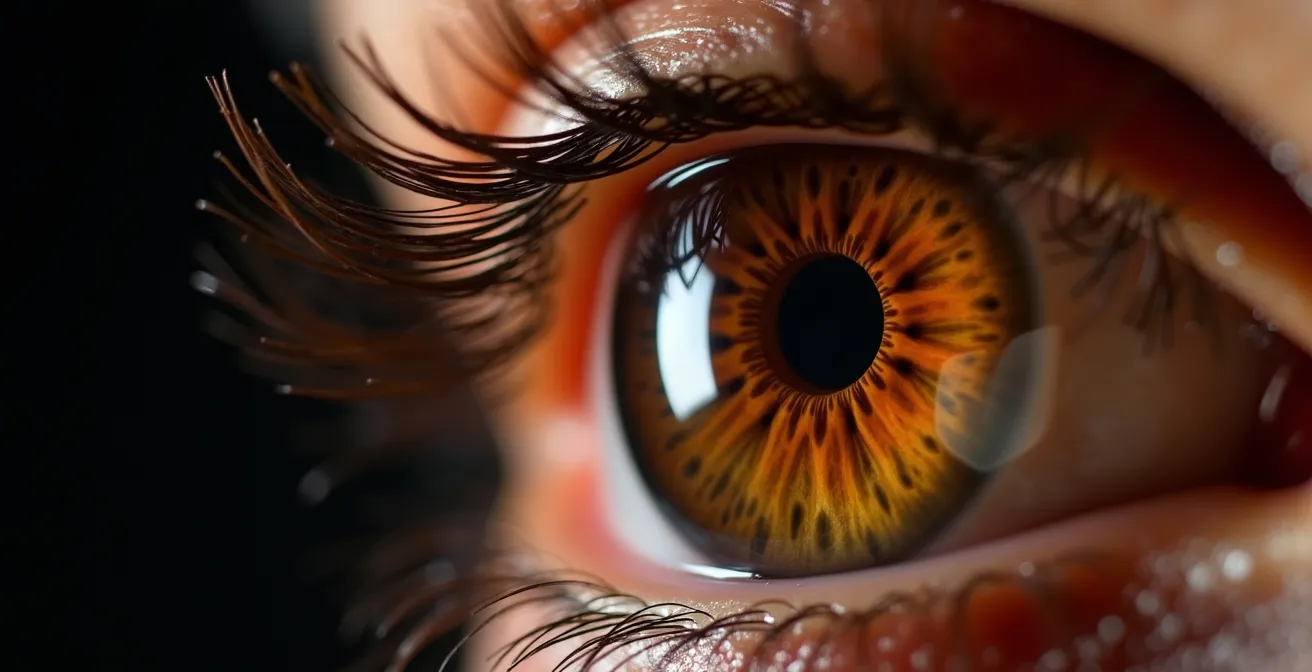
The image below provides a magnified view of these early changes, highlighting how subtle yet significant these initial biomarkers can be.
This early detection is particularly vital in the Canadian context. As the Diabetes Canada Clinical Practice Guidelines for retinopathy note, this vigilance is crucial across all populations. Their research highlights that proactive screening is a cornerstone of public health, especially since, as they state in “Retinopathy – Diabetes Canada Guidelines”:
Higher prevalence rates have been noted in Indigenous populations in Canada
– Diabetes Canada Clinical Practice Guidelines, Retinopathy – Diabetes Canada Guidelines
Is Paying $50 Extra for the OCT Scan Worth It for Healthy Eyes?
For many patients, the suggestion of an additional scan for a fee can feel like an upsell, especially when their vision seems perfectly fine. However, the Optical Coherence Tomography (OCT) scan is one of the most powerful diagnostic tools in modern optometry. Think of it as a high-resolution, cross-sectional ultrasound for the back of your eye. It allows us to see the distinct layers of the retina in microscopic detail, something that is impossible with a standard examination alone.
For a person with “healthy” eyes, an OCT scan establishes an invaluable baseline measurement of their unique retinal and optic nerve anatomy. This baseline is crucial because many degenerative diseases, like glaucoma or macular degeneration, progress so slowly that by the time you notice a change in your vision, significant and irreversible damage has already occurred. By comparing scans year after year, we can detect the slightest thinning of a nerve fiber layer or the smallest accumulation of fluid, flagging a disease process long before it impacts your sight.
Case Study: The Value of OCT in Canadian Healthcare
Research from the University of Waterloo highlights the practical application of this technology. OCT scans are non-invasive imaging tests that provide vital information, such as whether diabetic macular edema is present, and allow doctors to track the effectiveness of treatments. While in Ontario, OHIP covers an annual comprehensive eye exam for individuals with diabetes, the OCT scan itself often carries an additional patient cost. This small investment provides a level of diagnostic precision that is essential for preserving sight and monitoring systemic health, making it a highly valuable tool for proactive care.
So, is the extra cost worth it? If you view your eye exam as a predictive health screening, the answer is an unequivocal yes. It transforms the exam from a simple check-up into a highly detailed, proactive strategy for preserving both your vision and your systemic health for years to come.
The “Harmless” Floater That Could Signal a Retinal Detachment
Nearly everyone experiences “floaters” at some point—those tiny, translucent specks or squiggly lines that drift through your field of vision. In most cases, they are harmless bits of protein from the vitreous, the gel-like substance that fills your eye. They are a normal part of aging. However, a sudden and dramatic change in your floaters can be a sign of a true ocular emergency: a retinal tear or detachment.
This occurs when the vitreous gel shrinks and pulls away from the retina. If it pulls too forcefully, it can tear the delicate retinal tissue. Fluid can then seep through the tear and lift the retina off the back wall of the eye, much like wallpaper peeling from a wall. This is a medical emergency that can lead to permanent vision loss if not treated promptly. The key warning signs are a sudden “shower” of new floaters, often accompanied by flashes of light (photopsia) or a curtain-like shadow descending over your vision.
In this situation, your local optometrist is often your best first point of contact. In Canada, we are equipped to diagnose this issue and can provide an urgent referral to an ophthalmologist, often faster than waiting in a hospital emergency room. Knowing when to worry and when to wait is critical.
Your Action Plan: Emergency Triage for Floaters
- Assess Timeline: If you’ve had the same few floaters for months or years, they are likely benign and can be monitored at your next routine exam.
- Check for Warning Signs: A sudden, dramatic increase in the number of floaters, like a snow globe was shaken in your eye, requires immediate attention.
- Look for Flashes: The appearance of new light flashes, especially in combination with new floaters, is a critical warning sign of retinal traction.
- Contact Your Optometrist Immediately: For non-life-threatening eye emergencies like this, an optometrist’s office can often provide a faster and more specialized assessment than an ER.
- Expect Same-Day Referral: Canadian optometrists are trained to manage these emergencies and can arrange an urgent consultation with an ophthalmology specialist if a tear or detachment is detected.
When to Book the First Exam: Why School Screenings Are Not Enough?
One of the most common misconceptions among parents is that a school vision screening is a substitute for a comprehensive eye exam. While well-intentioned, these screenings are designed to do one thing: test distance vision using a standard eye chart. They are not capable of detecting a host of other common and serious pediatric eye conditions that can have a lifelong impact on a child’s learning and development.
School screenings can easily miss conditions like hyperopia (farsightedness), where a child can force their eyes to see clearly at a distance but experiences significant eye strain and fatigue with up-close work like reading. They also cannot detect amblyopia (“lazy eye”), where one eye does not develop normal vision, or strabismus (misaligned eyes). Furthermore, they are completely unable to assess the health of the eye itself to rule out the early signs of systemic or congenital diseases.
This is why professional associations are clear about the need for early and regular exams. The Canadian Association of Optometrists (CAO) recommends a child’s first eye exam between 6 and 9 months of age, another between ages 2 and 5, and then annually once they start school. This schedule ensures that their visual system is developing correctly and allows for early intervention, which is critical for successful treatment of many pediatric conditions.

These early exams create a foundation for a lifetime of good vision and health, catching potential issues at their most treatable stage.
HbA1c or Fasting Glucose: Which Marker Predicts Diabetes Earlier?
In conventional medicine, diabetes is typically diagnosed using blood tests that measure markers like fasting glucose or HbA1c (a measure of average blood sugar over three months). These are effective and essential tools. However, they are indirect measurements that reflect what is happening in your bloodstream. An eye exam, by contrast, offers a direct look at the physiological *consequences* of elevated blood sugar, and these physical changes can sometimes predate the point where blood markers cross the diagnostic threshold.
Research confirms that a significant portion of the population is unaware of their diabetic status until it’s discovered through other means. In fact, a comprehensive review of existing studies provides a startling figure: it’s estimated that ≥20% of people with diabetes first learn of their status during an eye examination. This is because the microaneurysms and tiny hemorrhages of early-stage diabetic retinopathy can be present even when a person is in a “prediabetic” state, where their blood sugar is elevated but not yet high enough for an official diagnosis.
This makes the eye a powerful predictive screening tool. While a fasting glucose test tells us your sugar level on a specific morning and an HbA1c gives us a three-month average, a retinal exam shows us the cumulative, physical impact of your body’s glucose processing over time. Finding these early retinal changes allows us to alert you and your GP, prompting closer monitoring and earlier lifestyle interventions that can potentially delay or even prevent the full onset of type 2 diabetes.
When to See Sunlight: Lowering Hypertension Through Light Exposure
The connection between the eye and the rest of the body is not just vascular; it is profoundly neurological. The optic nerve is, in essence, a direct extension of the brain. This intimate link is why conditions affecting the brain can sometimes manifest with signs in the eye, and conversely, why the health of the eye’s circulatory system can reflect the health of the brain’s.
This concept is not just a metaphor. As medical researchers have pointed out, the biological origins of the eye are intertwined with brain tissue. This fundamental connection is what allows us to use the eye as a diagnostic window for so much more than just vision. This perspective is beautifully summarized by medical experts who have studied this relationship extensively.
The eye’s circulation is very similar to the brain’s circulation. This is because eyes developed from brain tissue, hence they’re often referred to as ‘the window to the brain’
– The Conversation Medical Research, How your eyes could help diagnose high blood pressure
While the title of this section references light exposure, which has its own complex relationship with blood pressure through circadian rhythms and vitamin D synthesis, the core principle here is understanding this deep, structural connection. Observing the health of the blood vessels in the eye gives us a direct, real-time status update on the part of your circulatory system most similar to the one hidden within your skull. It is the closest we can get to a non-invasive “brain scan” of your vascular health during a routine check-up.
Key Takeaways
- Your retina provides a direct, non-invasive view of your vascular health, reflecting the state of blood vessels in your heart and brain.
- Early signs of diabetes, like microaneurysms, can be detected in an eye exam years before blood tests reach diagnostic levels.
- An OCT scan provides a critical baseline of your retinal health, enabling the detection of slow-progressing diseases like glaucoma long before vision loss occurs.
Will AI Diagnosis Replace Your Radiologist Within the Next 10 Years?
The future of predictive health through optometry is becoming even more powerful with the integration of Artificial Intelligence (AI). While the idea of AI replacing doctors may seem like science fiction, the reality is more of a powerful collaboration. AI algorithms are being developed that can analyze retinal images with a level of detail and consistency that surpasses human capability, identifying subtle patterns that may be invisible to the naked eye.
Leading Canadian institutions like the University of Waterloo’s Waterloo Eye Institute (WEI) are at the forefront of this research. Their work involves training AI models on vast datasets of retinal images to detect the earliest signs of disease. This technology is not about replacing the optometrist’s judgment but augmenting it. An AI can serve as a tireless, incredibly precise screening tool that flags potential issues, allowing the doctor to focus on interpretation, patient communication, and treatment planning.
Case Study: The Future of Diagnosis at the University of Waterloo
At the WEI, researchers are deploying their expertise in AI and biomedical imaging to pioneer new diagnostic methods. By using the eye as a window to the brain, they are developing technology to help diagnose conditions like Alzheimer’s and Parkinson’s disease earlier than ever before. Dr. Lyndon Jones, a key researcher on the project, notes that these AI models will help doctors catch problems that might otherwise have been missed, revolutionizing early detection as OCT imaging becomes more widespread.
The potential impact is staggering. Some studies using advanced imaging techniques combined with AI have shown remarkable results. Evidence suggests that AI systems can detect diabetic and hypertensive retinopathy up to 18 months earlier than standard examination methods. This isn’t about replacement; it’s about evolution. AI will empower optometrists to become even more effective guardians of your systemic health, solidifying the eye exam’s role as a cornerstone of proactive, predictive medicine.
Frequently Asked Questions About Children’s Eye Exams in Canada
What eye care is covered for children in Ontario?
OHIP covers one comprehensive eye exam annually for anyone aged 19 or younger, plus interim minor examinations for specific issues.
What conditions can school screenings miss?
School vision charts cannot detect hyperopia (farsightedness), amblyopia (lazy eye), strabismus, or early systemic diseases.
Are eye exams covered in other provinces?
Most provincial plans including AHCIP in Alberta and MSP in British Columbia cover comprehensive eye exams for children.