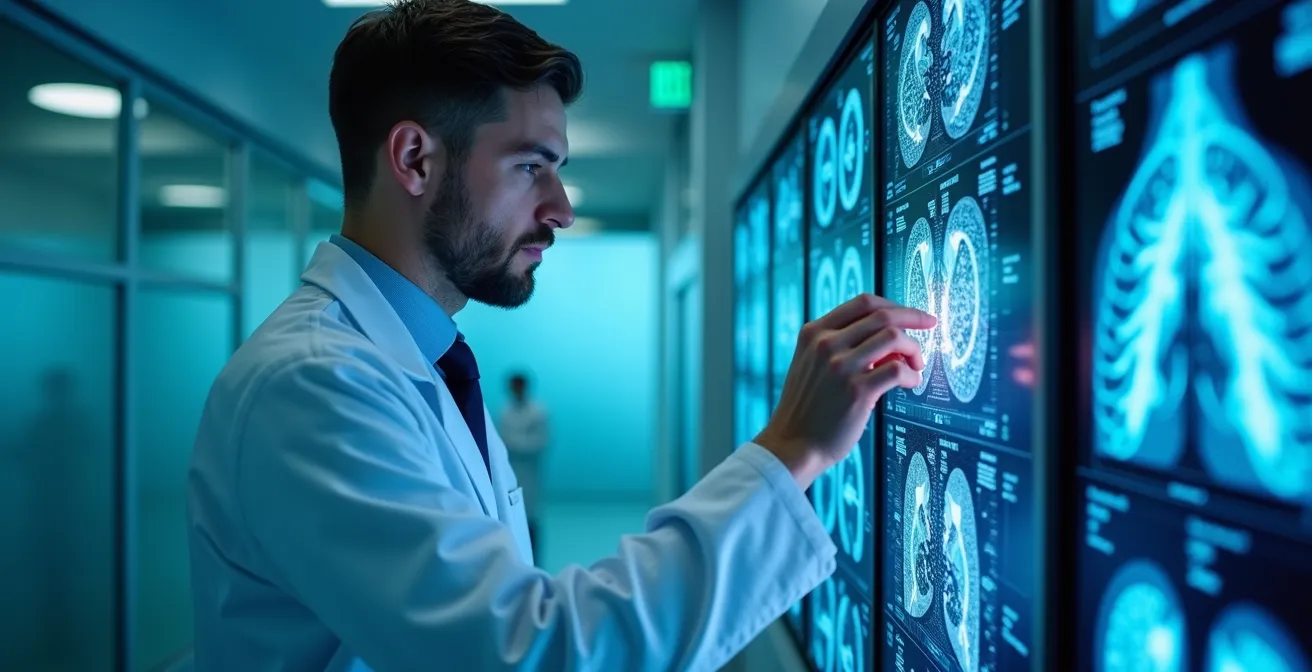
Artificial intelligence will not replace radiologists; instead, it is fundamentally re-engineering the entire diagnostic process in Canada, shifting human expertise from repetitive screening to complex problem-solving.
- AI excels at detecting patterns invisible to the human eye, enabling earlier and more accurate disease detection.
- The true value of a doctor lies in “clinical synthesis”—integrating scan results with patient history, context, and empathy, a skill AI cannot replicate.
Recommendation: Patients should view AI as a powerful enhancement to their care, enabling more informed conversations with doctors about proactive and predictive health strategies.
The quiet anxiety of waiting for the results of a medical scan is a universally understood experience. For days, or even weeks, life feels suspended until a specialist interprets the shades of grey on a screen and delivers a verdict. For years, the conversation around artificial intelligence in medicine has been dominated by a simple, dramatic question: will a machine soon take over this critical role? Many believe AI will serve as a simple “tool,” a faster calculator for the human expert. Others see it as an imminent replacement, rendering the radiologist obsolete.
However, this binary view misses the real, more profound transformation already underway. The critical shift isn’t about replacement, but about a complete re-engineering of the diagnostic workflow. AI isn’t just becoming a better tool for spotting anomalies; it’s creating new capabilities for predictive and opportunistic screening, fundamentally changing the value and focus of human doctors. It acts as a catalyst, forcing the medical field to redefine the very essence of a physician’s expertise. In the Canadian healthcare landscape, with its unique challenges of vast geography and strained resources, this shift is not just theoretical—it’s a practical necessity.
This article moves beyond the hype to explore this new reality. We will analyze where AI’s pattern-recognition power outstrips human ability, how Canadian doctors are already using it as a “second opinion,” and what uniquely human skills remain irreplaceable. We’ll also confront the serious risks, like algorithmic bias, and look ahead to how AI is making it possible to predict diseases years before they might otherwise be found. This is the true story of how AI is changing what it means to see inside the human body.
For those who prefer a visual format, the following video provides expert insight on the intersection of AI and radiology, complementing the detailed analysis in this guide.
To navigate this complex topic, we have structured this analysis to cover the most pressing questions for patients and tech enthusiasts alike. The following sections break down AI’s current capabilities, its collaborative role with physicians, its inherent limitations, and its future potential in the Canadian healthcare system.
Table of Contents : The Future of AI in Canadian Medical Imaging
- Why Is an AI App Better at Spotting Skin Cancer Than a GP?
- How Do Doctors Use AI as a “Second Opinion” Without Losing Control?
- Algorithm or Gut Feeling: What Can AI Never Replicate in Medicine?
- The Bias Problem: Why AI Might Misdiagnose Certain Demographics?
- How Can AI Predict Your Heart Attack 5 Years Before It Happens?
- Is Paying $50 Extra for the OCT Scan Worth It for Healthy Eyes?
- When to Re-Analyze: Why Your Old DNA Data Might Yield New Secrets in 5 Years?
- Is Paying $1,000 for Whole Genome Sequencing Worth It for Healthy Adults?
Why Is an AI App Better at Spotting Skin Cancer Than a GP?
One of the most compelling demonstrations of AI’s diagnostic power is in dermatology. A general practitioner, despite their broad knowledge, cannot match the pattern-recognition ability of a specialized algorithm trained on millions of images of skin lesions. The reason lies in the nature of machine learning: AI doesn’t “see” a mole the way a human does. It analyzes it as a complex dataset of pixels, identifying subtle variations in colour, texture, and border asymmetry that are often invisible to the naked eye.
This capability translates into measurable improvements in accuracy. For example, a recent Stanford Medicine-led meta-analysis found that AI assistance boosted diagnostic sensitivity for skin cancer to 81.1% from 74.8% and specificity to 86.1% from 81.5%. This means AI helps catch more cancers while simultaneously reducing false positives. In a Canadian context, a study in Nova Scotia tested an AI system on nearly 400 lesions. While the AI missed 6 melanomas, human dermatologists in the study also missed 3-5 of those same cases, demonstrating a performance level that is already comparable to that of specialists.
This is not about replacing the GP or the dermatologist. It’s about diagnostic augmentation. By using an AI application to pre-screen suspicious lesions, a doctor can more effectively triage patients, prioritizing those with high-risk indicators for immediate biopsy and reassuring those with benign marks. The AI handles the high-volume, repetitive task of pattern analysis, freeing the human expert to focus on the patient’s history, risk factors, and the final treatment plan. It’s a clear case where a machine’s computational strength enhances, rather than replaces, a physician’s judgment.
How Do Doctors Use AI as a “Second Opinion” Without Losing Control?
The fear of losing control to a “black box” algorithm is a significant barrier to AI adoption in medicine. However, the most successful implementations position AI not as an autonomous decision-maker, but as an ever-present, tireless consultant. This “second opinion” model allows physicians to retain ultimate authority while benefiting from the AI’s analytical power. Canada, with its strong research community, is poised to lead in this collaborative approach. As the Canadian Association of Radiologists (CAR) states, “Medical imaging is uniquely positioned to lead the introduction and implementation of AI tools in medicine.”
This model is already in action in rural Canada, where access to specialists is a chronic issue. A prime example is Guardian Radiology, with 17 locations across Alberta and Saskatchewan. Since 2021, they have used an AI platform to analyze diagnostic images. This system doesn’t make the final call; instead, it flags potential abnormalities, quantifies findings, and prioritizes cases for the human radiologist. According to Dr. Casey Young, this algorithmic triage helps expedite treatment plans for critical cases, a vital improvement when wait times can be extensive.
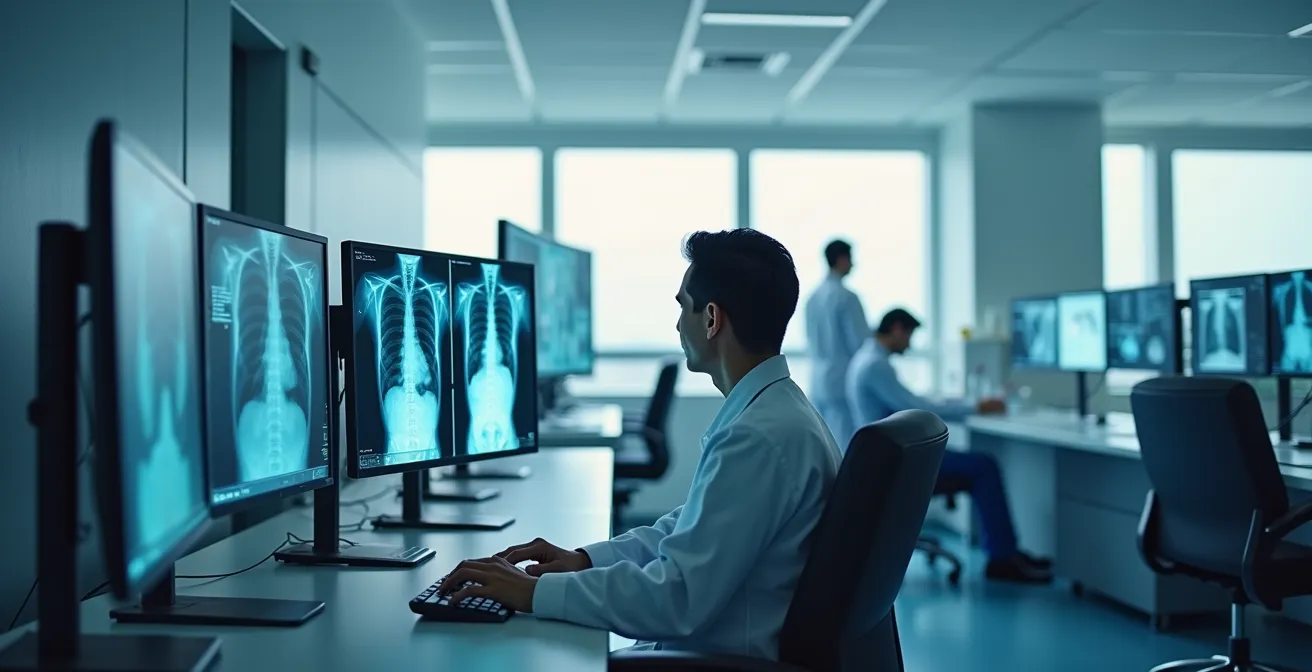
This collaborative workflow, where the radiologist validates or refutes the AI’s suggestions, is the key to maintaining control. The doctor is not a passive recipient of a computer’s verdict. They are the final arbiter, using the AI’s output as one piece of data among many—alongside the patient’s file, lab results, and clinical history. This ensures that the nuance and context of an individual’s case are never lost, while leveraging AI to make the process faster and more efficient for communities that need it most.
Algorithm or Gut Feeling: What Can AI Never Replicate in Medicine?
While AI’s proficiency in image analysis is undeniable, the diagnostic process is far more than just pattern recognition. An algorithm can identify a shadow on a lung X-ray with incredible accuracy, but it cannot understand the story behind the image. This is where the irreplaceable value of human expertise—often described as “gut feeling” or clinical intuition—comes into play. This intuition is not magic; it is a rapid, subconscious process of clinical synthesis.
A human physician integrates a vast array of disparate information that exists outside the pixels of a scan. As one radiology resident noted, AI’s current strength is in image acquisition, where it has “decreased scan times and improved image quality.” But the interpretation is another matter entirely. The truly human elements of diagnosis that AI cannot replicate include:
- Clinical Synthesis: Integrating imaging findings with the patient’s narrative, family history, lifestyle, and other contextual factors.
- Physical Examination Correlation: Connecting something felt during a physical exam with what is seen on a scan.
- Healthcare System Navigation: Helping a patient manage the complex web of referrals and appointments between different specialists.
- Cultural Sensitivity: Recognizing how diseases can present differently in specific populations or understanding a patient’s cultural context around illness.
- Empathetic Communication: Delivering a difficult diagnosis with the appropriate emotional support and guidance, a task that requires genuine human connection.
AI’s strength in radiology currently is in imaging acquisition. It has decreased scan times and improved image quality, allowing for less patient exposure to radiation and increased availability of MRI scanners.
– Radiology Resident, Sermo Community Discussion on AI in Radiology
An AI can tell you *what* it sees, but a doctor can tell you *what it means* for you, as an individual. It cannot sit with a family, explain complex options, or weigh a patient’s personal values when recommending a course of action. The future isn’t a choice between an algorithm or a gut feeling; it’s a partnership where the algorithm handles the data, and the human provides the wisdom.
The Bias Problem: Why AI Might Misdiagnose Certain Demographics?
One of the most significant and dangerous pitfalls of AI in medicine is algorithmic bias. An AI model is only as good as the data it’s trained on. If the training dataset predominantly features images from one demographic, the algorithm will naturally perform poorly when analyzing images from underrepresented groups. This isn’t a theoretical problem; it’s a documented reality with life-threatening implications.
In dermatology, for instance, most large, publicly available image datasets are overwhelmingly composed of pictures of light-skinned individuals. Consequently, research from the University of California San Francisco reveals that an AI trained on lighter skin tones showed significantly lower performance for lesions on darker skin tones. This creates a dangerous healthcare gap where the technology provides a safety net for some populations while failing others. The same risk applies to gender, age, and genetic ancestry if the training data is not meticulously balanced.

This challenge is particularly acute in a country as diverse as Canada. As Rachel Dorey of Dalhousie Medical School noted in the context of a Nova Scotia study, “We hope that this technology will continue to improve and be able to scan those darker skin tones as well because we are very diverse here in Nova Scotia.” Addressing this requires a concerted effort to build and validate datasets that reflect Canada’s multicultural population. It also underscores the need for human oversight. A radiologist aware of these potential biases can critically evaluate an AI’s output, especially when dealing with a patient from an underrepresented group, preventing a flawed algorithm from perpetuating health inequities.
How Can AI Predict Your Heart Attack 5 Years Before It Happens?
Perhaps the most revolutionary aspect of AI in diagnostics is its ability to perform opportunistic screening. This is where an AI finds signs of a disease that no one was even looking for. A patient might get a chest CT scan for a suspected respiratory infection, but an AI reviewing that scan can simultaneously analyze the coronary arteries for calcium buildup, a key predictor of future heart attacks.
This is a paradigm shift from reactive to proactive medicine. The human eye, focused on the primary purpose of the scan, might easily miss these incidental findings. An AI, however, can be programmed to screen for dozens of potential conditions on every single scan it processes. As Dr. Bhavik Patel, an AI director at the Mayo Clinic, explains, “We have an AI model now that can incidentally say, ‘Hey, you’ve got a lot of coronary artery calcium in your heart, and you’re at high risk for a heart attack or stroke in five years.’ And you might not have otherwise known that.”
In the Canadian healthcare system, this capability is a potential game-changer. A 2022 Fraser Institute report highlighted the long wait times for diagnostic imaging, with Canadians waiting on average 5.5 weeks for a CT scan and over 10 weeks for an MRI. By extracting the maximum possible information from every scan that is performed, opportunistic AI screening can identify at-risk individuals years in advance, allowing for preventive interventions like lifestyle changes or medication. This turns a diagnostic tool into a powerful public health instrument, catching diseases before symptoms ever appear and potentially saving countless lives and healthcare dollars down the line.
Is Paying $50 Extra for the OCT Scan Worth It for Healthy Eyes?
Optical Coherence Tomography (OCT) is a high-resolution imaging technique that provides a cross-sectional view of the retina. For years, it has been a staple for managing known eye diseases like glaucoma and macular degeneration. However, many Canadian optometrists now offer it as an optional add-on to a routine eye exam for healthy patients, typically costing between $50 and $80 out-of-pocket. The question for many is: is it worth the extra cost?
The answer is increasingly “yes,” largely due to the enhancing power of AI. An OCT scan generates an enormous amount of data, and AI algorithms can analyze these retinal layers to detect subtle changes that predate the onset of visible symptoms. For instance, research from the University of California has demonstrated up to 92% accuracy in identifying early signs of Alzheimer’s disease from retinal scans, a feat impossible for the human eye. This turns the OCT scan from a simple eye health check into a potential window into your neurological health.
In Canada, coverage for OCT scans is inconsistent, making it an out-of-pocket expense for most healthy adults. The following table provides a general overview of the situation in several key provinces.
| Province | Basic Eye Exam Coverage | OCT Scan Coverage | Out-of-Pocket Cost |
|---|---|---|---|
| Ontario (OHIP) | Seniors/Children only | Not covered | $50-80 |
| British Columbia | Partial coverage | Not covered | $45-75 |
| Alberta | Limited coverage | Not covered | $50-70 |
While the extra fee can seem steep for a “just in case” test, it should be viewed as an investment in a highly detailed, personal health baseline. As AI models become more sophisticated, the data from an OCT scan you get today could be re-analyzed in the future to screen for a growing number of systemic diseases, from diabetes to cardiovascular conditions. Paying the extra $50 is a bet on the future of proactive, data-driven medicine.
Key Takeaways
- AI’s primary strength is in superhuman pattern recognition, enabling earlier disease detection than humanly possible.
- The core role of the physician is shifting to “clinical synthesis”—integrating data with patient context, a skill AI lacks.
- Algorithmic bias is a critical risk; human oversight is essential to prevent AI from amplifying health inequities in diverse populations like Canada’s.
When to Re-Analyze: Why Your Old DNA Data Might Yield New Secrets in 5 Years?
One of the most profound concepts in the age of AI-driven medicine is that your personal health data is not static. A dataset, like your sequenced genome or a detailed retinal scan, can gain value over time. An analysis performed today is based on current scientific knowledge and the capabilities of today’s algorithms. Five years from now, both will be vastly more advanced.
This concept of longitudinal re-analysis is especially relevant for complex datasets like DNA. A genetic variant that is classified as “of uncertain significance” today might be definitively linked to a specific disease risk in a few years, thanks to new research and more powerful AI models. Holding onto your raw genomic data allows you to periodically re-interrogate it in light of new discoveries, potentially uncovering new insights into your long-term health risks or predispositions. The Canadian Association of Radiologists highlights this potential, noting the opportunity to be a leader by “leveraging recent advances in AI… together with the electronic healthcare infrastructure.”

This transforms personal health data from a one-time snapshot into a durable, evolving asset. It means the value of a comprehensive scan or a genome sequence isn’t just in what it tells you today, but in what it could tell you in the future. This dynamic potential is a core part of the argument for investing in deep, data-rich health assessments. As AI continues its exponential improvement, the secrets hidden in your old data might just be waiting for a smarter algorithm to find them.
Is Paying $1,000 for Whole Genome Sequencing Worth It for Healthy Adults?
The ultimate proactive health investment is Whole Genome Sequencing (WGS), a process that maps out your entire genetic code. Once a multi-million dollar endeavor, the cost has plummeted to around $1,000, making it accessible to a wider audience. But for a healthy adult with no specific symptoms, is it a worthwhile expense? The answer depends on your tolerance for uncertainty and your belief in the future of personalized medicine.
The growth in this area is undeniable. The AI in radiology market, which encompasses genomic analysis, is projected to grow from $1.26 billion in 2023 to $2.88 billion by 2028. This growth is fueled by the demand for personalized medicine and AI’s unique ability to decipher the immense complexity of the human genome to predict disease. A WGS can reveal predispositions to cancers, heart conditions, and adverse drug reactions, allowing you to take preventive measures long before a disease might manifest.
However, it also opens a Pandora’s box of information that can be complex and anxiety-inducing. For Canadians considering this path, several practical factors must be weighed. The following checklist provides a starting point for making an informed decision in the Canadian context.
Action Plan: Key Points to Verify for Whole Genome Sequencing in Canada
- Provincial Programs: Check if your province offers any pilot programs for preventive genomic screening, which may subsidize the cost.
- Data Sovereignty: Verify the company’s policy on data storage and ensure your sensitive genomic data will remain within Canadian borders to be protected by Canadian privacy laws.
- Service Grade: Compare clinical-grade sequencing offered through hospitals or genetic clinics versus direct-to-consumer services, as the quality and support differ significantly.
- Official Guidelines: Review the Canadian College of Medical Geneticists (CCMG) guidelines for population screening to understand the current medical consensus.
- Re-Analysis Potential: Consider the service’s policy on long-term data access and the potential for future AI re-analysis as algorithms and knowledge improve.
Ultimately, paying for WGS is a personal choice. It’s an investment not just in your current health, but in a lifetime of data that will only become more valuable as AI technology continues to unlock the secrets encoded in our DNA.
The next step for every patient is to engage in informed conversations with their healthcare providers. Ask how these new diagnostic tools can fit into your personal health journey and what proactive steps you can take today for a healthier tomorrow.